

On this page
If you like maps and cities, and you wonder why your bus takes 40 minutes to cover a short distance, a planning degree is worth a look. It is a smaller, less-known cousin of architecture and civil engineering.
What is a Bachelor of Planning?
A Bachelor of Planning (B.Plan) is an undergraduate degree in planning towns, cities and regions: deciding where homes, jobs, roads, parks and public transport go, and writing the rules for how land is used. At the School of Planning and Architecture (SPA), New Delhi, the B.Plan is a four-year course of eight semesters. Its programme page lists eight studios and field-based exercises, around forty theory subjects and two internships of six weeks each.
SPA says students prepare layout plans, zonal plans, master plans and regional plans, and spend the eighth semester on independent research. In plain terms, you learn to:
read a city: survey land use, population, housing and traffic, then map what you find
plan for movement: where roads, bus routes and stations go, and what should be built near them
write land-use rules: zoning, building heights and what may be built where
weigh people against each other: SPA lists "sensitivity towards diversity and conflicting interests in planning" as a course goal
A 2021 NITI Aayog report on urban planning capacity counts 49 institutions in India offering degrees in urban planning and allied fields such as environmental, transportation, housing and infrastructure planning.
How do you get into B.Plan in India?
The national entrance test for B.Plan is JEE Main Paper 2B. NTA's JEE (Main) 2027 Information Bulletin sets Paper 2B as a three-hour computer-based test with 100 questions for 400 marks:
Mathematics: 25 questions, 100 marks
Aptitude test: 50 questions, 200 marks
Planning-based questions: 25 questions, 100 marks
A wrong answer costs one mark in every part, and unlike the B.Arch paper there is no drawing test. The same bulletin lists Session 1 exam dates of 20 to 24 and 28 January 2027, with applications open until 22 November 2026. It also tells candidates to check each institute's own eligibility criteria, so read the admission page of every college on your list. Our guide to JEE Main Paper 2 for B.Arch and B.Planning covers each section.
Maths is a quarter of the marks. If your algebra or coordinate geometry has gaps, the Fermi Concept Library has a lesson for each concept in mathematics, so you can fix one topic at a time.
What is the career scope after a Bachelor of Planning?
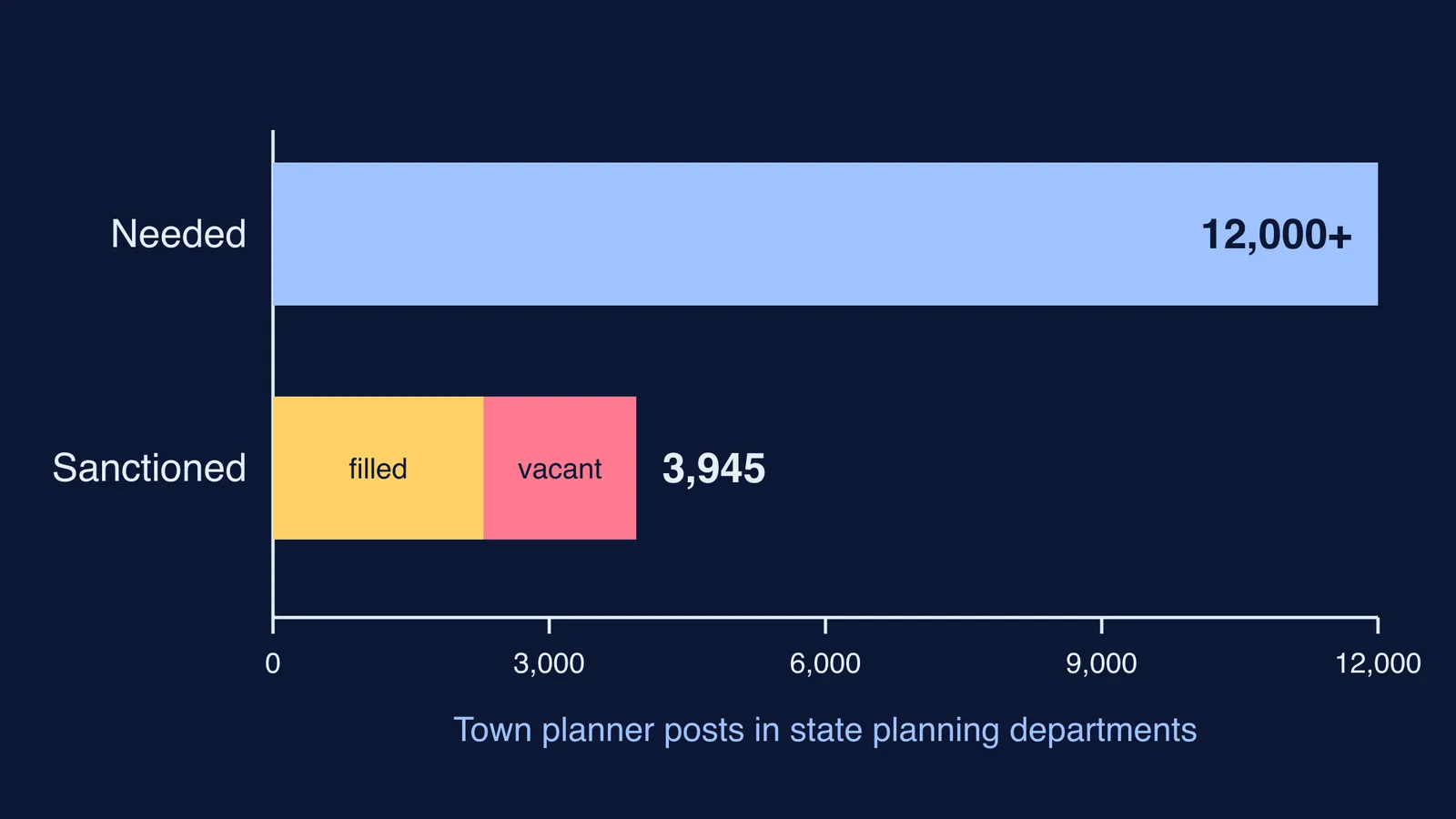
The NITI Aayog report found that 65% of India's 7,933 urban settlements had no master plan. A study cited in the report says state town and country planning departments need over 12,000 town planner posts, yet fewer than 4,000 were sanctioned and about half of those were vacant. PRS Legislative Research's summary puts vacancies as high as 42% of 3,945 sanctioned posts, and notes the committee's call for 8,268 extra lateral-entry posts for town planners.
There is a catch. The report says that in several states a qualification in town planning is not an essential criterion for these jobs, that employers often hire people from other disciplines, and that the private sector in urban planning "has remained under-developed". So keep a second strength in hand, such as data, GIS mapping or writing, alongside the degree.
Where do planners work?
The NITI Aayog report describes planning work in:
state town and country planning departments, working under laws that let states prepare and notify master plans
city governments, which regulate development through planning regulations and building bye-laws
private consultancies, which public bodies empanel and hire for planning and project work
education and research, which the report counts as one of the three pillars of planning capacity
Specialisations such as transport or environmental planning are often studied at master's level; the report notes that AICTE has an approved list of 25 names for postgraduate planning degrees. The Institute of Town Planners, India is a professional body of town planners, and it publishes a list of schools it approves for the purpose of ITPI membership, worth checking before you choose a college.
Is planning right for you? A one-weekend test
Before you fill in any form, try the job in miniature:
Pick a 1 km stretch near home, such as the road to school.
Walk it with a notebook. Mark each plot as housing, shop, office, school, park, empty land or other.
From a safe spot on the footpath, watch one junction for 15 minutes and count buses, cars, two-wheelers, autos and people on foot.
Write one page: what is missing (a footpath, a bus stop, shade, toilets) and who would gain or lose if it were added.
Look on your city's development authority website for its master plan and see whether your stretch matches it.
If you finish wanting to redesign that junction, take B.Plan seriously. If it felt like a chore, compare architecture and civil engineering or read about career options after civil engineering.
Parents: ask your child to talk you through their one-page notes. It will tell you more about fit than any cut-off list.


