

On this page
When looking at buildings under construction, it is easy to assume that the people who design them and the people who build them study the exact same thing. In reality, architecture and civil engineering are two distinct degrees leading to different daily work, governed by different rules.
If you are a parent talking about STEM careers with your child, it helps to outline these differences early so they can target the right entrance exams. While the two professions collaborate closely on the same projects, the architect decides what a space will look like, and the civil engineer calculates how to make that vision stand up safely.
Design versus structures: what is the day-to-day work?
The core difference between the two fields is their focus on aesthetics versus physics.
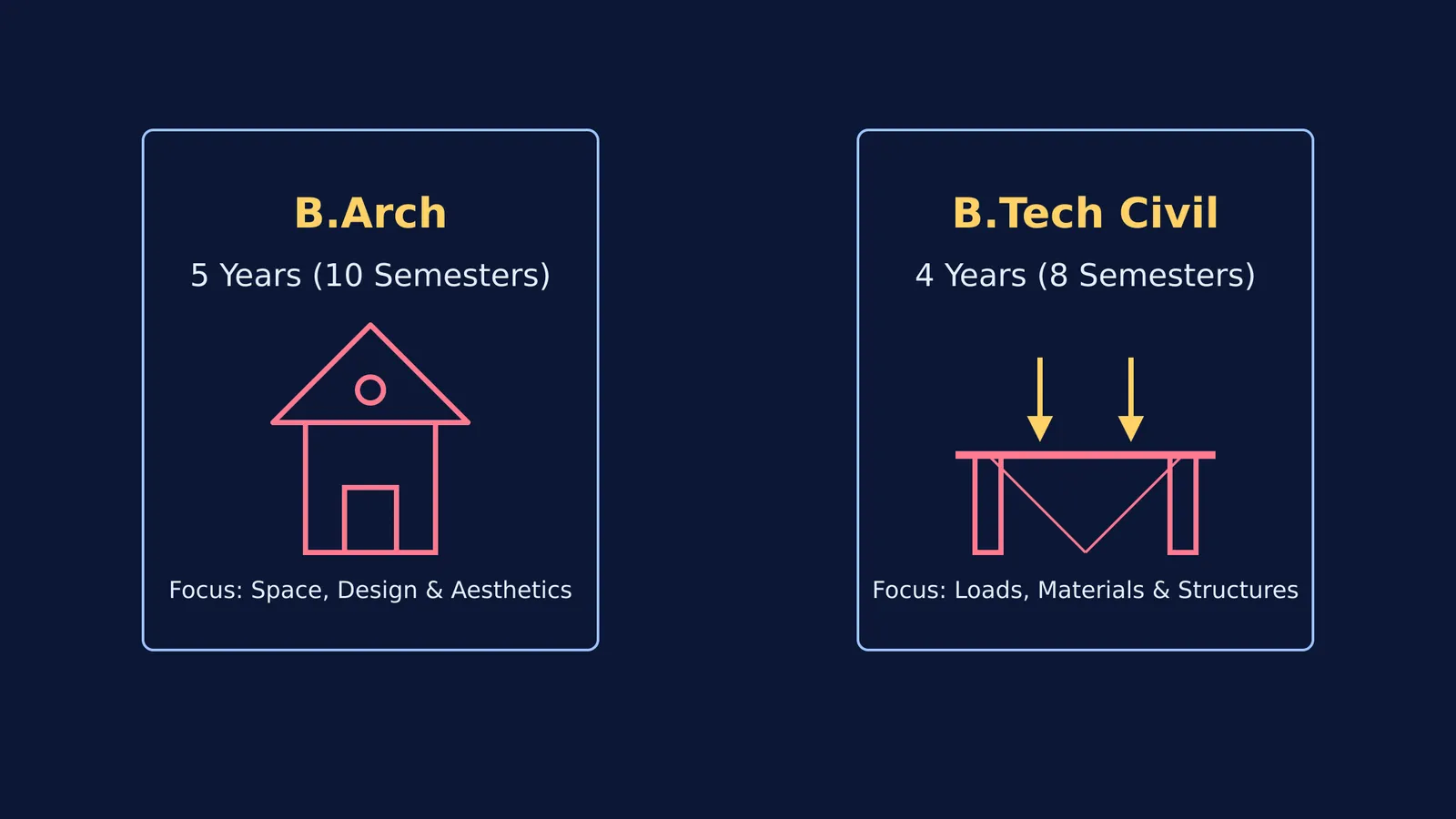
Architects act as spatial designers. Their job is to decide how a building feels to the people inside it, how it looks from the outside, and how the rooms flow together. They spend their time drafting floor plans, choosing materials for the facade, and ensuring the design meets local building codes and client needs. Their daily work involves a lot of 3D modeling and creative problem-solving to ensure the space is functional and beautiful.
Civil engineers deal with the physical reality of the structure. They calculate load distributions, wind resistance, and the required strength of the concrete or steel. A civil engineer is responsible for ensuring the building does not collapse under its own weight or during an earthquake.
Furthermore, a civil engineer works on a much broader range of projects than an architect. Beyond buildings, civil engineers design and oversee the construction of large-scale infrastructure such as highways, bridges, railways, water treatment systems, and dams.
B.Arch vs B.Tech Civil Engineering: how long is the course?
In India, the duration of the two degrees differs by a full academic year.
A Bachelor of Architecture (B.Arch) is a 5-year course, spanning 10 semesters. Because architecture education is highly studio-based, the Council of Architecture (CoA) requires the final year to include a mandatory professional internship lasting between six months and one year. This hands-on experience is critical for understanding how theoretical designs translate to real-world construction.
A Bachelor of Technology (B.Tech) in Civil Engineering is a standard 4-year degree, completed in 8 semesters. As outlined for programs admitting students via the Joint Entrance Examination (JEE), B.Tech students complete a rigorous curriculum which heavily features advanced mathematics, physics, fluid dynamics, and materials science.
When you sit down to study the foundational physics or maths required for these rigorous engineering courses, Fermi's AI tutor can work out what you already know and build a plan for the session, so you sit down to a clear next step.
Licensing: who gets to be called an Architect?
The most critical difference between the two paths in India is a legal one.
The title of "Architect" is strictly protected by law under the Architects Act, 1972. You cannot legally call yourself an architect or formally sign off on architectural plans unless you are registered with the Council of Architecture. To register, you must hold a recognized B.Arch degree.
A B.Tech in Civil Engineering does not qualify you to register with the CoA or use the title, even if you find yourself designing small structures during your career. While civil engineers have the technical knowledge to build, the official approval of a building's design aesthetics and spatial planning remains the legal domain of registered architects.
Which entrance exams do you need?
Your choice between the two fields dictates which exams you must sit in Class 12.
For Architecture (B.Arch): You must qualify in specialized exams that test your creative abilities. You can take either the NATA (National Aptitude Test in Architecture) or the JEE Main Paper 2. Both tests assess your drawing skills, aesthetic sensitivity, and spatial reasoning alongside mathematics.
For Civil Engineering (B.Tech): You must sit for standard engineering entrance exams like JEE Main Paper 1 or state-level exams such as MHT-CET or WBJEE. These exams focus entirely on physics, chemistry, and mathematics.
If you are struggling with the tough physics concepts tested in these engineering exams, the Fermi Concept Library holds every concept in physics, chemistry, biology, mathematics and computing, each with its own lesson and its place in the map.


