On this page
The ITI admission form asks you to rank trades. The right choice depends on the work you would enjoy on an ordinary day, how long your family can support training, and whether employers near you take apprentices in that trade. Here is how five common trades compare, with a worksheet to decide.
What does each ITI trade involve day to day?
Each trade under the Craftsmen Training Scheme has an official curriculum from the Directorate General of Training (DGT), Ministry of Skill Development and Entrepreneurship. The details below come from those documents.
Electrician (two years): wiring, earthing, meters and transformers, then motors, control panels, inverters and EV charging stations, per the DGT Electrician curriculum. Entry: Class 10 with science and maths.
Fitter (two years): cutting, filing, drilling and assembling metal parts, working up to tolerances of ±0.02 mm, plus pipe work, hydraulics and machine maintenance, per the DGT Fitter curriculum. Entry: Class 10 with science and maths.
COPA, Computer Operator and Programming Assistant (one year): office software, networks, cyber security basics, HTML, JavaScript and Python, per the DGT COPA curriculum. Entry: Class 10 pass.
Welder (one year): gas and arc welding, cutting, reading job drawings and inspecting welds, per the DGT Welder curriculum. Entry: Class 8 pass.
Mechanic Diesel (one year): overhauling diesel engines, fuel systems, starters and alternators, and troubleshooting vehicles, per the DGT Mechanic Diesel curriculum. Entry: Class 10 with science and maths.
A two-year trade is 2,400 hours of training plus 300 hours of on-the-job training or a group project, per the DGT Electrician curriculum. A one-year trade is 1,200 hours plus 150, per the DGT COPA curriculum. Passing the final All India Trade Test earns a National Trade Certificate from DGT; our guide on whether government skill certificates help you get a job explains how employers read it.
Which ITI trades get the most apprenticeships?
Many ITI pass-outs next join a paid apprenticeship under the Apprentices Act, 1961, which ends in a National Apprenticeship Certificate (NAC). In 2025, 11.84 lakh apprentices were engaged under the National Apprenticeship Promotion Scheme (NAPS), according to a Ministry of Skill Development release of 23 March 2026. The same release reports that a third-party evaluation of NAPS found 72% of apprentices in full-time jobs on completing their training.
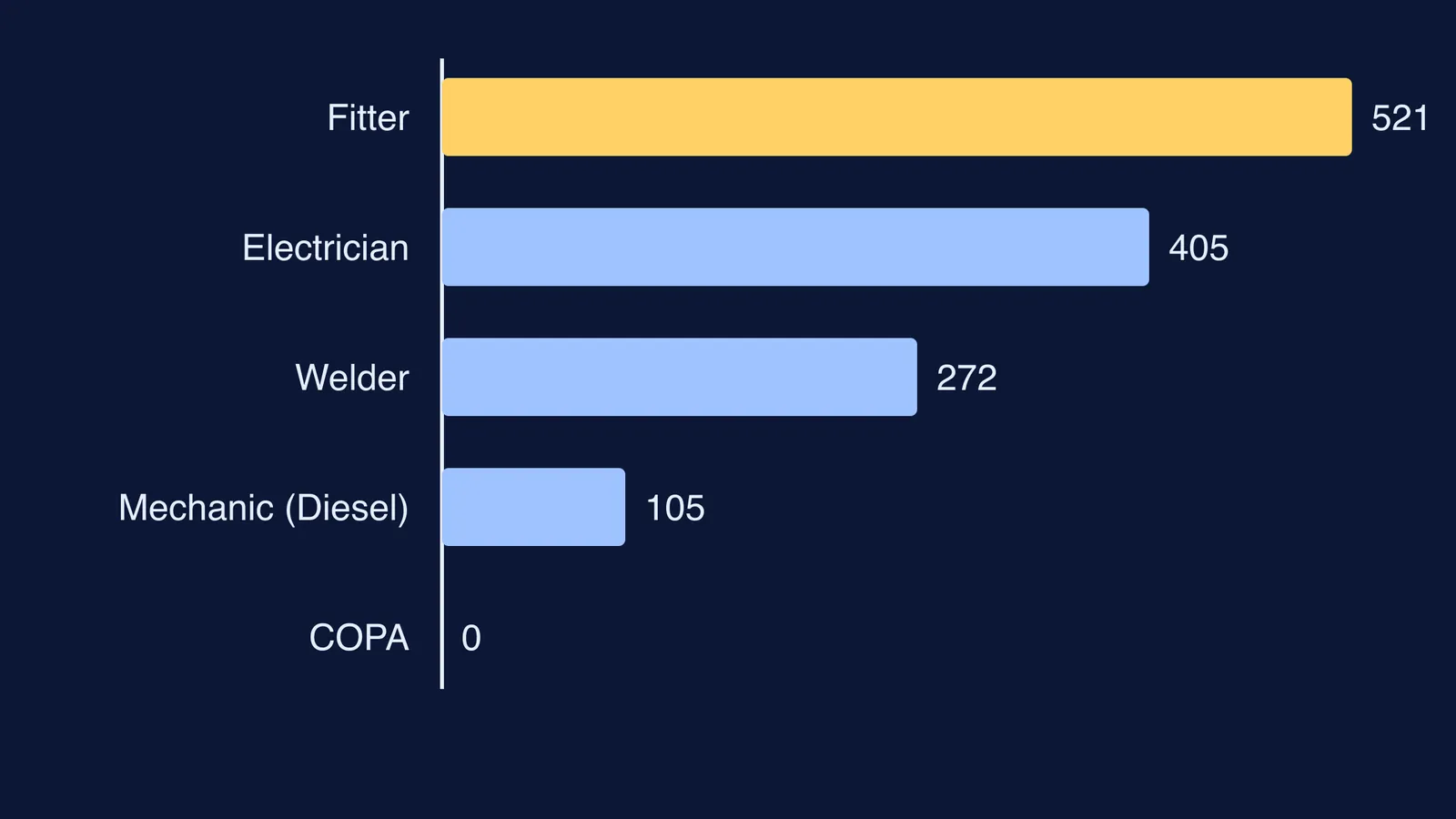
That release gives no trade-wise figures, so we counted one large real notice. South Eastern Railway's 2025-26 Act Apprentice notification offered 1,785 slots across 30 workshops, sheds and depots. By our count of its Annexure I:
Fitter: 521 slots
Electrician: 405 slots
Welder (Gas and Electric): 272 slots
Mechanic (Diesel): 105 slots
COPA: none
The notice ranks applicants by Class 10 marks, with a 50% minimum, so your board result still matters after ITI.
The official portal for this search is Apprenticeship India.
What can you do after an ITI trade?
The DGT Electrician curriculum, for example, lists these progression pathways:
Work as a technician and progress to supervisor and manager.
Complete an apprenticeship for the NAC.
Take Class 12 through the National Institute of Open Schooling.
Join a diploma in notified engineering branches by lateral entry.
Train as an ITI instructor, or start your own business.
Still weighing ITI against a three-year diploma? Read ITI or polytechnic after Class 10, then lateral entry to B.Tech after a diploma for the route to a degree.
How do you choose your ITI trade? A 15-minute worksheet
Pick two or three trades. Score each from 1 to 5 on these questions, then add up.
Daily work: would I enjoy this on an ordinary Tuesday? Watch a local electrician, fabricator or garage for an hour.
Eligibility: do I meet the entry rule, such as science and maths?
Time and money: can my family support one or two years before stipend income starts?
Local apprenticeships: how many openings in this trade can I reach from home?
Five-year goal: does this trade lead to a diploma, a railway job or my own shop, whichever I want?
Worked example. Say you scored 68% in Class 10, like fixing things, and your family can support two years. Electrician scores 5, 5, 4, 4, 5 for 23. Fitter scores 3, 5, 4, 5, 4 for 21. COPA scores 2, 5, 5, 3, 3 for 18. Electrician goes first on the form, fitter second. If two trades finish within 2 points, visit both workshops before deciding.
Electrician, fitter, welder and mechanic diesel all include Workshop Calculation and Science in their DGT curricula. If Ohm's law or percentages felt shaky in Class 10, fix them before classes start: the Fermi Concept Library has its own lesson for every concept in physics and mathematics, so you can revise one idea at a time.
Fill in the worksheet with a parent this week, then rank your trades on the form in that order.