

On this page
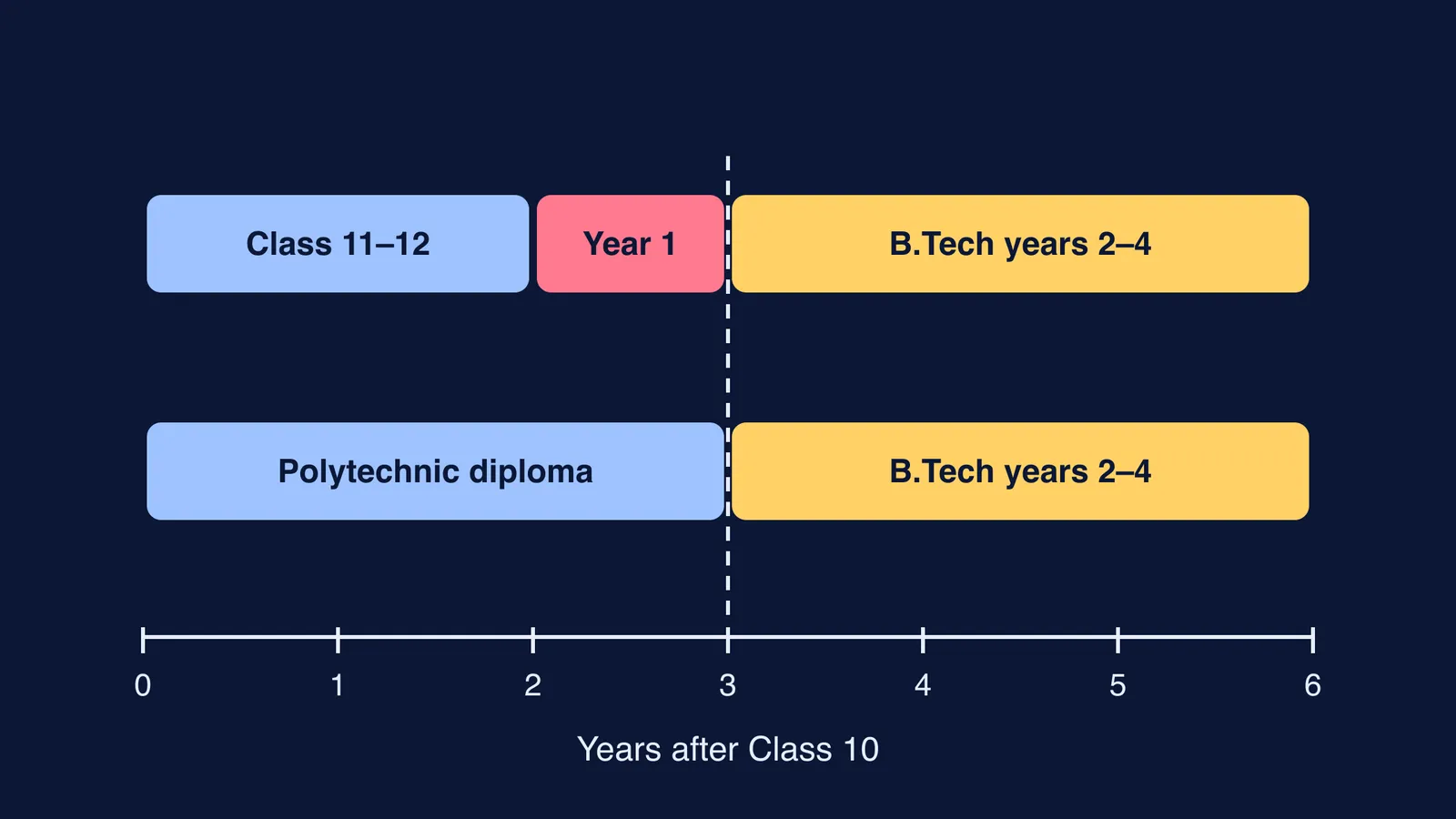
If you finished a polytechnic diploma, you do not have to start engineering from year one. Lateral entry lets you join a B.E. or B.Tech in the second year, so your degree takes three years instead of four, under AICTE's lateral entry rules. The national rules come from AICTE, but the admission itself runs through your state: its own entrance test, its own counselling and, often, its own domicile rules.
Who is eligible for lateral entry B.Tech after a diploma?
An AICTE circular dated 17 September 2020 sets out the eligibility for "Lateral Entry to Second year" in engineering and technology, a programme it lists as three years long.
Diploma holders: a pass with at least 45% marks (40% for reserved categories) in any branch of engineering and technology.
B.Sc. graduates: at least 45% (40% reserved) and Mathematics in Class 12. They must also clear Engineering Graphics or Drawing and Engineering Mechanics from first year, and are considered only after diploma holders fill the seats.
D.Voc. holders: a pass in the same or an allied sector.
The same circular says AICTE institutions should not turn diploma students away by restricting them to certain disciplines, and that bridge courses in Mathematics or basic engineering may be run where needed. States still match your diploma to the courses it can lead to: Andhra Pradesh's AP ECET 2026 instruction booklet admits candidates to "the Courses corresponding to the Diplomas" listed in its annexure. Check your own state's branch list before you apply.
How many lateral entry seats does a college have?
In Andhra Pradesh, lateral entry seats are 10% over and above the sanctioned intake of each course, in both university colleges and AICTE-approved unaided private colleges, according to the AP ECET 2026 booklet.
"Over and above" means these seats are added to the class, not taken from first-year students. So a branch with 60 sanctioned seats has 6 extra lateral entry seats in its second year. That is a small number, which is why your rank matters.
Which entrance exam do diploma holders take in each state?
Each state names its test differently. Examples from the 2026 cycle:
Andhra Pradesh: AP ECET. Conducted by JNTU Anantapur for the Andhra Pradesh State Council of Higher Education. The 2026 exam was on 23 April and results came on 7 May, according to the official booklet. Candidates must belong to Andhra Pradesh and meet its local and non-local rules.
Telangana: TG ECET. The state council (TGCHE) scheduled the 2026 exam for 15 May, for diploma and B.Sc. Mathematics holders entering B.E., B.Tech and B.Pharm, Deccan Chronicle reported.
Karnataka: DCET. Run by the Karnataka Examinations Authority for entry into the second year (third semester) of B.E. or B.Tech. Round 1 counselling runs through option entry, allotment, choosing to accept, paying fees and reporting to the college, Careers360 reported.
Maharashtra: Direct Second Year Engineering (DSE). Admission runs on the State CET Cell's DSE portal.
If your state is not here, search for "[your state] lateral entry" on its higher education council or technical education department website, not a coaching site.
What is on the AP ECET paper, and how should you prepare?
The AP ECET 2026 booklet gives the engineering stream paper as 200 objective questions for 200 marks: Mathematics 50, Physics 25, Chemistry 25 and your own engineering branch 100, with a separate paper for each branch.
Half the marks come from your own engineering branch, the subject of your diploma. A quarter come from Mathematics, and the rest from Physics and Chemistry. A simple weekly plan based on the marks:
Spend about half your study time on your branch, by revising your diploma notes subject by subject.
Spend about a quarter on Mathematics, starting with the topics you feel least sure about.
Split the last quarter between Physics and Chemistry.
Once a week, take a timed set of questions and note which topics cost you marks.
If a maths topic feels shaky from the ground up, the Fermi Concept Library has a lesson for every concept in mathematics, physics and chemistry. When you get a question wrong and cannot see why, the Fermi Problem Library has a step-by-step solver that explains the reasoning rather than printing an answer.
What should you check before counselling?
Your diploma percentage against the AICTE minimum of 45% (40% for reserved categories).
Your state's domicile rule and branch list.
Your marks memos, diploma certificate and category or income certificates, ready to upload.
A short list of colleges and branches, in order, before option entry opens.
Ask each college: "How many lateral entry seats does this branch have this year? Do you run a bridge course in Mathematics? Which first-year subjects, if any, will I need to clear?"
If you are still deciding what comes after Class 10, read our guides to POLYCET after Class 10 and choosing between ITI and polytechnic. If you would rather work first, see apprenticeships after a diploma or degree.


