On this page
If your child joined a JEE batch in September or October, the class is already several chapters ahead, and every new chapter assumes the old ones. But missed chapters do not all matter equally right now. A few carry most of the weight, and a small, steady plan beside regular classes, like the six-week one below, can rebuild them.
Which Class 11 chapters do later topics depend on?
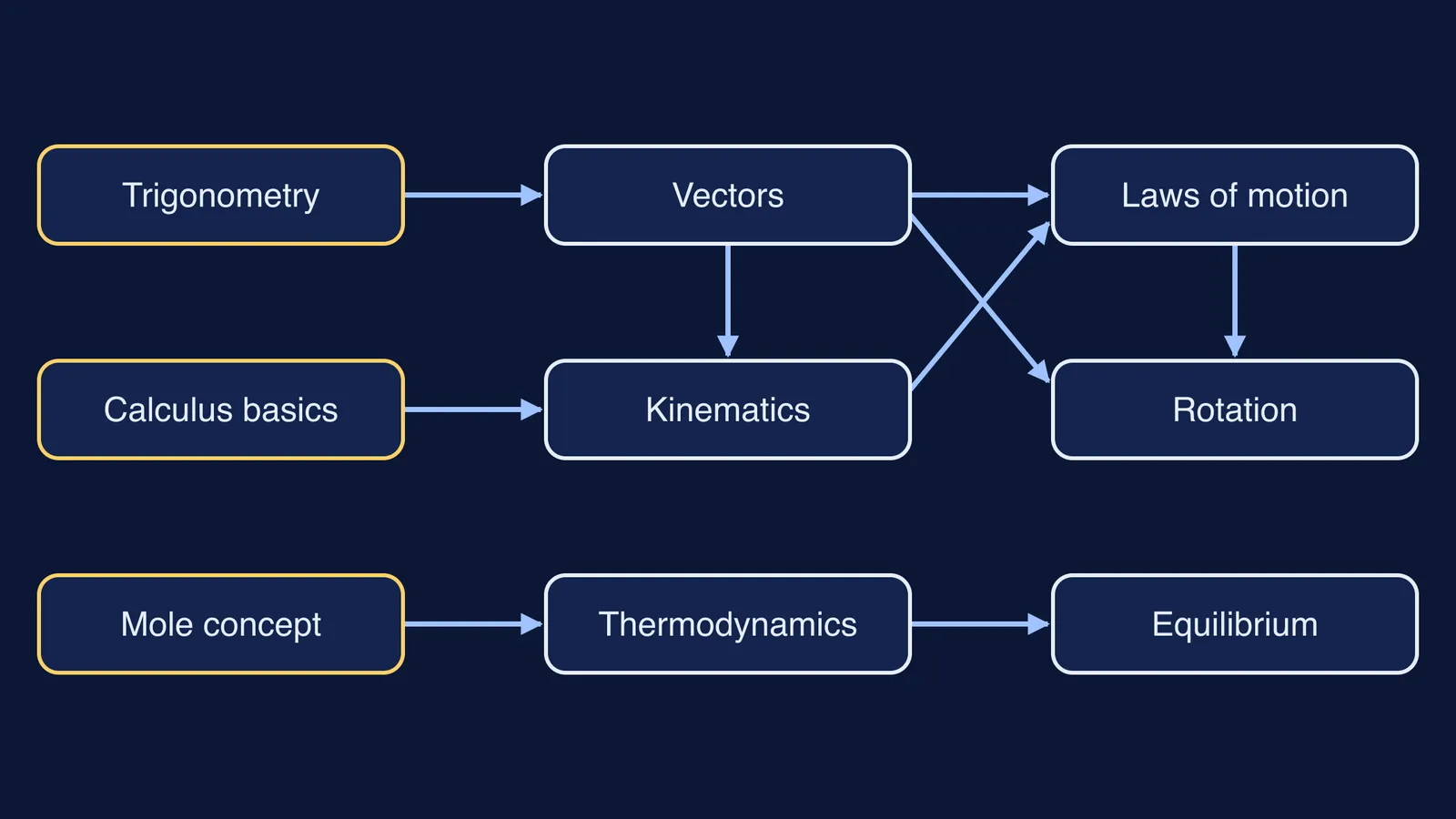
The official CBSE Class 11 syllabus for 2026-27 shows these links in its own topic lists. In the CBSE physics syllabus, Motion in a Straight Line uses "elementary concepts of differentiation and integration", and Motion in a Plane is built on vectors, their components and the scalar and vector product. In the CBSE chemistry syllabus, the Equilibrium unit relates the equilibrium constant to Gibbs energy, which is taught in Thermodynamics, and Some Basic Concepts of Chemistry is where the mole concept and stoichiometry are taught. The CBSE maths syllabus puts trigonometry and limits and derivatives in Class 11 too.
So rebuild first the chapters that later ones borrow from:
Maths tools: trigonometric identities, basic differentiation, and vectors (taught in physics, used everywhere).
Kinematics and laws of motion: work and energy, rotation, gravitation and oscillations all build on motion equations and Newton's laws.
Mole concept: most numericals in physical chemistry, from thermodynamics to equilibrium, are worked in moles.
Chemical bonding: shapes of organic compounds rest on hybridisation and bonding ideas.
Chapters that stand more on their own, such as sets, linear inequalities and statistics, can wait for a later revision cycle. If you are unsure what a chapter needs, try this five-question prerequisite check before a new chapter.
How do you catch up without falling behind on new classes?
Rule one: never skip today's homework to do backlog. Fall behind on the current chapter and you have two backlogs.
Rule two: study the backlog the way learning sticks. A 2013 review by John Dunlosky and colleagues rated practice testing and distributed practice (spreading study over time) as the two high-utility techniques among the ten they examined; rereading and highlighting were rated low. In practice, that means short daily sessions and solving questions rather than rereading notes.
Here is a six-week plan for a student whose batch is about eight chapters ahead:
Week 1: List every missed chapter and mark it "current classes need it", "foundation" or "can wait". Start with trigonometry and basic differentiation.
Weeks 2-3: Kinematics and laws of motion in physics, and the mole concept in chemistry. One chapter at a time, 60-75 minutes a day, six days a week.
Week 4: Chemical bonding, plus any gap that current lectures expose.
Weeks 5-6: The remaining foundation chapters. On the seventh day of each week, take a mixed 20-question test from everything rebuilt so far.
Each daily session has the same shape: 15 minutes on the NCERT section, 40 minutes of graded questions without looking at solutions, and 10-20 minutes checking answers and writing each mistake in one line.
A worked example
Say your batch is teaching rotational motion and you missed laws of motion. Do not restart from chapter one. Tonight, do free-body diagrams and Newton's second law questions, because torque problems use the same force analysis. Tomorrow, do the rotation homework first, then your backlog slot on laws of motion.
Tell your teacher early: see how to tell your coaching teacher you're falling behind. A five-day plan for a chapter left for self-study fits the same slot.
When a concept will not make sense from notes, the Fermi Concept Library gives each concept in physics, chemistry and mathematics its own lesson and its place in the map, so you can see where it fits. For numericals you are stuck on, the Fermi Problem Library has worked problems with a step-by-step solver that explains the reasoning rather than printing an answer.
How can parents help a child who joined coaching late?
Your job is not to teach physics. It is to protect the plan.
Help fix the backlog slot at the same time each day, short enough to survive a test week.
Ask about the plan, not marks: "Which chapter is this week's? What went wrong in yesterday's questions?"
Expect some weak test scores early on, because tests may cover chapters your child has not rebuilt yet.
Protect sleep. The American Academy of Sleep Medicine recommends that teenagers aged 13 to 18 sleep 8 to 10 hours per 24 hours; a late-night backlog session that cuts sleep costs the next day's class.
A script for the first conversation: "You joined late, so being behind is normal. It is not a sign you can't do this. Let's pick the three chapters your classes need most and one time each day for them. Tell me on Sunday how the week went."
If your child seems low for weeks, cannot sleep or talks about giving up on everything, speak to a doctor or counsellor. Tele MANAS, a free 24x7 national mental-health helpline, is on 14416 or 1800-891-4416.
Start this week with one list and one daily slot.