On this page
You start Work, energy and power, hit the first derivation, and get lost. Often the new chapter isn't the problem. An earlier idea, such as resolving a force or using v² = u² + 2as, never quite settled. A five-question check before you start finds that gap while it is still small.
What should you know before starting a new chapter?
You need the handful of earlier ideas the chapter uses again and again. A prerequisite is an idea from an earlier chapter or class that the new chapter assumes you can already use. Five is a practical number to check in one sitting.
Test whether you can use those ideas, not whether you remember their names. In a study of 115 pharmacy students tested before their courses, Hailikari and colleagues (2008) found that knowing how to use earlier ideas was especially related to achievement, while a facts-only task was not linked to final grades. One task, applying organic chemistry knowledge, accounted for 24% of the variation in final grades in a later pharmaceutical chemistry course. So your five questions should ask you to do something, not define something.
Why check prior ideas before a chapter?
Gaps follow you. A meta-analysis by Simonsmeier and colleagues (2022) of 8,776 effect sizes found a high correlation (r = .53) between what students knew before a topic and what they knew after it. The same study found that, on average, prior knowledge barely predicted how much students gained. So knowing more doesn't guarantee you learn faster, but students who start behind tend to still be behind at the end.
Getting a question wrong before you read is not wasted. In five experiments, Richland, Kornell and Kao (2009) asked participants questions about an essay before they read it. They did better on the later test than participants given extra reading time, even on the questions they could not answer at first. This is called the pretesting effect.
For the theory behind this, read our piece on David Ausubel and why what you already know shapes what you learn.
How do you ask AI for a chapter's prerequisites?
Copy this into any AI chat and fill in the brackets:
"I'm about to start [chapter name] in [Class 11 NCERT Physics / your book]. List the five earlier ideas this chapter uses most, and the earlier chapter each comes from."
"Ask me one short question on each idea, one at a time. Each question should make me use the idea, not define it. Don't show the answer until I reply."
"After each reply, tell me if I'm right. If I'm wrong, name the idea I'm missing in one sentence. Don't teach the new chapter yet."
Then check the list against your book. Every idea used in the chapter's first two worked examples should be on it. AI can sound sure and still be wrong; the textbook has the final say.
Worked example: five questions before Work, energy and power
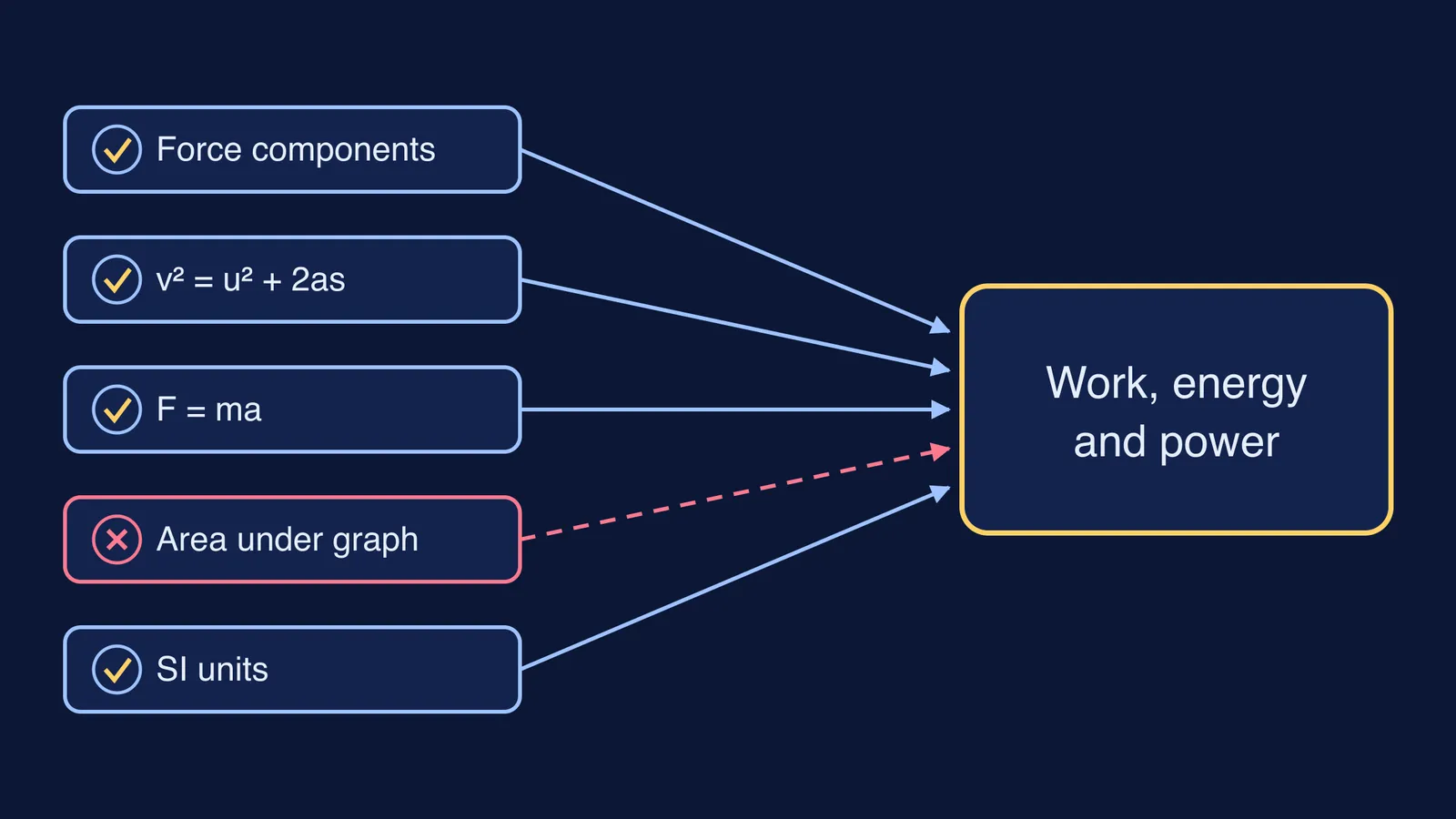
The work-energy theorem is built from Newton's second law and the equations of motion, so these are the ideas to test:
A 10 N force pulls at 60° above the horizontal. What is its horizontal component? (10 cos 60° = 5 N.)
A car speeds up from rest to 10 m/s over 25 m at constant acceleration. What is the acceleration? (v² = 2as, so 100 = 50a and a = 2 m/s².)
A 2 kg block accelerates at 3 m/s². What is the net force on it? (F = ma = 6 N.)
A speed-time graph is a straight line from 0 to 8 m/s over 4 s. How far did the object go? (Area of the triangle: ½ × 4 × 8 = 16 m.)
Write 1 newton × 1 metre in base SI units. (kg m² s⁻², which is one joule.)
Answer on paper first, then type your answers to the AI.
What should you do with your score?
5 out of 5: start the chapter.
4 out of 5: fix the one gap first. Ask the AI for one more question on that idea and get it right before you begin.
3 or fewer: revisit the earlier chapter for those ideas first. Reading a new chapter on a weak base often means reading it twice.
To fix a gap, look up the single idea you missed rather than re-reading a whole chapter. The Fermi Concept Library gives every concept in physics, chemistry, biology, mathematics and computing its own lesson and its place in the map. Fermi's AI tutor works out what you already know and builds a plan for the session, so this check becomes part of how you study.
Once you're ready, two habits fit on top of this one: previewing the chapter with AI questions before class and turning the chapter into a learning objectives checklist.