

On this page
In short
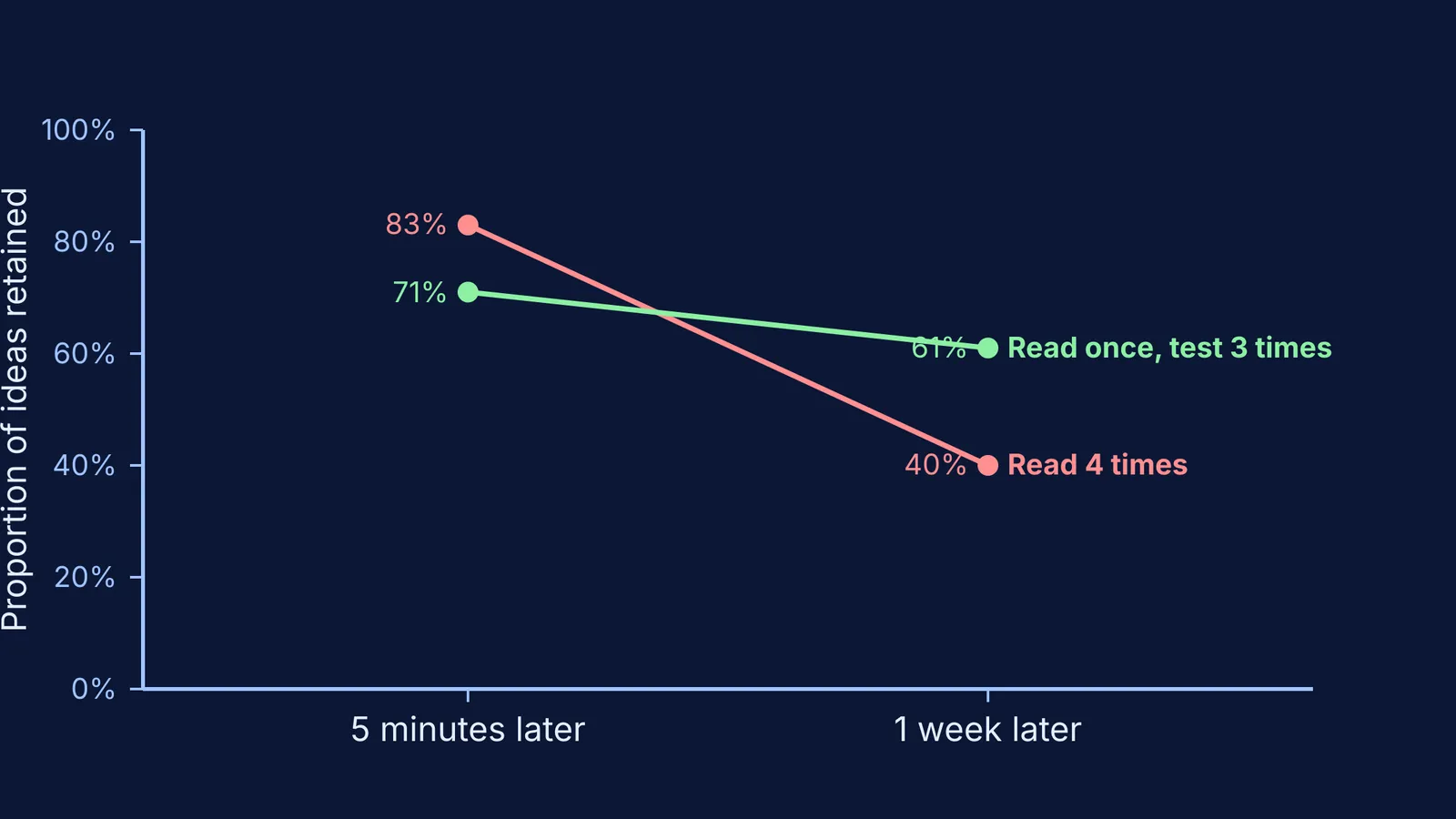
Students who test themselves retain 61% of the material after a week, while those who only study retain just 40%. By asking an AI tutor to turn an NCERT chapter into a learning objectives checklist, you can test your understanding of each concept before ticking it off.
Reading a textbook feels like learning. Your eyes move down the page, you highlight a few important sentences, and the ideas make sense. But when the exam paper arrives a week later, the details have vanished.
This happens because reading is passive. To actually learn, you have to try to retrieve the information from your memory. Instead of rereading, you can use AI to break an NCERT chapter into a checklist of "I can" statements, and then test yourself on each one.
Why is reading the textbook not enough?
When you read a chapter repeatedly, you build fluency, not memory. Because the text becomes familiar, your brain tricks you into thinking you have mastered the material.
A 2006 study by Henry Roediger and Jeffrey Karpicke tested this illusion (Roediger & Karpicke, 2006). They split students into two groups to learn scientific passages: one group read the text four times, while the other group read it once and took three practice tests. When tested five minutes later, the readers felt confident and scored 83%, while the testers scored 71%. But learning is about what stays with you. When the final test was given a week later, the results flipped. Students who tested themselves retained 61% of the material, while those who only studied retained just 40%.
The takeaway is clear: testing yourself is a learning event. If you want to remember Class 11 physics or biology for the final exam, you need a system that forces you to recall information.
How do I turn a chapter into a learning objectives checklist with AI?
The easiest way to force active recall is to change how you define being "done" with a chapter. Instead of saying, "I have read Chapter 4," your goal should be, "I can answer questions on the five main ideas in Chapter 4."
You can use Fermi's AI tutor to do the heavy lifting. Open the AI tutor and paste this prompt:
"I am studying [Chapter Name] from Class [Grade] NCERT [Subject]. Please turn this chapter into a learning objectives checklist. Write them as 8 to 12 'I can' statements (e.g., 'I can explain the difference between X and Y' or 'I can derive the formula for Z'). Do not give me the answers."
The AI will output a clean, actionable checklist. For example, if you ask for a checklist on Work, Energy and Power, you might get:
I can calculate the work done by a variable force using integration.
I can state and prove the work-energy theorem.
I can differentiate between conservative and non-conservative forces with examples.
I can calculate the final velocities of two bodies after a one-dimensional elastic collision.
This gives you a roadmap. If you are struggling with a specific objective on the list, you can look it up in the Concept Library to fill the gap. Breaking down the material this way also makes a large chapter feel less overwhelming.
How do I use the checklist to test myself?
A checklist is useless if you just tick the boxes while looking at the book. The rule is simple: you cannot tick an objective until you have successfully answered a question about it from memory.
Here is a practical routine you can try during your next study session:
Pick an objective: Choose one "I can" statement from your AI-generated list.
Ask for a test: Tell the AI tutor, "Give me a conceptual question to test if I can differentiate between conservative and non-conservative forces."
Attempt the answer: Close your textbook and type out your best attempt, or solve the numerical on a piece of paper and upload a photo.
Get feedback: The tutor will check your reasoning. Because it holds a line of reasoning across a whole session, it will point out exactly where you went wrong and ask a follow-up question if you missed a key detail.
Tick the box: Once you get it right without help, tick the objective off your list.
Why do "I can" statements work better?
When you read a syllabus, it is usually written as a list of nouns: Projectile Motion, Mendelian Genetics, or Chemical Bonding. These are topics, not tasks.
Translating a topic into an "I can" statement changes your psychological approach. It transforms a vague noun into a specific action. You immediately know whether you can or cannot derive an equation, draw a ray diagram, or predict a genetic cross. It removes the ambiguity from your study sessions.
If you want to make your daily study sessions more structured, try applying this method alongside The 45-Minute Plan for Studying With an AI Tutor. When you finish a chapter, you can also write your summary, then compare it with AI to ensure you have not missed any subtle details.
By turning passive reading into a structured, checklist-driven testing session, you stop fooling yourself into thinking you know the material, and actually start remembering it.


