

On this page
When students sit down with an AI tool, they often fall into a trap: they paste a hard problem and copy the answer. This finishes the homework quickly, but it bypasses the cognitive work required to learn.
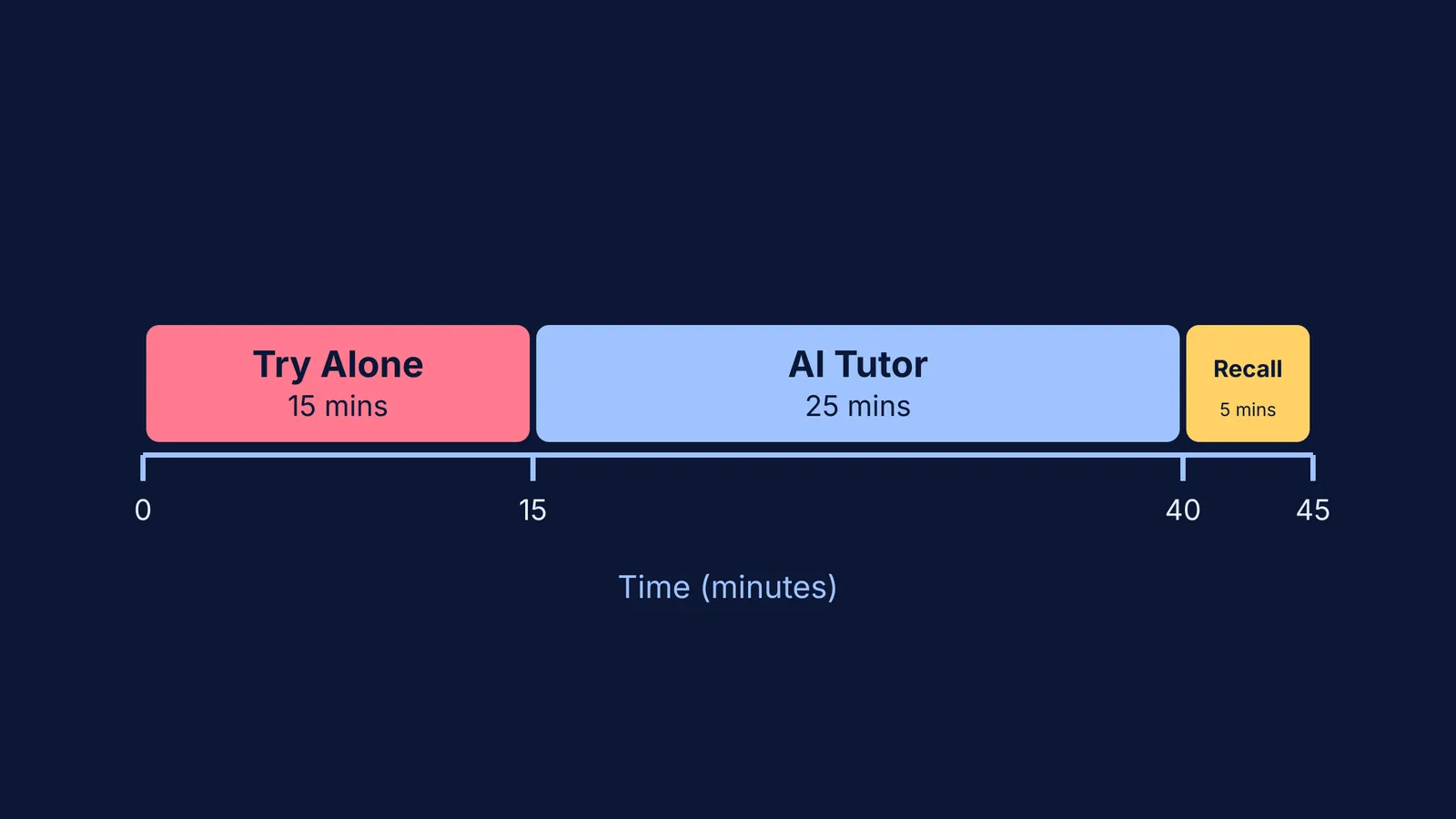
A productive study session is not just about having the right tools; it is about how you pace your effort. Research across cognitive psychology and education points to a specific rhythm for learning complex subjects: a 45-minute block divided into three distinct phases.
How long should a study session be?
While the classic 25-minute Pomodoro technique is popular for clearing emails or doing repetitive chores, deep academic work requires more time to build momentum. Many students assume that studying for three hours straight shows dedication. In reality, sitting at a desk for hours without a break leads to a "vigilance decrement," where the brain's ability to process new information sharply drops. You might still be reading the words, but you are no longer retaining them.
A 2025 study of student attention found that 49% of students can maintain focus for up to 45 minutes during complex tasks [[1]](https://doi.org/10.29311/ndtns.vi20.4998). This 45-minute block hits the sweet spot: it is long enough to wrestle with a difficult concept, but short enough to end before cognitive fatigue sets in. This structure is the foundation of a study routine that lasts, because it prevents the burnout that often follows cramming sessions.
Why try it alone before asking for help?
The first 15 minutes of your study session should be spent entirely alone with the material, without asking an AI or looking at the textbook.
This phase relies on a concept called "productive failure." A 2008 study by learning scientist Manu Kapur demonstrated that when students struggle with a complex problem before receiving formal instruction, they develop a deeper conceptual understanding [[2]](https://doi.org/10.1080/07370000802212669). Even if the initial attempt is wrong, wrestling with the problem forces the brain to retrieve prior knowledge and map the boundaries of what it does not know.
Instead of flipping straight to a solution when you get stuck, bring your attempted working to Fermi's AI tutor. It can work out what you already know and build a plan for the session, starting exactly where you left off.
What should you ask the AI tutor?
For the next 25 minutes, bring in the AI. The goal here is not to ask for the final answer, but to use the tutor to overcome the specific hurdle you identified in the first phase.
Instead of pasting a photo of a question and copying the first output, use the AI as a sounding board. For example, if you are stuck on a rotational motion problem, tell the tutor what you have tried: "I set up the torque equation, but I am not sure what to use for the radius of gyration."
Fermi holds a line of reasoning across a whole session, notices where you are stuck, and decides whether to explain, ask, or show. It writes on a board and draws figures alongside you. Research into AI tutors vs answer chatbots shows that students learn best when they receive targeted hints that force them to do the final cognitive step themselves. This is why a good AI tutor will prompt you to think, rather than just printing the final lines of working out.
Why end with a recall test?
The final five minutes are the most important part of the session. Close your books, minimize your AI tutor window, and write down everything you can remember about the topic you just studied.
This is known as a recall test, or retrieval practice. A landmark 2006 study by Roediger and Karpicke found that students who took a memory test after studying remembered significantly more material a week later compared to those who simply restudied the text [[3]](https://doi.org/10.1111/j.1467-9280.2006.01693.x).
Reading a clear explanation from an AI can create an "illusion of fluency"—you feel like you understand it because the explanation made sense. Forcing yourself to recall the steps from memory proves whether the knowledge has actually stuck.
How to use your recall test results
A recall test does more than just measure what you know; it actively changes how your brain stores information. However, the process is only complete when you check your work.
After you have written down everything you can remember from your 45-minute session, open your notes or ask your AI tutor to review your summary. Compare what you wrote against the actual facts. Did you miss a negative sign in the formula? Did you forget the final step of the derivation? Finding these gaps immediately after they form stops you from memorising the wrong method.
Once the 45 minutes are up, take a 10-minute break away from your desk. When you return, you can start your next session by trying a fresh question in the Fermi Problem Library.


