

On this page
If you are used to reading a chapter before class to prepare, you might have noticed that it is hard to stay focused. You read the words, but during the actual lesson, your mind still wanders. Reading passively does not give your brain a reason to care about the new information.
The secret to better focus in class is not reading the chapter beforehand. Instead, it is trying to answer questions about the material before you have even seen it. This simple shift turns a passive lecture into an active search for answers.
Why does guessing wrong help you learn?
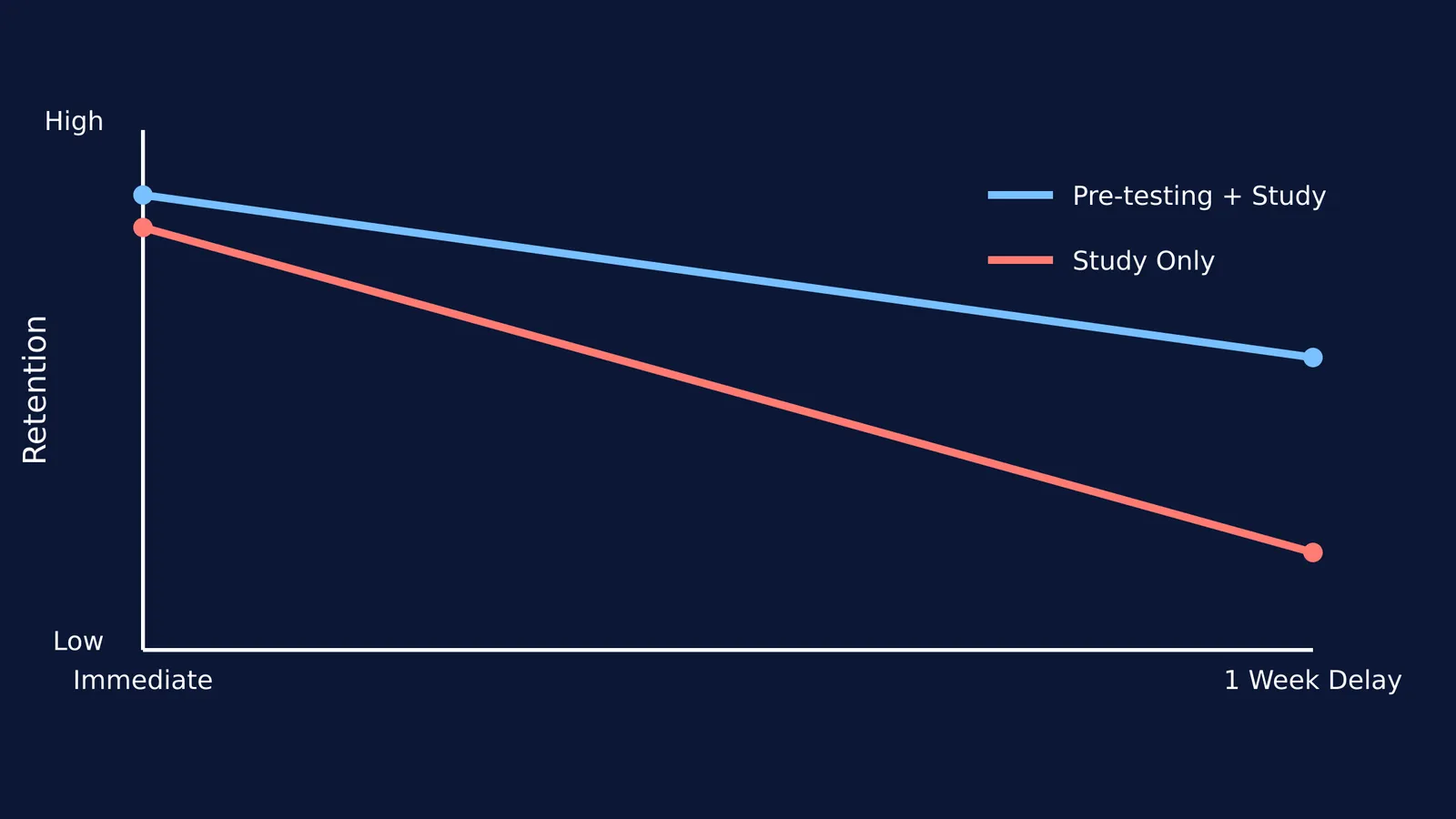
In 2009, cognitive scientists Lindsey E. Richland, Nate Kornell, and Liche Sean Kao published a landmark study on the "pre-testing effect". Taking a pre-test on a set of information enhances your ability to learn that information later, even if you cannot answer the questions correctly (Journal of Experimental Psychology: Applied).
Attempting to answer a question creates a temporary knowledge gap in your mind. This gap acts as a mental hook. When you inevitably get the answer wrong, your brain becomes highly sensitive to the correct information. It triggers a curiosity response, making you want to know the real answer. Later, when the teacher mentions the concept during the lesson, your attention zeroes in on it automatically.
This happens because of a cognitive mechanism called "prediction error." The brain learns most efficiently when it makes a prediction and is then corrected. The surprise of being wrong strengthens the neural pathways associated with the correct answer. Pre-testing can boost long-term retention by 10 to 30% compared to passive reading (ResearchGate).
How to use AI before class to preview a chapter?
You can use an AI tutor to generate a targeted pre-test. Do not ask for a summary of the chapter, because reading a summary is just another form of passive learning. Instead, ask for a few conceptual questions that force you to think about how the ideas in the chapter might work.
Here is a prompt you can use before your next lesson: "I am about to attend a class on [Chapter Name]. Give me five conceptual multiple-choice questions about the core ideas in this chapter. Make them focus on the 'why' and 'how' rather than just vocabulary. Do not give me the answers yet. I want to guess them."
For example, if you are studying physics and the next chapter is on projectile motion, the AI might ask you what happens to the horizontal speed of a ball thrown off a cliff, assuming there is no air resistance. Even if you do not know the formula yet, guessing forces you to think about gravity and motion.
Do not worry about getting a low score on your guesses. The goal is not to prove what you know; the goal is to prime your brain for what is coming next.
What should you do during the lesson?
Once you have your pre-test questions, you can take them into the classroom. Keep your written guesses visible on your desk. As the lesson begins, your goal is no longer just to "pay attention" in a general sense. Your goal is specifically to find out if your guesses were right.
Listen closely to the teacher's explanations. Every time they cover a concept that answers one of your questions, check your initial guess. If you were wrong, cross it out and write the correct concept next to it. Because you already invested mental effort into the question, this correction will stick in your memory much longer than if you had simply copied the fact off the blackboard.
By the end of the lesson, you will have naturally absorbed the most important parts of the chapter. If you still have doubts after the lesson, Fermi's AI tutor can work out what you already know and build a plan for the session, so you sit down to a clear next step instead of feeling lost.
Using this method consistently will change how you experience your classes. You will find yourself anticipating the teacher's next point rather than struggling to keep up. For more ways to use AI for your study routine, read about how to Make an AI chatbot quiz you properly: rules and example prompts or Using an AI tutor in the week before an exam: a day-by-day plan.


