On this page
Coaching batches often run short of time, and a common fix is a line on the board: this chapter is for self-study. You get the module and the DPPs (daily practice problems), but no lectures. The chapter still counts in the exam. The plan below covers it in five days, in a fixed order: NCERT first, then the module's solved examples, then the DPPs.
What does "do this chapter by self-study" actually mean?
It means the teaching is now your job, and the materials you have are enough if you use them in order. NCERT builds the idea slowly. The module's theory pages are compressed and assume you know it. The solved examples show how the idea becomes marks. The DPPs check whether you can do it alone.
That order matches what researchers have found about learning from examples. A review of worked-examples research by Atkinson, Derry, Renkl and Wortham recommends several examples for each problem type, placed close to matched practice problems. Studying the solved examples and then going straight to DPPs on the same types follows that advice.
Why read NCERT before the coaching module?
Because the module's summaries are much easier to follow once NCERT has explained the idea in full. The trap is reading it twice and feeling ready.
A review of ten study techniques by Dunlosky and colleagues rated practice testing and distributed (spaced) practice as high utility, and rereading and highlighting as low utility. So read each section once, close the book, and write down what you remember: definitions, the main equation, one diagram. Then open the book and fix what you missed.
In an experiment by Roediger and Karpicke, students who took recall tests on a passage remembered more of it two days and one week later than students who restudied it, even though restudying made students more confident. Feeling sure after a second reading is not the same as knowing.
How should you study the module's solved examples?
Cover the solution. Try the question for a few minutes. Then uncover one line at a time and say why each step follows.
In a study of students working through mechanics examples, Chi and colleagues found that the "good" students generated many explanations of the example steps and related them to principles in the text, while "poor" students generated few explanations and later relied heavily on the examples. Our guide to four self-explanation prompts for solved examples gives you the questions to ask at each line. If you can already solve a type cold, skip its examples and go to the DPP; why worked examples help beginners more than toppers explains why.
A five-day plan for one self-study chapter
Take a chapter such as Work, Energy and Power in Class 11 physics. Times are a guide; stretch them on a holiday.
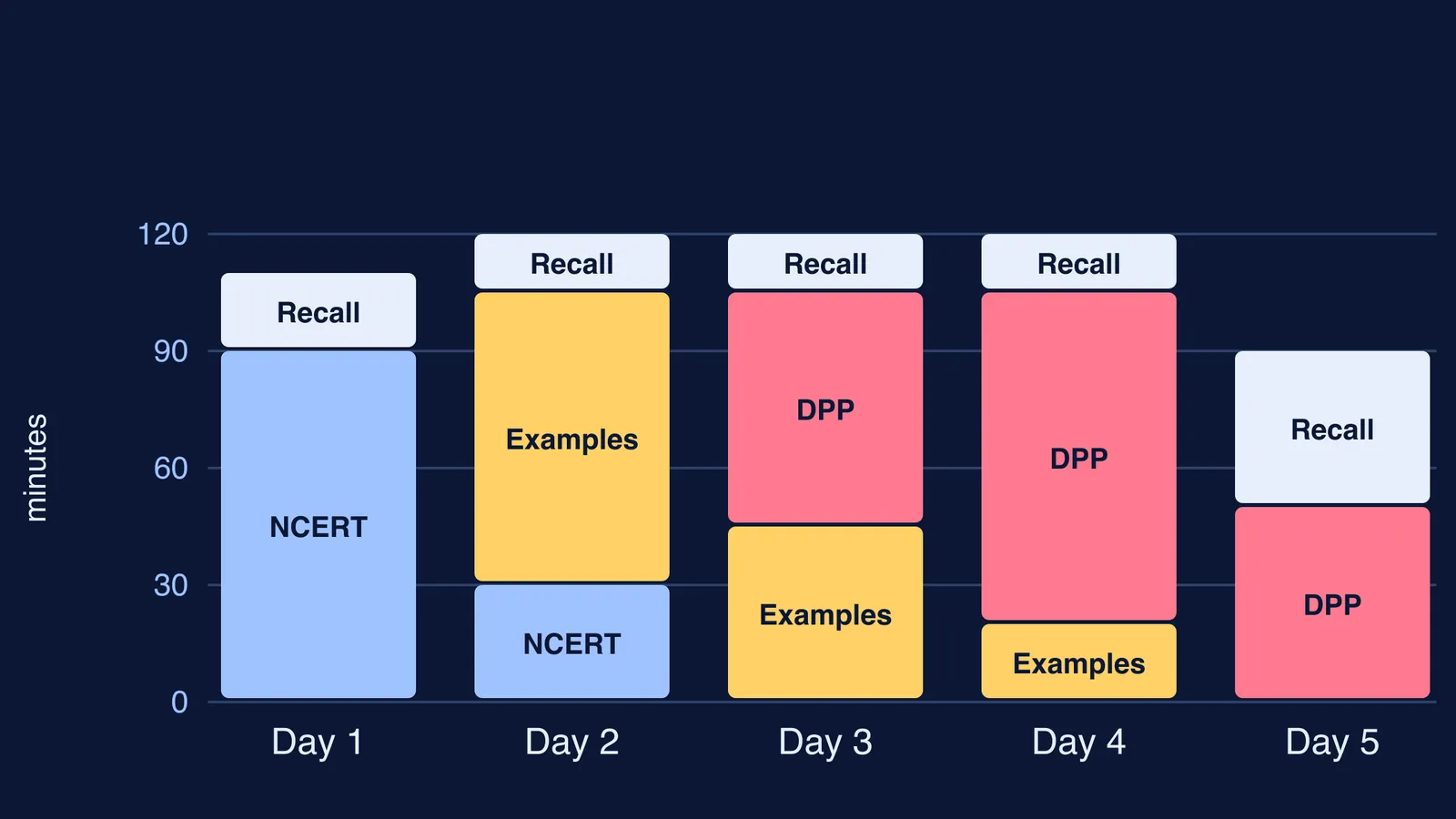
Day 1 (about 110 minutes): 90 minutes reading the NCERT chapter and its in-text examples. Then 20 minutes writing everything you remember on a blank page, and checking it against the book.
Day 2 (about 120 minutes): 30 minutes on the NCERT end-of-chapter exercises you can do. Then 75 minutes on the first half of the module's solved examples, covering each solution first. End with 15 minutes of recall: list the problem types you saw and the first step for each.
Day 3 (about 120 minutes): 45 minutes on the remaining solved examples, then 60 minutes on DPP 1 without looking anything up. Mark every question you could not start. 15 minutes of recall: write the chapter's formula sheet from memory.
Day 4 (about 120 minutes): 20 minutes going back to the examples that match yesterday's marked questions, then 85 minutes on the next DPPs. Keep an error log with three columns: question, what went wrong, the idea you missed. 15 minutes of recall.
Day 5 (about 90 minutes): 40 minutes on a closed-book chapter test, made from your blank-page notes and error log. Then 50 minutes redoing every DPP question you got wrong, without the solution.
What if the DPPs still feel too hard?
Usually one idea from NCERT did not land. If the same idea shows up three times in your error log, go back to that NCERT section and redo the blank-page recall.
If the gap is a concept, the Fermi Concept Library has a lesson for each concept in physics, chemistry, biology and mathematics. If you picked the wrong method on a problem, the Fermi Problem Library has worked problems with a step-by-step solver that explains the reasoning rather than printing an answer, so you can check your approach against it.
Parents can help without teaching the chapter: ask on Day 5 to see the blank page and the error log, not the marks.
When the chapter is done, put it on your revision calendar; our rereading vs practice testing experiment shows how to revise it without rereading.