On this page
Most students read a solved example the way they read a story: line after line, nodding along, until the answer appears. Then they get stuck on the next problem. The fix: after each line, stop and say why it follows. Here are four prompts, a worked example, and a way to let AI check you.
What is self-explanation while reading solved examples?
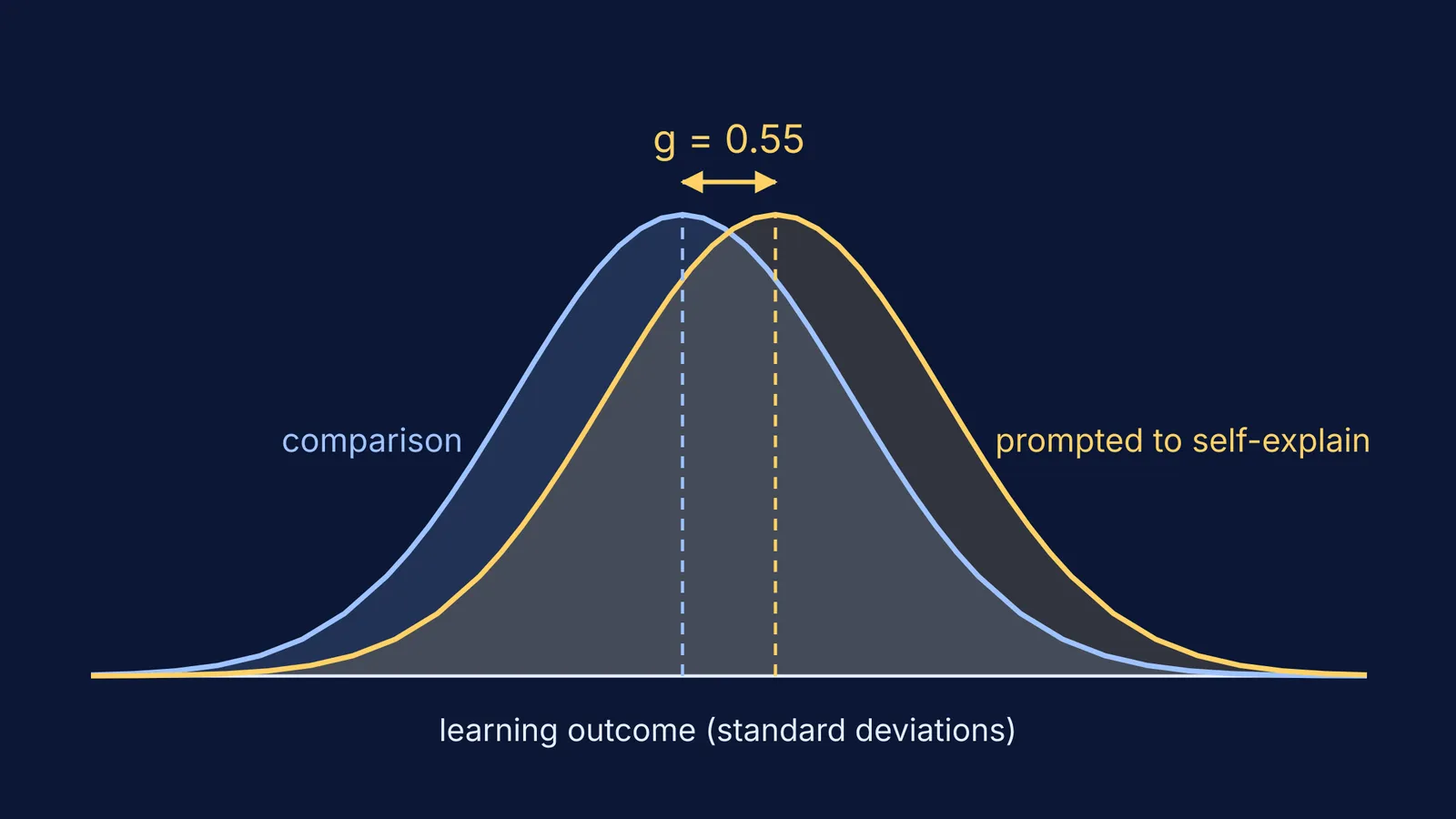
"Self-explanation is a process by which learners generate inferences about causal connections or conceptual relationships," according to a meta-analysis by Bisra, Liu, Nesbit, Salimi and Winne in Educational Psychology Review. That review pooled 69 effect sizes from 64 research reports and found an overall weighted mean effect of g = 0.55 for students given self-explanation prompts while studying or solving problems (abstract on ERIC; DOI).
In a 1989 study, Michelene Chi and colleagues listened to students think aloud while they studied worked-out mechanics examples (Chi et al., Cognitive Science). The stronger students generated many explanations, tied each action to a principle in the text and noticed accurately when they did not understand. The weaker students explained little, misjudged their own understanding and leaned heavily on the examples when solving new problems.
You can learn the habit. In a later study, 14 eighth-grade students were simply asked to self-explain after reading each line of a passage on the circulatory system, while 10 students read the same text twice (Chi, de Leeuw, Chiu and LaVancher, Cognitive Science). The prompted group gained more from pretest to posttest.
Why does explaining each line beat rereading?
Rereading makes a text familiar; explaining connects it to what you know and shows the gaps. A review of study techniques by John Dunlosky and colleagues makes the key warning: you have to explain, not merely paraphrase or summarise what you are doing or reading (Dunlosky, American Educator; full monograph).
Alexander Renkl studied 36 university students learning probability from worked-out examples and found that learning gains were predicted by the kind of explanation, even after controlling for time spent (Renkl, Cognitive Science). Successful learners gave more principle-based explanations, said what goal each step served, and reasoned ahead to the next step.
What are the four self-explanation prompts?
These four are drawn from the findings of Renkl and Chi above.
Principle: Which law, rule or definition makes this line true?
Goal: What is this step trying to get, and why do we need it?
Predict: Cover the next line. What should come next?
Monitor: Which part of this line do I not get yet?
A worked example: one projectile problem, line by line
A ball is thrown horizontally at 10 m/s from a cliff 20 m high. Take g = 10 m/s² and ignore air resistance. How far from the base does it land?
Line 1: Vertically, 20 = ½ × 10 × t².
Principle: vertical and horizontal motion are independent; the initial vertical velocity is zero, so s = ut + ½at² reduces to ½gt².
Goal: find the time, because time is the one quantity both motions share.
Line 2: t² = 4, so t = 2 s.
Predict: before reading on, say what comes next. Horizontal distance, using the time just found.
Line 3: x = 10 × 2 = 20 m.
Principle: with no horizontal force, horizontal velocity stays constant, so distance is speed times time.
Monitor: "Why didn't 10 m/s change how long it took to fall?" If you cannot answer that, you have found your gap. Go back to the principle in Line 1.
This takes longer than reading, so do fewer examples properly. If you are already fluent in a topic, though, examples help less; our post on when worked examples stop helping explains the expertise reversal effect.
How can AI check your self-explanations?
AI's danger is that it explains for you, skipping the step that does the work. Write your explanation first, then ask AI to judge it, not replace it. A script you can paste:
"Here is line 3 of a solved physics example and my explanation of why it follows. Do not give me your own explanation. Tell me whether mine names the correct principle. If it is missing a condition, ask me one question that helps me find it."
AI can be wrong, so check any principle it names against your NCERT textbook. For a gentler start, try faded worked examples made with AI, or read our overview of the self-explanation effect.
The Fermi Problem Library has worked problems with a step-by-step solver that explains the reasoning rather than printing an answer, so you can cover each step and predict it first. Fermi's AI tutor decides whether to explain, ask or show, and checks understanding as it goes, which suits the Monitor prompt.
Tonight, take one solved example from your textbook and run all four prompts on every line.