

On this page
If the immune system is the part of biology you keep coming back to, the road from a BSc in life sciences into immunology research in India is well marked. It has three gates: a master's degree, a research fellowship and a PhD interview. Knowing them early lets you prepare for each while still in the one before.
What qualifications do you need for an immunology PhD in India?
The clearest example is the BRIC-National Institute of Immunology PhD advert for 2026-27, from an autonomous institute under the Department of Biotechnology in New Delhi. It asks for a master's degree or a four-year bachelor's degree in any area of science and technology (or an MBBS, M.V.Sc. or equivalent). The same advert sets a minimum of 60% aggregate marks, with a 5% relaxation for reserved categories.
The part that is easy to miss is the fellowship. NII says candidates must hold a valid five-year doctoral fellowship from UGC, CSIR, ICMR, DBT or another government-recognised agency, and that admission depends on it. Selection is a single round of offline interviews, and labs and supervisors are allotted after you meet faculty in your area of interest.
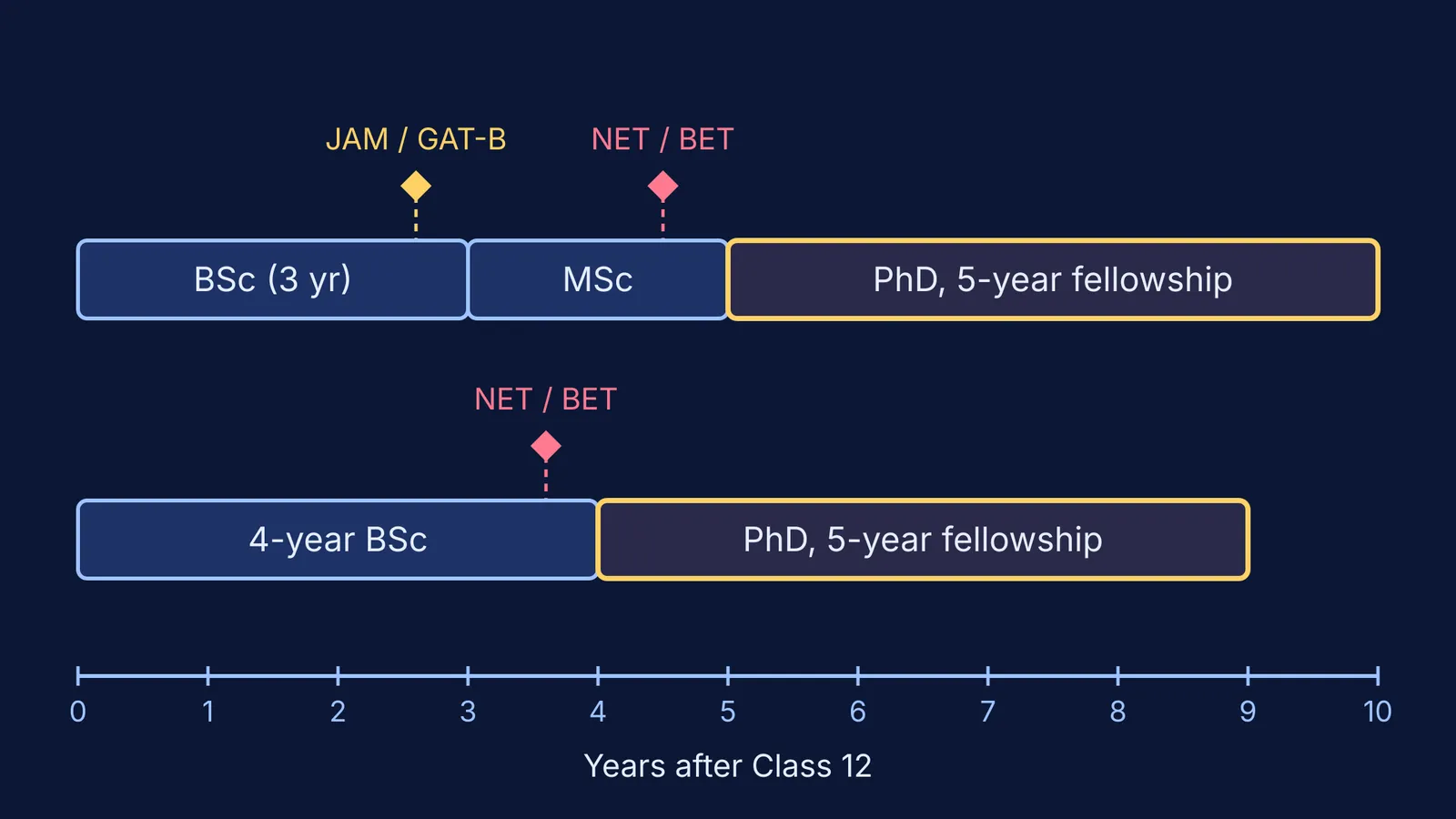
So for a student with a three-year BSc, the usual order is: MSc first, fellowship exam during or after it, then PhD applications.
Which exams lead from a BSc to immunology research?
The National Testing Agency runs two of the main ones: the Joint CSIR-UGC NET and GAT-B with BET.
MSc entry. GAT-B is for admission to Department of Biotechnology supported postgraduate programmes in biotechnology and allied areas, and BET is for the DBT Junior Research Fellowship, as NTA's 2023 notice, reported by Careers360, puts it. JAM is the entrance for postgraduate science programmes at IITs and other participating institutes.
Fellowship. The Joint CSIR-UGC NET, whose December 2026 notice lists a Life Sciences and Bio-Technology paper, and BET are the common routes to a JRF. Rules on age and final-year eligibility change, so read the current bulletin on the NTA site before you apply.
Straight to a PhD. JGEEBILS, coordinated by the Tata Institute of Fundamental Research, is used for PhD admission at its participating institutes and for integrated MSc-PhD at a few of them. Each institute runs its own admissions.
If you want to skip a separate MSc, read our guide to integrated PhD programmes after a BSc.
What lab techniques will you meet in immunology research?
Two methods you will almost certainly use in your MSc dissertation and first PhD year:
ELISA. The name comes from a 1971 paper by Eva Engvall and Peter Perlmann, Enzyme-linked immunosorbent assay (ELISA): quantitative assay of immunoglobulin G90454-X). An antibody linked to an enzyme makes a colour change you can measure, so you can tell how much of a protein is in a sample.
Flow cytometry. Flow cytometry measures properties of single cells, such as size and granularity, as they flow in suspension through a measuring device, according to a review in Critical Reviews in Biotechnology. Dyes or antibodies aimed at molecules on or inside cells let you tell cell types apart; the review lists immunophenotyping of blood cells among its main uses. Immunologists also share a long consensus guide: the European Journal of Immunology guidelines for flow cytometry.
Around these sit everyday skills: sterile cell culture, accurate pipetting, keeping a lab notebook someone else could follow, and basic statistics. Before a practical, a quick pass through the underlying ideas, such as antibody structure, in the Fermi Concept Library means the protocol makes sense instead of being a list of steps.
How do you plan the route from BSc to a PhD interview?
BSc second year: find a summer project in an immunology or microbiology lab. Our guide to research internships for undergraduates covers where to look.
BSc final year: sit JAM or GAT-B, and list MSc programmes with faculty working on immunity or infection.
MSc first year: start fellowship exam preparation and check the current CSIR-UGC NET and BET bulletins for when you may apply.
MSc second year: do your dissertation in an immune-related lab, then shortlist PhD labs. In NII's 2026-27 advert the application window ran from 10 to 30 April, so watch its site from early spring.
Before interviews: read two recent papers from each lab you want, and be ready to explain your own dissertation result in two minutes.
When you email a lab, keep it short: "I am a final-year BSc student at [college]. I read your paper on [topic] and would like to learn [technique] in a summer project. I have done [one relevant thing]. My CV is attached." Our post on choosing a PhD supervisor helps you judge the reply.
If the plan feels like a lot, Fermi's AI tutor can work out what you already know and build a plan for each study session, so the fellowship syllabus becomes one topic at a time.


