On this page
Cracking NEET-UG first time is the normal route for top scorers: NTA's NEET (UG) 2026 results press release says over 93 per cent of the 138 candidates who scored above 690 were first-time takers. What helps is knowing the paper exactly, covering NCERT completely, and spending the last months practising and fixing mistakes rather than starting new material.
What does the NEET-UG paper look like?
The NEET (UG) 2026 Information Bulletin from the National Testing Agency sets out the pattern:
180 compulsory multiple-choice questions, each with four options, in 180 minutes, in pen-and-paper mode.
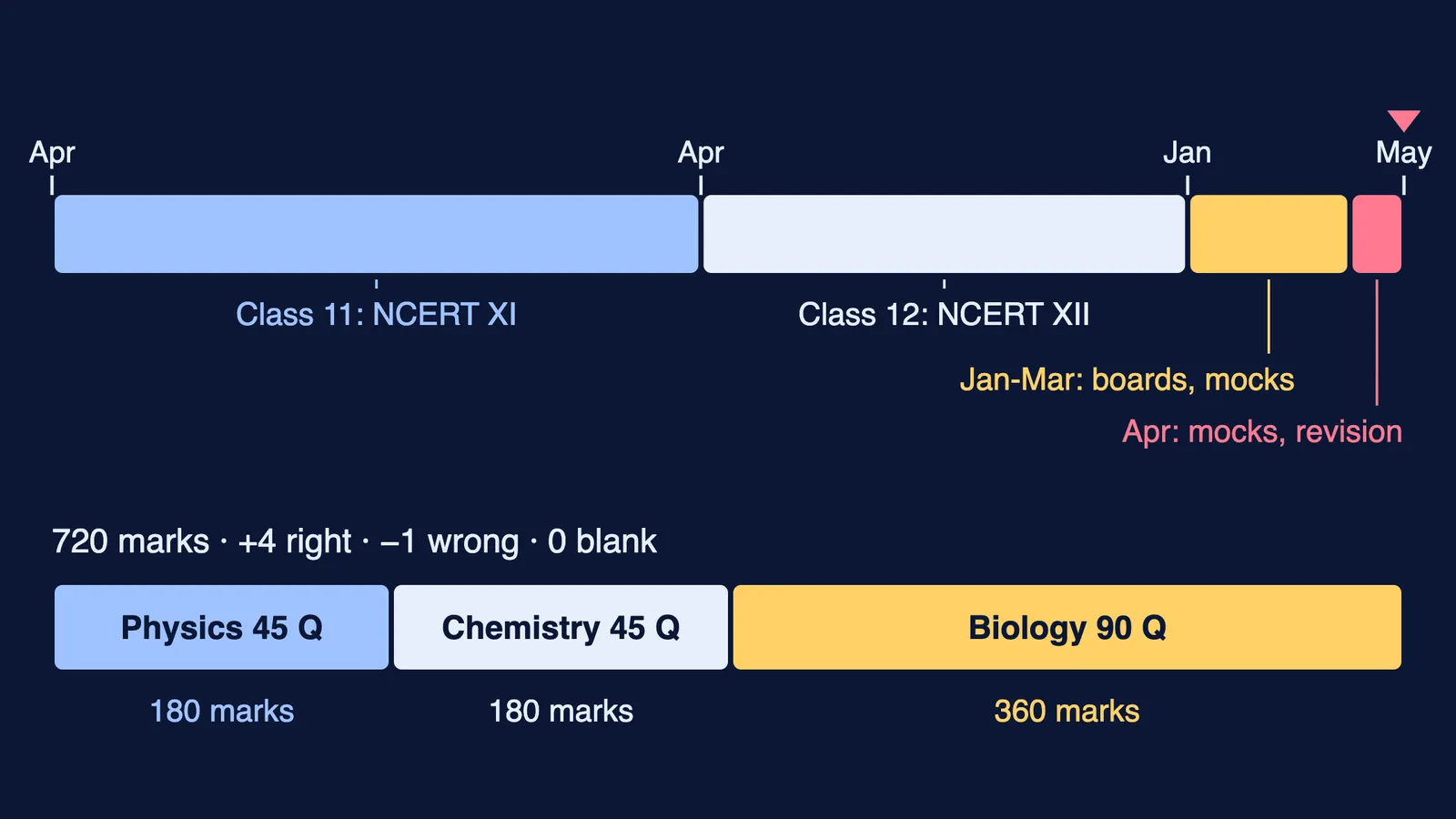
Physics 45 questions (180 marks), Chemistry 45 (180 marks), Biology 90 (360 marks): 720 marks in all.
+4 for a correct answer, -1 for a wrong one, 0 for a question left blank.
That works out to one minute per question, and half the paper is biology. Rules can change, so check the official NEET-UG website before you plan around them. The 2026 exam was first held on 3 May, and NTA later ran a re-examination on 21 June.
The marking also tells you how to guess. With four options, a blind guess is worth on average 0.25 × 4 − 0.75 × 1 = +0.25 marks. Cut it to two options and the average rises to 0.5 × 4 − 0.5 × 1 = +1.5 marks. So a blind guess gains little on average and adds risk, while a guess after you have confidently struck out two options is clearly worth making.
Why should NCERT come first?
The syllabus is set by the National Medical Commission, not by any coaching material. Its NEET (UG) 2026 syllabus has 20 units in physics, 20 in chemistry and 10 in biology, and the biology units read like the NCERT contents page. NMC's biology units 6 to 10 are Reproduction, Genetics and Evolution, Biology and Human Welfare, Biotechnology, and Ecology; the NCERT Class 12 Biology textbook has units VI to X on exactly those topics, in the same order.
So NCERT is the map of the exam. Read every line of the biology books, including diagrams, tables and examples, and solve every in-text and end-of-chapter question in physics and chemistry before you open a thick reference book. NCERT has also dropped some topics in recent years; our guide on how to check the rationalised NCERT syllabus shows how to see what changed before you buy a guide.
How should you plan from Class 11 to May?
Class 11, April to March: build the base. Finish NCERT Class 11 alongside school. Do a short chapter test every weekend.
Class 12, April to December: second book, first revision. Cover NCERT Class 12, and give one day a week to revising a Class 11 chapter so it does not fade.
January to March: boards plus full papers. Prepare for your board exams, which use the same books, and add one full-length paper every week or two under exam timing.
April to exam day: mocks and repair. Two or three full mocks a week, each followed by analysis. No new reference books now. In the final weeks, follow a set schedule like our NEET last-month revision plan.
If a concept keeps slipping, a short lesson that rebuilds it from the start helps more than another page of questions. The Fermi Concept Library covers every concept in physics, chemistry and biology, each with its own lesson and its place in the map.
How do you use mock tests without wasting them?
Testing yourself is a way to learn, not only to measure. In a study in Psychological Science, Roediger and Karpicke (2006) found that students who took practice tests remembered prose passages better two days and a week later than students who re-read the passages the same number of times, even though the re-readers felt more confident.
After each mock, sort every lost mark into one of four bins:
Didn't know it: reread the NCERT section the same day.
Knew it, wrong method: redo the problem without looking at the solution.
Silly slip: write the slip down in one line; patterns show up within a few weeks.
Ran out of time: note which section ate the clock.
For the "wrong method" bin, worked steps help. The Fermi Problem Library has worked problems with a step-by-step solver that explains the reasoning rather than printing an answer. If you are unsure whether to retake an old paper, see should you reattempt an old mock test.
What should parents keep in mind?
Steady sleep, regular meals and one fixed day off each week usually help a two-year plan more than extra late nights. Ask about what your child fixed this week, not only the mock score. If stress starts to affect sleep, eating or mood for weeks, talk to a doctor or counsellor; Tele MANAS, the government's mental-health helpline, is on 14416.
Start this week with one NCERT chapter and one timed set of questions, then let the mistake bins tell you what to do next.