On this page
"Genetic engineering" on a brochure sounds like four years of editing genes. In practice it is an engineering degree first, and the gene work arrives in the middle years.
To show this, we read one official curriculum line by line: SRM Institute of Science and Technology's B.Tech in Biotechnology with Specialization in Genetic Engineering (Regulations 2021, revised July 2024). Other universities arrange things differently, so treat this as a worked example, not a rule.
What do you study in a BTech genetic engineering programme?
The SRM programme carries 163 credits over eight semesters, according to its official curriculum. Year by year:
Year 1: calculus and linear algebra, advanced calculus, physics (electromagnetic theory, quantum mechanics, waves and optics), chemistry, electrical and electronics engineering, programming and engineering graphics, with cell biology and biochemistry starting in semester 2.
Year 2: microbiology, genetics and cytogenetics, molecular biology, bioprocess principles and engineering, chemical engineering principles and artificial intelligence, most with their own lab course.
Year 3: gene manipulation and genomics, immunology, protein engineering, biostatistics, animal and plant biotechnology, and data science.
Year 4: bio-separation technology, the last electives, and a final semester given entirely to a major project, or a project plus an internship.
You pick five professional electives from a gene-focused list: human genetics, molecular diagnostics, gene therapy, genome editing, functional genomics, genetics of cancer, metabolic engineering of microbes, and genetic engineering for crop improvement, among others.
If that load worries you, Fermi's AI tutor can work out what you already know and build a plan for the session, so you start from your real gaps.
How is genetic engineering different from biotechnology?
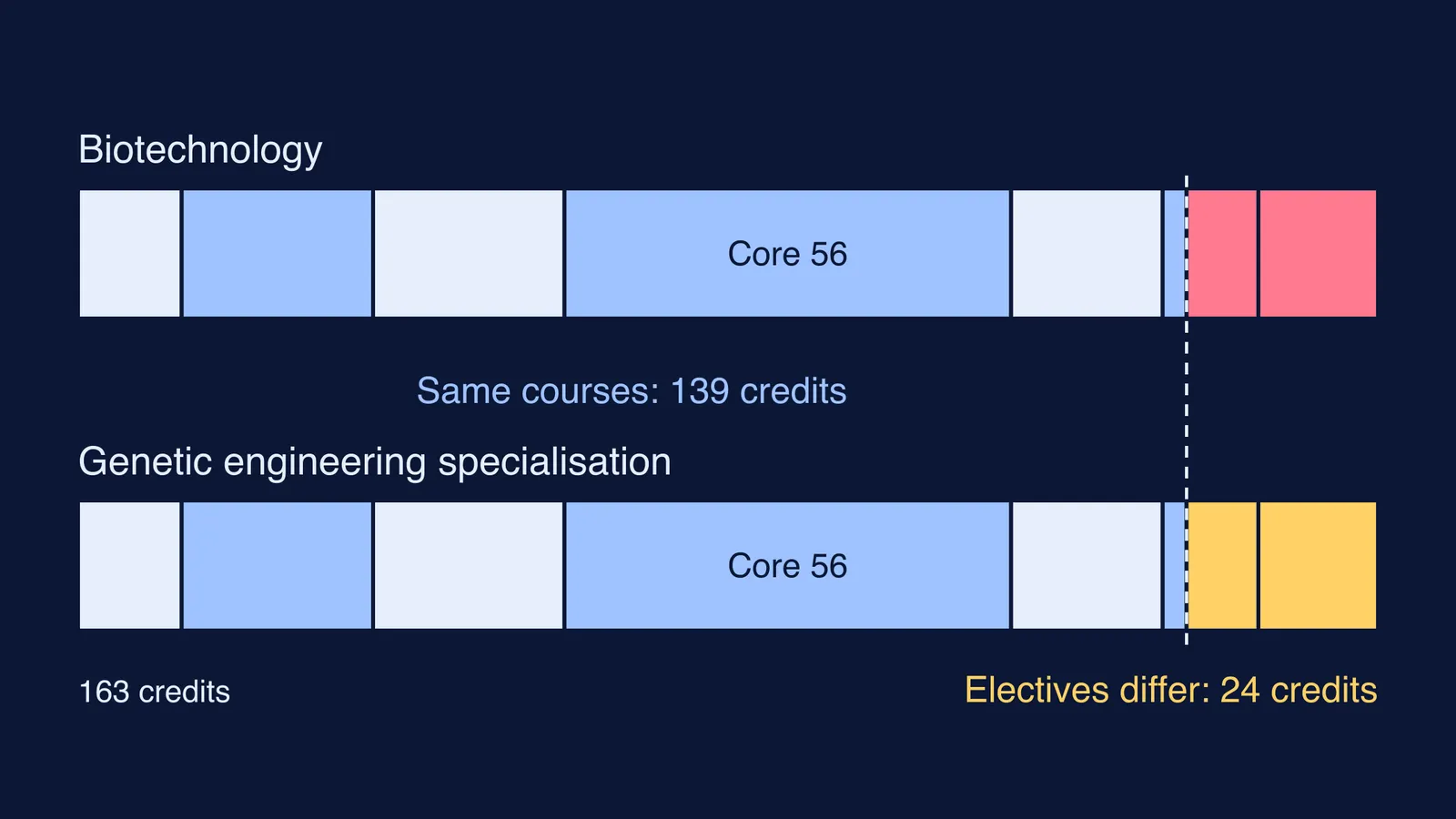
We put SRM's plain B.Tech Biotechnology curriculum next to the genetic engineering one. Both list the same humanities, science, engineering, core and project courses, so 139 of the 163 credits are identical. The difference sits in the 24 elective credits: 15 for professional electives and 9 for open electives.
The plain biotechnology degree offers five elective streams: medical, pharmaceutical, plant and food, bioprocess technology, and environmental biotechnology. The specialisation swaps that spread for one list built around genes and genomes.
So at SRM the choice decides eight elective courses, taken between semester 4 and semester 7, not your whole degree:
Pick the specialisation if you already know you want molecular work such as diagnostics, genome editing, gene therapy research or crop genetics.
Pick general biotechnology if you are still unsure, or drawn to fermentation, pharma, food or environmental work. Our guide to bioprocess engineering and where it leads shows what that side looks like.
Other colleges may run a standalone genetic engineering BTech with its own core; only their curriculum PDF will tell you.
What can you do after a BTech in genetic engineering?
There are four main routes.
Industry after the BTech: diagnostics, bioprocess and production, and quality roles. Our list of biotech careers beyond the lab covers six jobs to know.
A master's: GATE 2027 includes a Biotechnology (BT) paper, with exams on weekends between 6 and 21 February 2027, according to IIT Madras, the organising institute. GAT-B and its companion test, BET, are used for admission to postgraduate programmes in biotechnology and allied areas (Careers360 report on the 2026 notice).
Research and a PhD: the same two tests are also used to award the DBT Junior Research Fellowship (same Careers360 report). The NTA held GAT-B and BET 2026 on 17 May 2026 for 26,662 registered candidates across 54 cities, according to its public notice.
Biosafety and regulation: in India, genetically modified organisms are regulated under rules notified in 1989 under the Environment Protection Act, with the Review Committee on Genetic Manipulation monitoring research and the Genetic Engineering Appraisal Committee as the apex body for large-scale use (FAO GM Foods Platform). Each institution doing such research sets up an Institutional Biosafety Committee to oversee it, and that work needs people who know both the science and the rules.
If you enjoy the data side of genomics, read our guide to bioinformatics courses and careers too.
How do you check a programme before you apply?
Use this checklist at counselling or by email:
Download the official curriculum PDF from the university's website, not a portal summary.
Count how many credits are specific to genetic engineering, and how many are shared with biotechnology.
List which courses carry lab hours, and ask what equipment students actually use.
Read the final semester: project, internship or both? Ask where seniors did theirs.
Check the exact degree title printed on the certificate, since that is what job and master's forms will ask for.
Ask seniors which exams they took after graduating: GATE BT, GAT-B or none.
Year 2 molecular biology draws on the Class 12 chapters on DNA and biotechnology. If those feel shaky, the Fermi Concept Library gives every biology, chemistry and mathematics concept its own lesson and its place in the map, so you can see how one idea leads to the next.
Start with step 1 tonight: download one curriculum and count the shared credits yourself.