On this page
Discovering penicillin was not enough. A review in Emerging Infectious Diseases notes that in 1941 the United States did not have enough penicillin to treat a single patient, and that by September 1943 the stock could meet the demands of the Allied armed forces. A key step was moving the mould from shallow dishes to deep tanks, bubbling air through the tank while an electric stirrer agitated it.
That jump, from a dish on a bench to a tank in a factory, is what bioprocess engineers do.
What is bioprocess engineering?
Bioprocess engineering is the design and running of processes that use living cells or their enzymes to make a product at a scale that pays. The Union Cabinet's BioE3 policy release describes high performance biomanufacturing as the ability to make products "from medicine to materials" through advanced biotechnological processes.
The work splits into three parts:
Upstream: preparing the cells, the growth medium and a sterile tank.
The bioreactor: keeping temperature, pH, oxygen and mixing right while cells grow and make the product.
Downstream: separating the cells, breaking them open if needed, and purifying the product.
What do you study in bioprocess engineering?
A clear public list is the official GATE 2026 Biotechnology syllabus from IIT Guwahati. Its engineering sections cover material and energy balances, mixing and oxygen transfer in bioreactors (including kLa, the oxygen transfer coefficient), heat exchangers, kinetics of cell growth and product formation, batch, fed-batch and continuous processes, and scale-up. Its upstream and downstream processing topics include sterilisation of air and media, filtration, centrifugation, cell disruption and chromatography, and a further section covers process control.
The same syllabus opens with engineering mathematics, including differential equations, Laplace transforms and numerical methods. So the calculus you do for JEE Main is the language of this subject.
How long does a batch culture take?
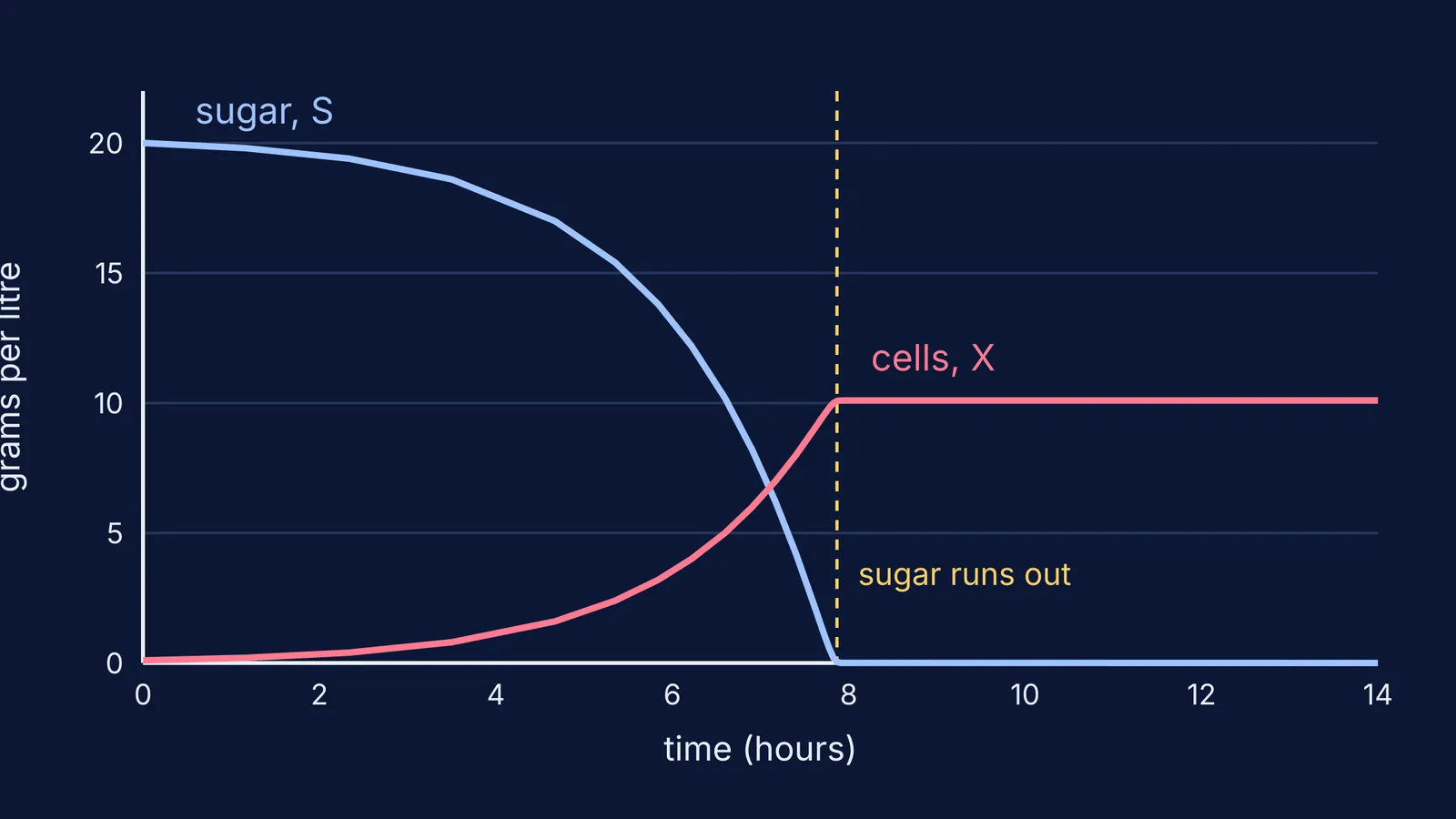
The hero diagram shows a simple batch culture, calculated from the Monod growth model with illustrative numbers. Suppose:
The tank starts with 20 g of sugar per litre and 0.1 g of cells per litre.
Each gram of sugar becomes 0.5 g of cells (the yield).
The cells' top growth rate is 0.6 per hour.
The most cells you can get is 0.1 + 0.5 × 20 = 10.1 g per litre. At full speed the cells double every ln 2 ÷ 0.6, about 1.16 hours. Going from 0.1 to 10.1 g per litre is about 6.7 doublings, so roughly 7.7 hours. The model gives about 7.9 hours, because growth slows as sugar gets scarce. Then growth stops.
Real cultures also run short of oxygen, heat up and foam, and each gets harder as the tank grows. If terms like doubling time or the Michaelis-Menten equation are new, the Fermi Concept Library has a lesson for each concept in biology, chemistry and mathematics, with its place in the map.
Which branches lead to bioprocess jobs?
Several routes reach the same plant floor:
B.Tech in biotechnology or biochemical engineering. IIT (BHU) Varanasi has offered a five-year integrated dual degree in biochemical engineering and biotechnology since 2006, with admission through JEE (Advanced). Our guide to B.Tech or B.Sc in biotechnology compares the two paths.
Chemical engineering. Reactors, heat transfer and separations, with biology added through electives or a master's.
Food technology. Fermented foods, enzymes and new proteins all need process engineers; see food technology after Class 12.
B.Pharm. Biologic medicines and vaccines are made in regulated plants; read about production jobs in pharmaceutical companies.
B.Sc in microbiology or biotechnology, followed by an M.Sc or M.Tech that adds the engineering.
Where do bioprocess engineers work?
The Union Cabinet approved the BioE3 policy for high performance biomanufacturing on 24 August 2024. It names six focus sectors: bio-based chemicals, biopolymers and enzymes; smart proteins and functional foods; precision biotherapeutics; climate-resilient agriculture; carbon capture and use; and marine and space research.
The India Bioeconomy Report 2026 puts the bioeconomy at USD 195.3 billion in 2025, about 4.8 percent of GDP, with over 11,800 biotech startups. Inside a company, typical roles include fermentation or cell-culture operations, downstream purification, process development and scale-up, quality control, and technology transfer.
A checklist before you choose a branch
Before you fill your choices, open each college's curriculum PDF and look for:
A course on bioreaction engineering or growth kinetics.
Heat and mass transfer, including oxygen transfer.
A downstream processing course with a chromatography lab.
A pilot-scale fermenter lab, not only shake flasks.
Electives in process control or GATE-relevant subjects.
If you get to speak to a faculty member, ask: "Where did your last batch of students do summer internships, and did any work in a production plant?" The answer tells you more than a brochure.
If you get stuck on growth or yield calculations, the Fermi Problem Library has worked problems with a step-by-step solver that explains the reasoning rather than printing an answer. Start with one curriculum PDF this week and tick the checklist above.