

On this page
What is the difference between BTech and BSc in food technology?
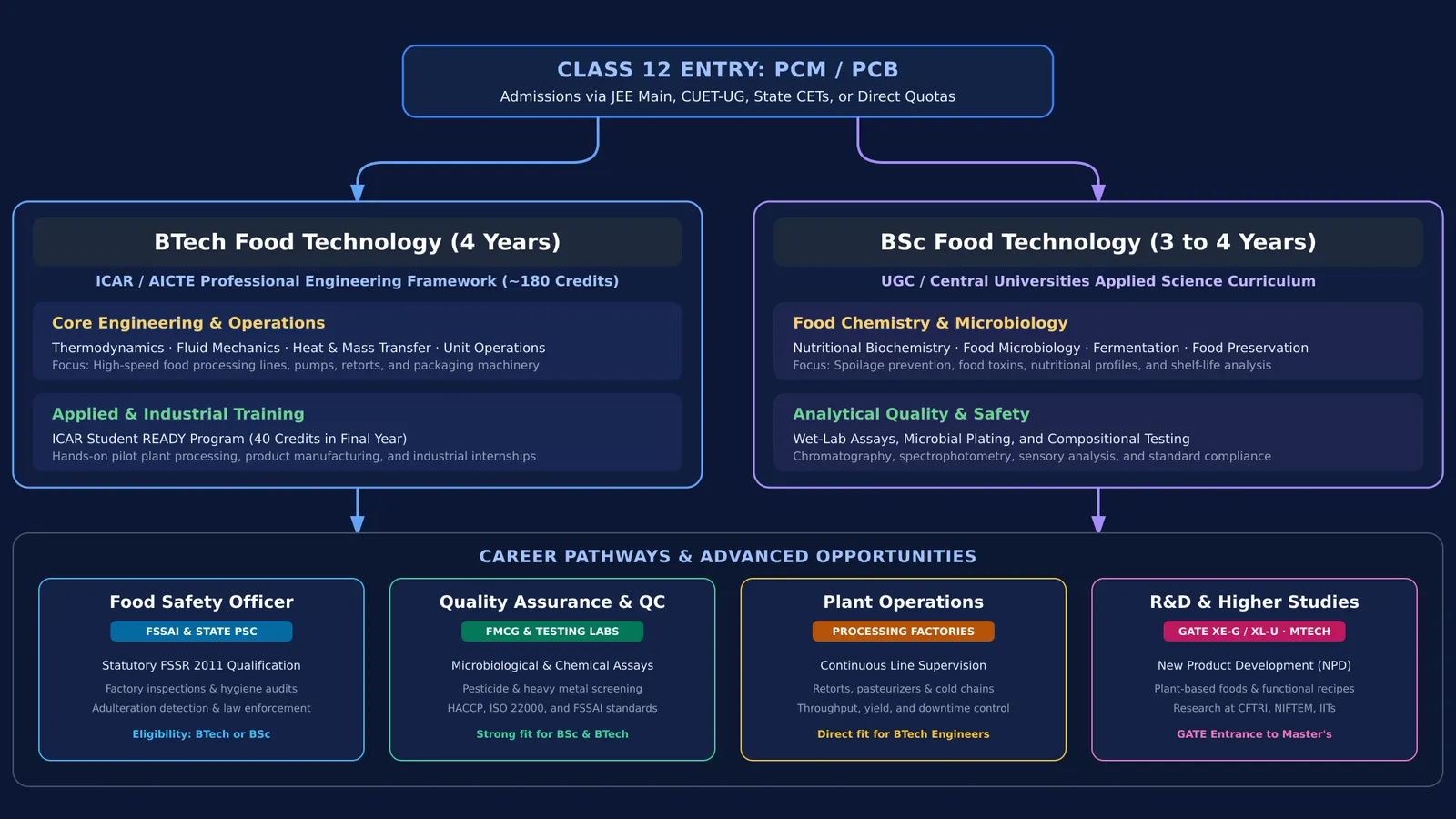
If you are talking about STEM careers beyond engineering and medicine, food technology offers a practical blend of biochemistry, agricultural sciences, and manufacturing. India's Ministry of Food Processing Industries notes that the sector accounts for 12.83% of employment in registered manufacturing factories. After Class 12, admissions divide into two distinct pathways: a four-year Bachelor of Technology (BTech) and a three- or four-year Bachelor of Science (BSc).
The BTech route treats food as an engineered product undergoing mechanical, thermal, and chemical transformations. Premier campuses such as NIFTEM Kundli, an Institute of National Importance under the Ministry of Food Processing Industries, admit students through JEE Main counseling alongside direct quotas evaluating JEE, CUET, and NEET scores. The engineering syllabus demands solid mathematics to handle fluid mechanics, heat exchanger design, thermodynamics, and high-speed packaging machinery.
The BSc route, offered by institutions such as the University of Delhi through CUET UG, concentrates on food microbiology, chemistry, and nutritional analysis. Delhi University admits candidates through either Physics, Chemistry, and Mathematics (PCM) or Physics, Chemistry, and Biology (PCB) combinations, requiring 30% marks in a qualifying language paper. While BTech students calculate pump capacities and heat transfer rates, BSc students focus on chemical assays, microbial cultures, and compositional quality testing.
What subjects will you study across the degree?
Curricula in agricultural universities adhere to frameworks set by the Indian Council of Agricultural Research. Under the ICAR Fifth Deans' Committee recommendations, a four-year BTech degree covers roughly 180 credits across five areas:
Food Processing Technology: post-harvest handling, grains, dairy, beverages, and confectionery.
Food Process Engineering: fluid mechanics, steam sterilization, drying kinetics, and cold chains.
Food Safety and Quality: microbial toxins, sensory analysis, and hygiene standards.
Food Business Management: food regulations, supply logistics, and plant economics.
Student READY Program: a final-year component featuring pilot-plant operations and industrial internships.
Early semesters bridge high school science to processing lines. Students apply laboratory tests, resembling basic tests for carbohydrates, fats and proteins in the chemistry lab, before moving to chromatography. The Fermi Concept Library covers every foundational concept in physics, chemistry, biology, and mathematics to help learners master underlying reaction kinetics and thermodynamics.
Engineering students also calculate mass and energy balances across unit operations. The Fermi Problem Library has worked problems with a step-by-step solver that explains the reasoning rather than printing an answer. For thermal diffusion and fluid flow, the Fermi Simulation Lab provides interactive simulations for ideas easier to see than read.
How do you qualify for food safety and manufacturing roles?
A food technology degree leads to careers across private consumer brands, processing plants, and government bodies. Under the Food Safety and Standards Act, 2006, the Food Safety and Standards Authority of India (FSSAI) and State Public Service Commissions hire Food Safety Officers (FSOs) to inspect manufacturing units and monitor adulteration. Rule 2.1.3 of the Food Safety and Standards Rules, 2011 lists a bachelor's degree in Food Technology as an approved qualification for this statutory role.
In industry, graduates generally step into three core departments:
Quality Assurance and Quality Control (QA/QC): analyzing raw ingredients and finished goods against microbial and pesticide tolerances.
Production and Plant Engineering: supervising continuous pasteurizers, retorts, and packaging lines.
New Product Development (R&D): formulating shelf-stable recipes, plant-based foods, and clean-label alternatives.
For advanced research, graduates can sit for the Graduate Aptitude Test in Engineering (GATE) under Engineering Sciences (XE-G) or Life Sciences (XL-U) to secure funded master's programs at national laboratories and engineering institutes.
How should you decide between engineering and applied science?
Your choice between BTech and BSc should match your high school subjects and everyday preferences. If you enjoy calculus and physical systems, an engineering degree fits production plant operations. If you prefer wet-lab experiments, biochemistry, and microbiology, a BSc leads directly to quality assurance, testing laboratories, and product formulation. Understanding your first semester at science or engineering college helps prepare you for the laboratory hours ahead.
Before selecting your degree, use this four-step decision guide:
Check eligibility: verify if your preferred colleges require Mathematics or accept Biology through CUET or NEET.
Assess quantitative comfort: BTech degrees require multi-semester engineering calculus and transport phenomena.
Choose your work setting: decide whether you prefer active factory processing floors or analytical laboratory benches.
Align graduate goals: BTech graduates transition smoothly into MTech degrees, while BSc graduates often pursue specialized MSc programs or agribusiness management.
Review the admission notifications of your target universities early to verify subject combinations and seat reservation criteria before Class 12 examination results are declared.


