

On this page
If you enjoy the genetics chapters in biology and you are the friend people come to when something is worrying them, genetic counselling is a career worth knowing about. It is still small in India. A 2024 survey of the profession in Genetics in Medicine Open estimated about 250 genetic counsellors in India in 2022, up from about 76 in 2017. Small means fewer people competing for training seats, and also fewer ready-made jobs, so it helps to know the route before you choose a degree.
What does a genetic counsellor actually do?
The standard definition comes from a task force of the US National Society of Genetic Counselors: genetic counselling is "the process of helping people understand and adapt to the medical, psychological and familial implications of genetic contributions to disease" (Resta and colleagues, Journal of Genetic Counseling, 2006). That paper breaks the job into three parts: reading family and medical histories to judge the chance of a condition, explaining inheritance, testing and management, and counselling people so they can make informed choices and adjust to the result.
In practice, the NSGC describes counsellors meeting individuals or families before or after genetic testing, interpreting results in the light of personal and family history, and giving emotional support while people make decisions. Counsellors work alongside doctors and the wider medical team.
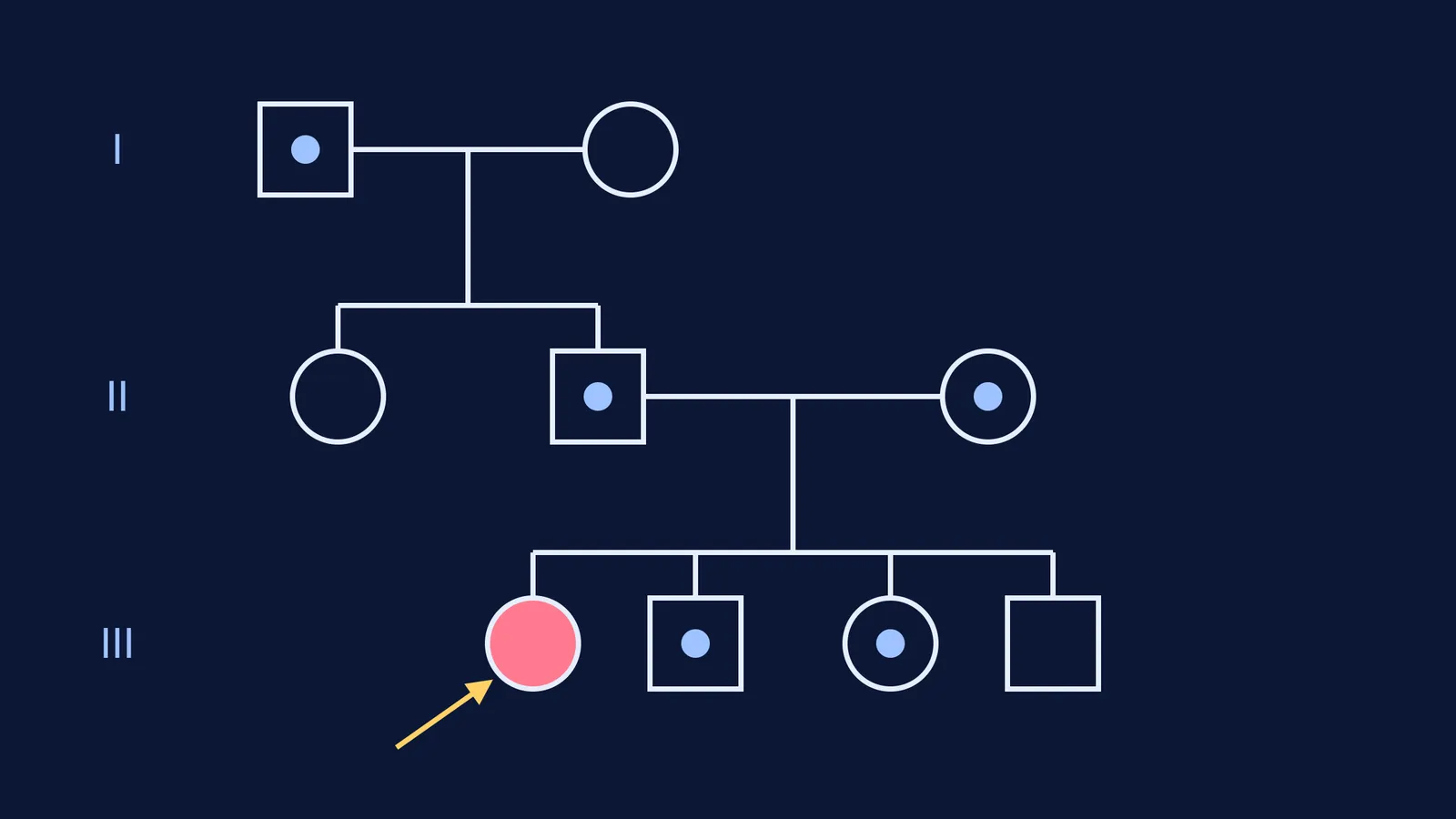
Here is what a typical case can look like. A couple's first child has been diagnosed with an autosomal recessive condition, and they want to know about a second pregnancy. The counsellor draws a three-generation family tree, like the one at the top of this page, and explains that both parents are probably carriers who show no signs of the condition. For two carrier parents, roughly a quarter of their children inherit two disease-causing copies of the gene and have the condition. The counsellor then talks through the testing options and supports whatever the couple decides. The biology is Class 12 genetics; the hard part is explaining it clearly to two anxious people.
What should you study to become a genetic counsellor in India?
The route is a bachelor's degree in a life science or health field, then a postgraduate programme in genetic counselling. As one example, Manipal's MSc in Genomic Counseling at its Bengaluru campus is a two-year, full-time course. It accepts a BSc in genetics, human genetics, nursing, biotechnology, molecular biology, medical laboratory technology, nuclear medical technology or cardiovascular technology, or an MBBS or BDS, with at least 60% aggregate. Students do clinical postings in medical genetics, IVF and reproductive medicine, fetal medicine, paediatric neurology and medical oncology.
Across the country, the 2024 survey counted four genetic counselling training programmes in India in 2022: one master's, one graduate diploma and two certificate courses, lasting one to two years and together training 10 to 15 students a year. It notes that some one-year programmes have closed and new two-year master's programmes have started. It also recorded no national or state regulation of the profession in India; oversight comes from a professional body, the Board of Genetic Counseling, India. Eligibility rules differ between universities and change from year to year, so read each programme's current prospectus.
Where do genetic counsellors work in India?
An earlier global review in the American Journal of Medical Genetics found that most genetic counsellors in Asia work clinically as generalists, in both private and public health care, while a few, including some in India, work mainly in industry. Worldwide, the 2024 survey reports more laboratory genetic counsellor roles and more clinical specialisation, with clinician scientists hiring counsellors in areas such as rare disorders, cardiogenetics and neurogenetics.
The government is building services too. The Department of Biotechnology's UMMID initiative set up NIDAN Kendras in government hospitals to provide counselling, prenatal testing and diagnosis, management and multidisciplinary care for inherited disorders. The NSGC adds research, education and industry roles to the list.
A plan from Class 11 to your first application
Class 11 and 12: take biology. Get confident with inheritance and family trees; our guide to pedigree chart symbols and what they mean is a good place to start. If a term like allele, locus or carrier is still fuzzy, the Fermi Concept Library has a lesson for every biology concept, each placed in a map of the subject.
Choosing a degree: pick a BSc that appears on the eligibility lists of the MSc programmes you like, such as genetics, biotechnology, molecular biology or nursing. Check the lists before you join, not after.
During your BSc: keep your aggregate above the cut-offs, and practise explaining science to people who are not scientists, such as younger students or family members.
Before applying: ask each programme these questions. Which hospital departments will I be posted in, and for how long? Who supervises my counselling sessions? Does the course prepare me for certification by the Board of Genetic Counseling, India? Where did the last two batches find work?
If you are unsure whether you prefer patients or the lab, compare this path with other science careers that involve working with people and with biotech careers beyond the lab bench before you pick your BSc.


