

On this page
You did the homework. It is sitting on your desk at home while your teacher walks down the row checking notebooks. That is a different problem from not doing it, and it needs a different fix: a packing checklist, a 10-minute bag routine the night before, and one fixed spot where school things live.
Why do you keep forgetting homework you already did?
Forgetting is not the same as being lazy. In a 2016 paper on reminders, Todd Rogers and Katherine Milkman note that while limited self-control is often why people fail to follow through on good intentions, another cause is "simply forgetting to enact intentions when opportunities arise." For homework, the moment to act is when you pack. If you pack at 7:15 am, half-awake with the bus coming, that is a poor moment to rely on memory.
The fix is to move packing to a calm time, make it the same every day, and stop relying on your memory to hold the list.
What should go on a school bag packing checklist?
Write two lists and stick them on the wall where you pack.
Every day:
School diary or planner
ID card and bus pass
Pencil box: two pens, pencil, eraser, sharpener, scale
Homework folder (one folder, so loose sheets never travel alone)
Water bottle and tiffin
Changes with the day:
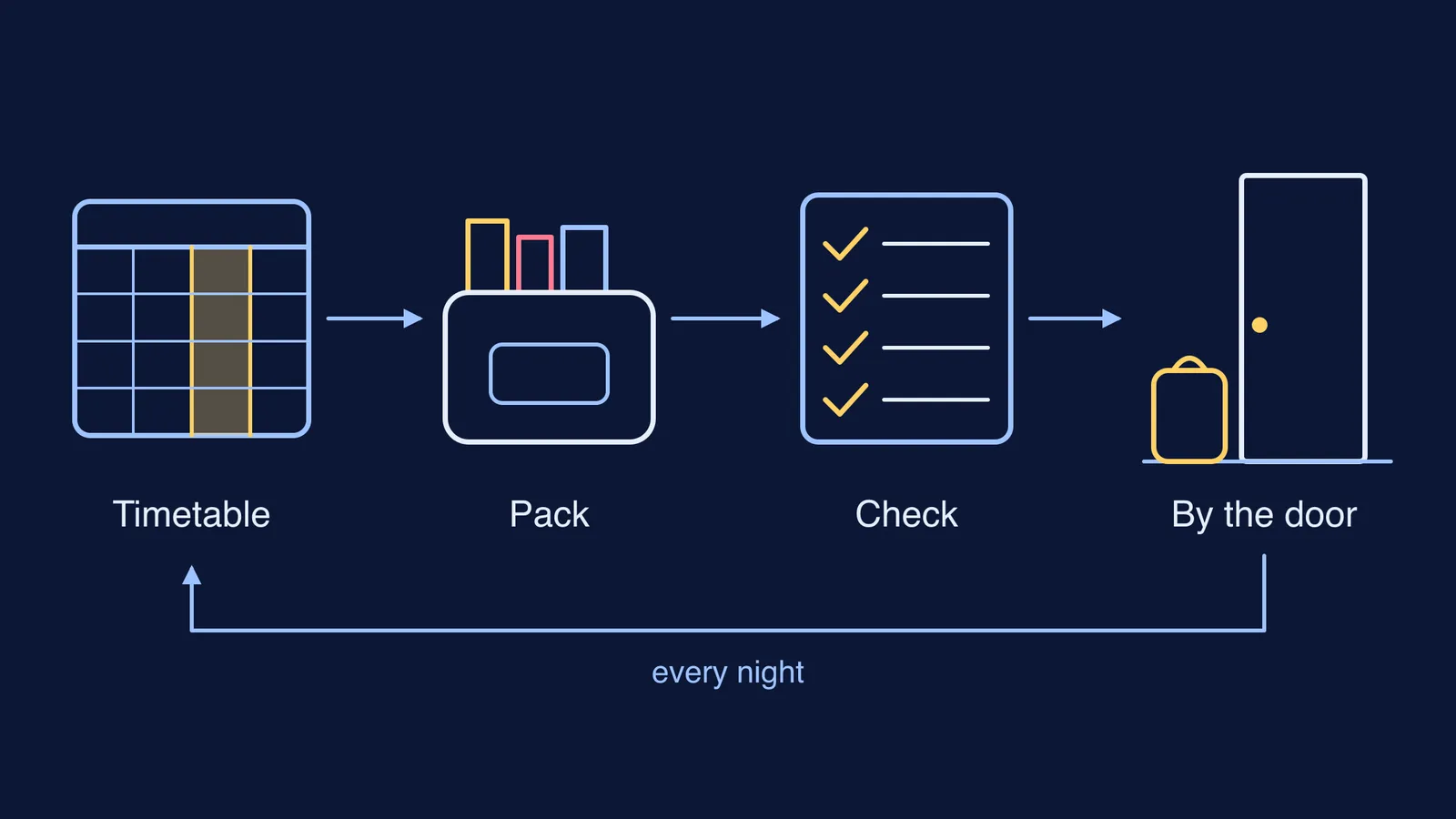
Textbook and notebook for each period on tomorrow's timetable
PE shoes, lab coat, practical record, art or craft material
Signed slips, fee envelopes, project files
Packing from the timetable also keeps the bag light. The Ministry of Education's School Bag Policy 2020 suggests that a school bag weigh about 10% of the student's body weight, and asks heads of schools to ensure a fair distribution of textbook weight per day (ThePrint's report on the policy).
If your diary is a mess, set it up first with our guide to using a paper planner with a weekly layout.
How does a night-before bag routine work?
Pick a fixed time, such as straight after dinner and before any phone time. Then:
Empty the bag. Loose papers go into the homework folder or the bin.
Open tomorrow's timetable and pack in period order.
Open the diary. For each piece of homework due tomorrow, touch the finished work and put it in.
Go through the "changes with the day" list.
Zip the bag and put it in its spot.
Then turn the routine into if-then plans. Psychologists call these implementation intentions: plans of the form "If situation Y is encountered, then I will initiate goal-directed behavior X!" In a review of 94 independent tests, Peter Gollwitzer and Paschal Sheeran found these plans had a medium-to-large positive effect on reaching goals (d = 0.65). Two that suit this problem:
"If I finish a piece of homework, then it goes into the bag before I start the next one."
"If dinner is over, then I pack my bag."
Where should school things live at home?
Choose one spot near the door: a shelf, a hook or a corner of the floor. The bag lives there and nothing else does. School shoes sit next to it.
Some things cannot go in the night before, like a tiffin in the fridge. For those, use a cue you will see on the way out. Rogers and Milkman found that reminders tied to distinctive cues, which catch your attention when it is time to act, can be more effective than written or electronic reminder messages (Psychological Science, 2016). In practice: hang a bright clip on the bag strap that means "tiffin is in the fridge", and take it off only when the tiffin is in. Our two-part plan for less rushed school mornings builds on the same spot.
What can parents do without taking over?
For the first two weeks, sit nearby while your child packs. Then step back to a glance at the zipped bag.
Swap blame for a question. Instead of "How could you forget again?", try: "Was it packing, or remembering to pack? Let's fix whichever one it was." Then change the checklist, not the child.
Ask the class teacher how homework is announced (diary, app or board) so you both read the same list.
Sometimes homework stays home because it was never finished. If your child got stuck on question four, that is a learning gap, not a packing problem. Fermi's AI tutor works out what a student already knows and builds a plan for the session, so the evening starts with a clear next step.
If forgetting runs across everything, not just homework, talk to the class teacher, the school counsellor or your child's doctor. If stress or low mood is part of it, the government's Tele MANAS helpline is toll-free on 14416 or 1-800-891-4416 (PIB).


