

On this page
A paper planner helps you study when it does three jobs: it shows what is coming, it limits what you try to do today, and it makes you look back once a week. The layout below does all three with one two-page spread per week, set up on Sunday evening.
What should a weekly planner spread include for studying?
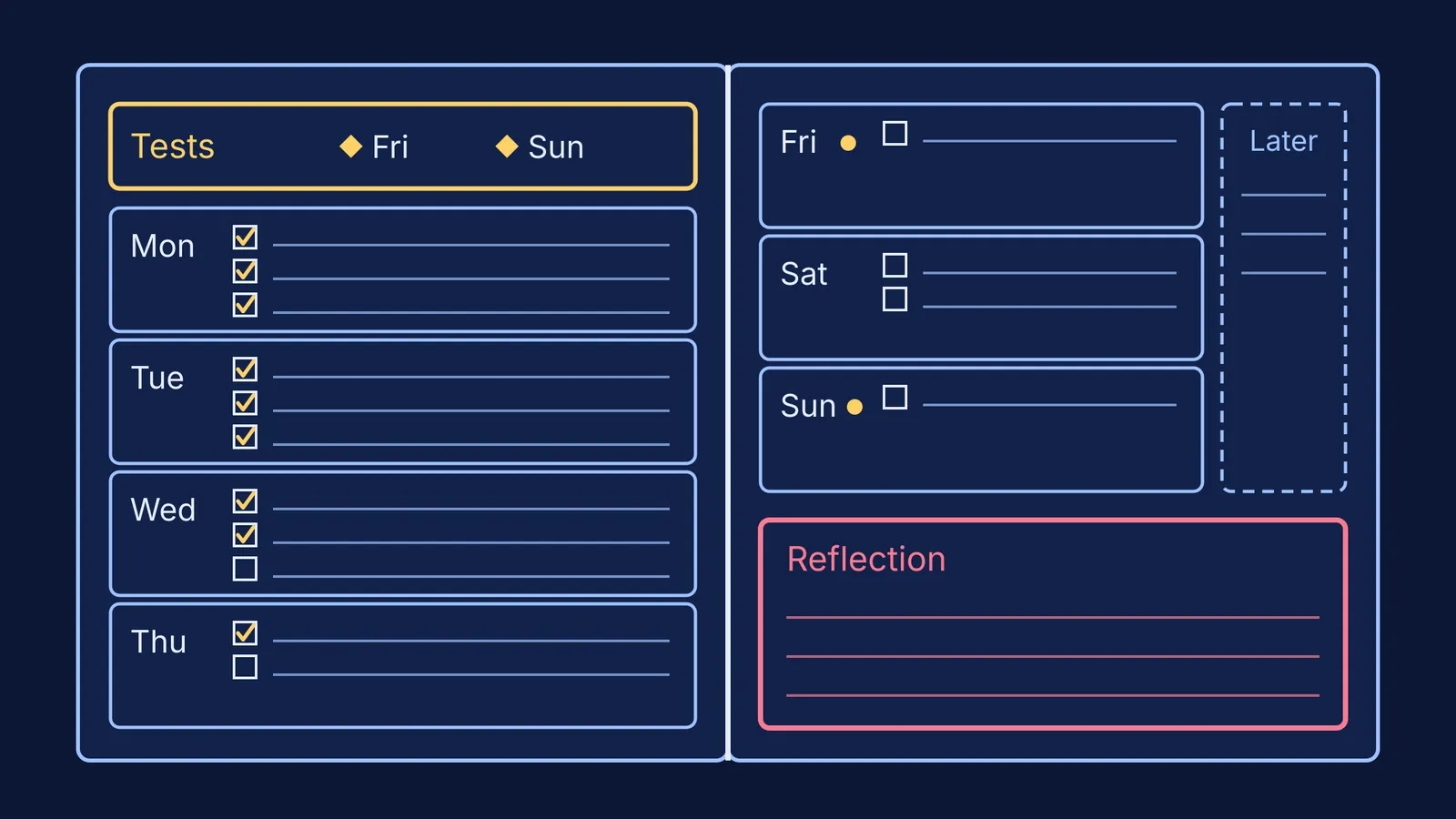
Open any notebook flat and treat the two facing pages as one week.
Test strip (top of the left page). One line for every school test, assignment deadline and coaching test this week and next, with the date and the chapter.
Day boxes. Monday to Thursday on the left page, Friday to Sunday on the right. In each box, draw three checkboxes with a line beside each.
Later column (right edge). A narrow column for tasks that come up but do not belong to a day yet.
Reflection box (bottom right). A rectangle about the size of your palm, left empty until the weekend.
Fill the test strip first, then the day boxes. For a fuller method of writing each day's list, see our guide on making a daily study to-do list that fits your day.
Why limit yourself to three study tasks a day?
Because almost everyone plans as if nothing will go wrong. Psychologists call this the planning fallacy: the tendency to underestimate how long your own tasks will take.
In a classic study by Buehler, Griffin and Ross (1994), psychology students predicted they would finish their honours theses in 33.9 days on average and actually took 55.5 days; only 29.7% finished by their own best-guess date.
Three tasks leaves room for a late bus, a doubt class that runs over or a chapter harder than it looked. Finish all three and you can pull one from the Later column. For how much slack to keep across a week, read how much buffer time to keep in your study timetable.
Each task should say what, when and where. “Physics” is not a task. “After dinner, at my desk: 12 NCERT exercise questions from Laws of Motion” is. Plans in this “when X, I will do Y” form are called implementation intentions.
A meta-analysis of 94 independent tests found that implementation intentions had a medium-to-large effect on reaching goals, d = 0.65 (Gollwitzer and Sheeran, 2006).
How do you plan around test dates in a planner?
In experiments by Masicampo and Baumeister (2011), unfinished goals caused intrusive thoughts and worse performance on unrelated tasks, and letting people make a specific plan for those goals removed those effects. A planner gives each test a place to live, so your mind does not have to keep raising it.
Work backwards from each date in the test strip. Here is a worked example for a Class 11 student with a chemistry unit test on mole concept on Friday and a physics coaching test on kinematics on Sunday.
Monday: reread mole concept notes and redo the solved examples; first half of the kinematics module; school homework.
Tuesday: 15 timed stoichiometry questions; second half of the kinematics module; school homework.
Wednesday: redo Tuesday's wrong chemistry questions; write the kinematics formula sheet from memory and check it; school homework.
Thursday: one mixed chemistry set under test timing; lights out on time.
Friday: chemistry test, then note what went wrong while you still remember.
Saturday: one mixed kinematics set under test timing; review its mistakes.
Sunday: physics test, then fill in the reflection box.
What goes in the weekly reflection box?
In a 2017 study of college statistics students, those prompted before each exam to plan which learning resources they would use, and how, outperformed a control group by an average of one third of a letter grade.
Your Sunday version can be four short answers:
What did I finish? Count the ticks.
What did I carry over, and why? Too big, day too full, or harder than expected?
Which topic or mistake kept coming back?
What is one change for next week?
If question 3 keeps naming the same idea, say limiting reagent, that is a concept gap, not a planning problem. The Fermi Concept Library has a lesson for every concept in physics, chemistry, biology, mathematics and computing, so you can go back to the idea itself before next week's practice. And if your reflection ends with “I don't know where to start,” Fermi's AI tutor can work out what you already know and build a plan for the session.
Parents: ask about answer 4, not the number of ticks. If planning starts to bring on constant worry or trouble sleeping, talk to a school counsellor or call the government's free Tele MANAS helpline on 14416.
Should you use a paper planner or a phone app?
You can use both. One workable split: fixed classes and test dates in a phone calendar for the reminders, and daily tasks and the reflection box on paper, where the whole week sits in view. If you want the digital half, here is how to use Google Calendar for a study timetable.
Start this Sunday: draw the spread, write the test strip, and fill only Monday's three lines.


