

On this page
Most study to-do lists are wish lists. Fifteen items go on the page, five get done, and by night the list feels like a failed report card. The fix is a list sized to the day you actually have: three must-dos, minutes beside each, and two lines of review.
Why do daily study to-do lists usually fail?
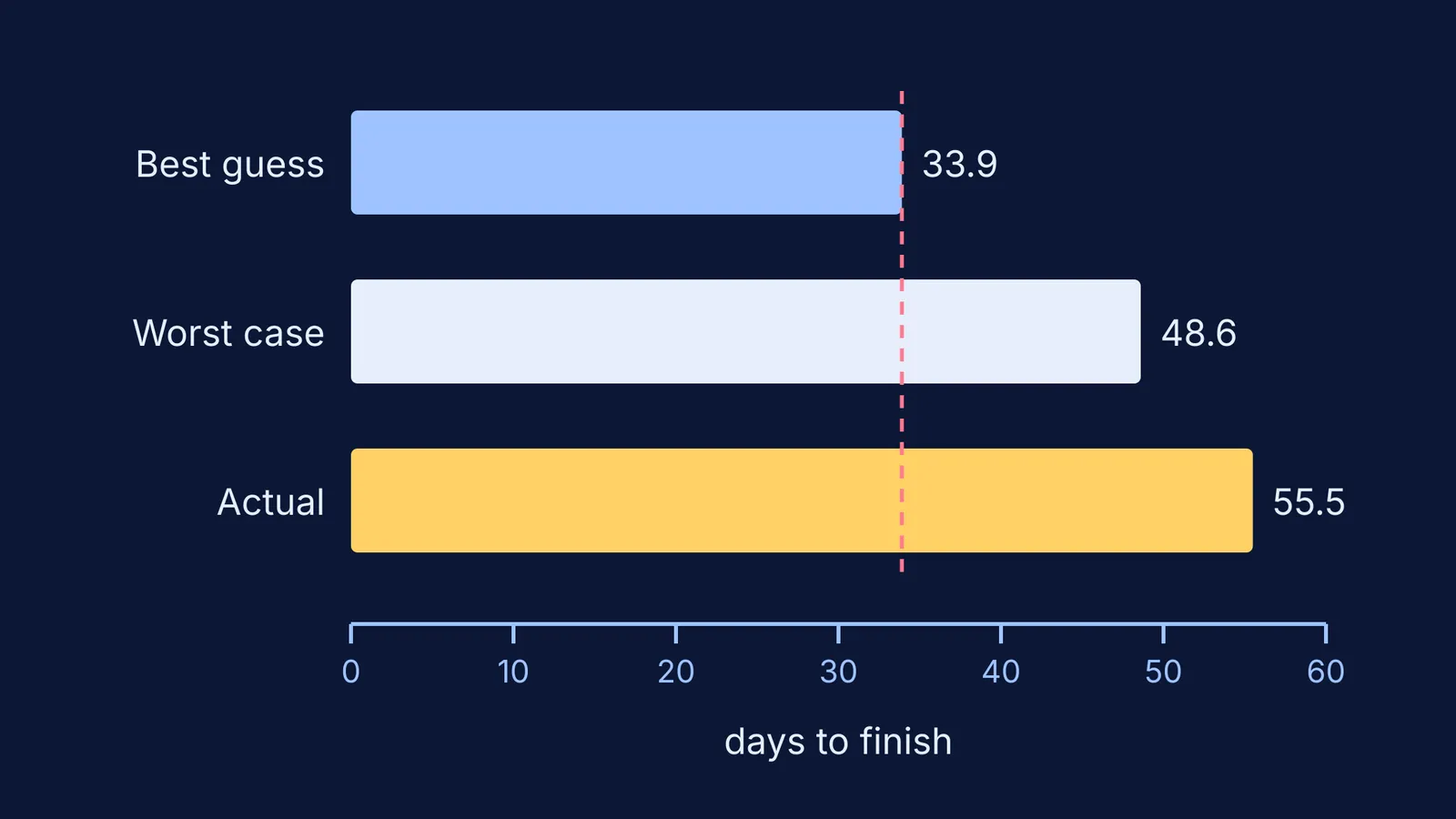
People are poor at guessing how long their own work will take. In a 1994 study, Roger Buehler, Dale Griffin and Michael Ross asked psychology students in the final semester of an honours thesis course when they would finish their theses. Their best guesses averaged 33.9 days; the theses actually took 55.5 days on average. Only 29.7% finished by their best-guess date, and even their average worst-case estimate, 48.6 days, fell short.
This is the planning fallacy. People focus on how this task will go rather than on how long similar tasks took; in a later study in the same paper, the bias disappeared when people were told to connect relevant past experiences to their predictions.
A long list has a second cost. In experiments by E. J. Masicampo and Roy Baumeister (2011), unfinished goals caused intrusive thoughts during an unrelated reading task, and making a specific plan for those goals removed the effect. A vague pile of unplanned items may keep tugging at your attention.
How do you make a daily study to-do list that works?
Give it five minutes, the night before or in the morning.
Count your free minutes honestly. Subtract school, coaching, travel, meals and family time. A coaching day may hold 150 minutes, not "the evening".
Pick three must-dos. The tasks that would make today count if nothing else happened. Write each as an action with a finish line: "Solve 15 rotational motion problems and rework every wrong one", not "Physics".
Size each in minutes, then add a buffer. Multiply your honest guess by 1.5 and write that number beside the task. In the thesis study, actual time ran about 1.6 times the best guess.
Check the total. The sized must-dos should fill at most two-thirds of your free minutes; the rest absorbs overruns.
Add one could-do line. Small extras, such as flashcards, touched only after the must-dos.
If you write tomorrow's list at bedtime, make it specific. In a sleep-lab study by Michael Scullin and colleagues (2018), 57 young adults wrote for 5 minutes before bed. Those who wrote a to-do list fell asleep faster than those who wrote about tasks they had already completed, and the more specific the list, the faster they fell asleep.
If the whole week is crowded, plan it first with time blocking for students juggling school and coaching and let each day's list draw from it.
What does a realistic daily study list look like?
Here is a Tuesday for a Class 12 student preparing for boards and JEE Main, with 210 free minutes. Two-thirds of 210 is 140, so the must-dos must fit inside 140.
Must-do 1: Maths, 12 definite integration problems from the module, mark the ones I could not start. Guess 40, sized 60.
Must-do 2: Chemistry, redo yesterday's 6 wrong mock questions from a blank page. Guess 30, sized 45.
Must-do 3: Physics, read the NCERT section on electric flux and write a five-line summary. Guess 20, sized 30.
Could-do: 20 organic reaction flashcards; one sample-paper question.
The sized total is 135 minutes, leaving 75 minutes of slack.
If a must-do is "start a chapter" and you do not know where to begin, Fermi's AI tutor can work out what you already know and build a plan for the session, so the task starts with a clear first step instead of a blank page.
What goes in the two-line review?
At night, write two lines under the list.
Line 1, what happened: "Maths done, 75 min (sized 60). Chemistry done, 40 min (sized 45). Physics not started."
Line 2, one change for tomorrow: "Integration sets take me longer than I think; size them at double. Do physics first."
Line 1 records how long your tasks really take, the past experience the thesis students left out. Line 2 turns a bad day into one adjustment, not a verdict on yourself.
A must-do that rolls over three days running is too big, too vague, or being avoided. Split it, or read why procrastination is about feelings, not laziness. When the slow part is checking wrong answers, the Fermi Problem Library has worked problems with a step-by-step solver that explains the reasoning rather than printing an answer.
How can parents help with a daily list?
Ask one question, "What are your three today?", and leave the sizing and review to your child; look at the review lines together once a week rather than checking the list nightly. If planning turns into constant worry or sleepless nights, talk to a doctor or counsellor; the free national helpline Tele MANAS answers on 14416 at any hour, as IIT Kanpur's counselling service notes.
Tonight, write three tasks, put minutes beside them, and leave space for two lines.


