

On this page
A paper timetable is easy to make and easy to forget. In a digital calendar, the same plan sits on your phone, reminds you before each session and shows which subject you keep skipping. Here is how to set one up in Google Calendar, with a sample week and a weekly review.
How do you set up Google Calendar for a study timetable?
Start on a laptop: you can only create new calendars from a browser, though they then appear in the phone app too.
Make one calendar per subject. Next to "Other calendars", click Add other calendars, then Create new calendar, and name it "Physics". Repeat for each subject, plus one called "Revision".
Give each subject a colour. Under My calendars, point to a calendar, click More and pick a colour (Google Workspace Learning Center). Every event on that calendar takes its colour.
Add study blocks as repeating events. Create an event, choose the subject's calendar, then click the arrow next to "Does not repeat" and pick how often it repeats and when it ends (Google Calendar Help). Set the end date to your exam or the end of term.
Write the task in the title, not just the subject. "Physics: NCERT Ch 5 problems 1-15" is a plan. "Physics" is a wish.
Set a reminder. Open the event, click Edit event, and next to Notifications choose a notification or email and how far ahead it arrives (Google Calendar Help). Ten minutes is enough to wrap up.
Why does a scheduled block work better than a to-do list?
A to-do list says what. A calendar block also says when and where. Psychologists Peter Gollwitzer and Paschal Sheeran call these plans "implementation intentions": if-then plans that fix when, where and how you will act on a goal. Their meta-analysis of 94 independent tests found a medium-to-large effect (d = 0.65) on reaching goals. The plans helped people get started and protected their effort from distractions.
A calendar also stops you cramming. A review of 839 assessments of spaced practice from 317 experiments on verbal recall, by Nicholas Cepeda and colleagues, found that the best gap between study sessions grew as the time until the test grew. So for a board exam months away, it makes sense to give each chapter several sessions spread over days or weeks, not one long sitting. Our guide to building a spaced revision schedule shows how to choose the gaps.
What does a study week in Google Calendar look like?
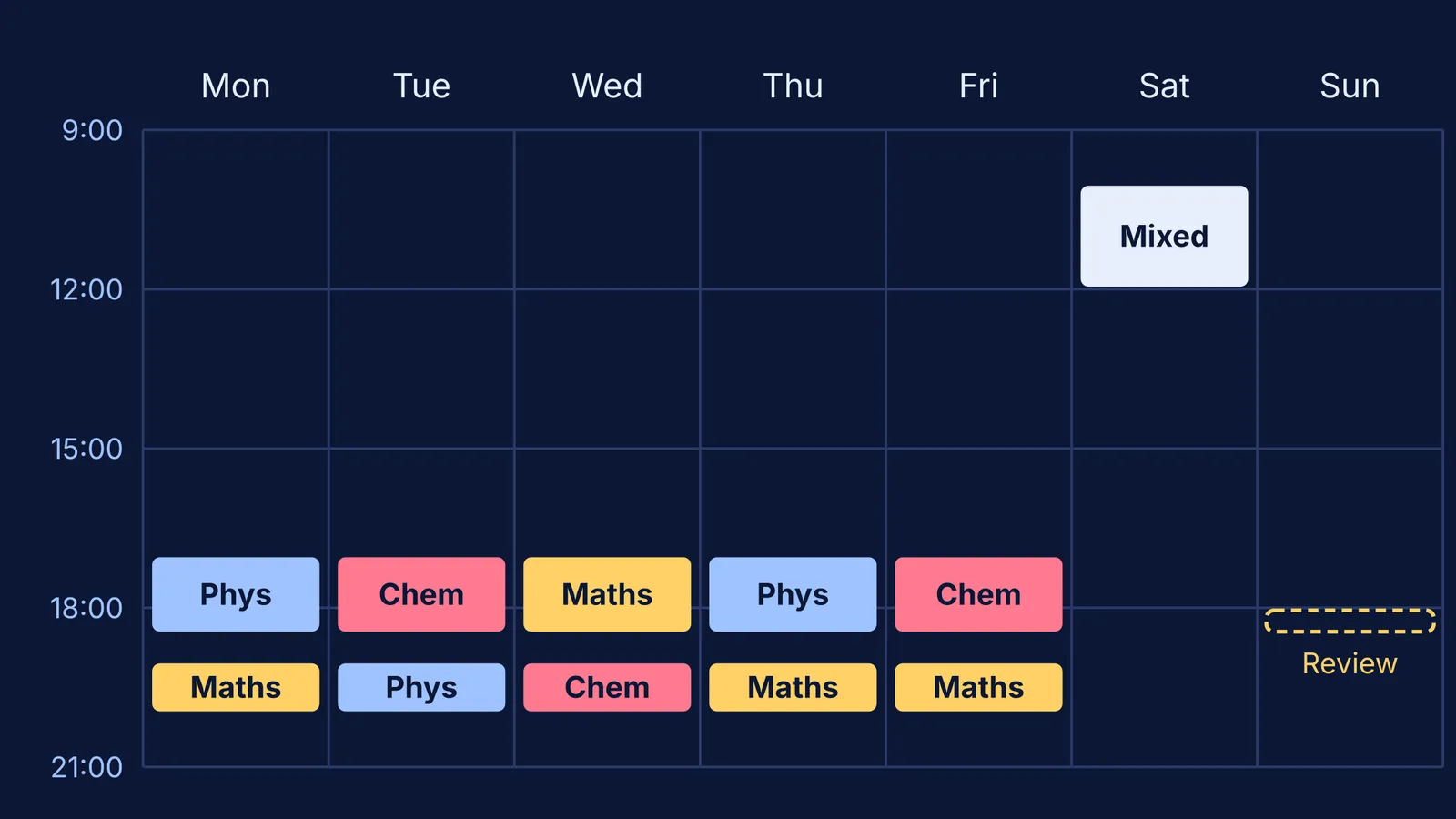
Here is a worked example for a Class 11 student who is home from school by 4 pm. It is the week drawn at the top of this page.
Monday: Physics 5:00-6:30 pm, Maths 7:00-8:00 pm
Tuesday: Chemistry 5:00-6:30 pm, Physics 7:00-8:00 pm
Wednesday: Maths 5:00-6:30 pm, Chemistry 7:00-8:00 pm
Thursday: Physics 5:00-6:30 pm, Maths 7:00-8:00 pm
Friday: Chemistry 5:00-6:30 pm, Maths 7:00-8:00 pm
Saturday: mixed revision 10:00 am-12:00 pm
Sunday: weekly review 6:00-6:30 pm
The long block is for new material; the short one is for problems or revision. Sunday is mostly free on purpose: a plan with no slack breaks the first time a test or a family function lands on it. For more on sizing blocks, read our guide to weekly time blocking for students.
How do you do a weekly review?
The Sunday block keeps the calendar honest. Ask the same five questions each week:
Which blocks did I do? Recolour missed ones grey.
Which subject got the least time?
Why did I miss blocks: the time, the task, or my phone?
What is due next week: tests, assignments, a mock?
Retitle next week's blocks so each names a specific task.
When you save a change to one session of a repeating event, Google asks you to choose which events in the series the update applies to. For a one-off change, apply it to that event only.
If you open a block and do not know where to start, Fermi's AI tutor works out what you already know and builds a plan for the session, so the block begins with a clear next step. If you keep getting problems wrong by choosing the wrong method, the Fermi Problem Library has a step-by-step solver that explains the reasoning rather than printing an answer.
What if you keep missing your study blocks?
Missing the same block every week means the plan is wrong, not you: move it to a time you keep, or shorten it. Parents can help by asking about the plan, not the hours. A simple script: "Which block was hardest to start this week? Do you want to move it?" Our piece on building a study routine that lasts has more ideas.
If dread or worry, not timing, is what stops you starting, talk to a parent, teacher or school counsellor. In India, the government's Tele MANAS helpline is toll-free on 14416.
Set up the subject calendars tonight, add next week's blocks, and put your first review in for Sunday.


