
On this page
If your family is repaying an education loan, the interest part of every EMI can lower your income tax. The rule most families know as Section 80E now sits in Section 129 of the Income-tax Act, 2025, which came into force on 1 April 2026. The wording barely changed, so what follows applies to both. Returns for income earned in 2025-26 still use the 80E label, as the Income Tax Department's AY 2026-27 guide for salaried individuals shows.
Who can claim the education loan interest deduction?
Section 129 of the Income-tax Act, 2025 gives the deduction to an individual who pays interest on a loan they took for higher education. You qualify only if all four of these hold:
You are claiming as an individual. The section says "an assessee, being an individual".
The loan is in your name. The Act says a loan "taken by him".
The course is for you, your spouse or your children, or for a student whose legal guardian you are. That is the Act's whole definition of "relative".
You pay the interest out of income that is taxed.
Under the Act, higher education means any course of study pursued after passing the Senior Secondary Examination (Class 12) or its equivalent from a recognised school, board or university.
The second condition matters most for parents. If the loan is in your child's name alone, the wording does not cover you, even if you pay every EMI. Before you sign, ask the bank who the borrower will be, and check with a chartered accountant.
Which lenders count for Section 80E?
The Act accepts only two kinds of lender:
A financial institution: a bank covered by the Banking Regulation Act, 1949, or any other institution the Central Government notifies.
An approved charitable institution, as defined in the section.
Money borrowed from relatives, friends or any other lender does not qualify.
For how many years can you claim the 80E deduction?
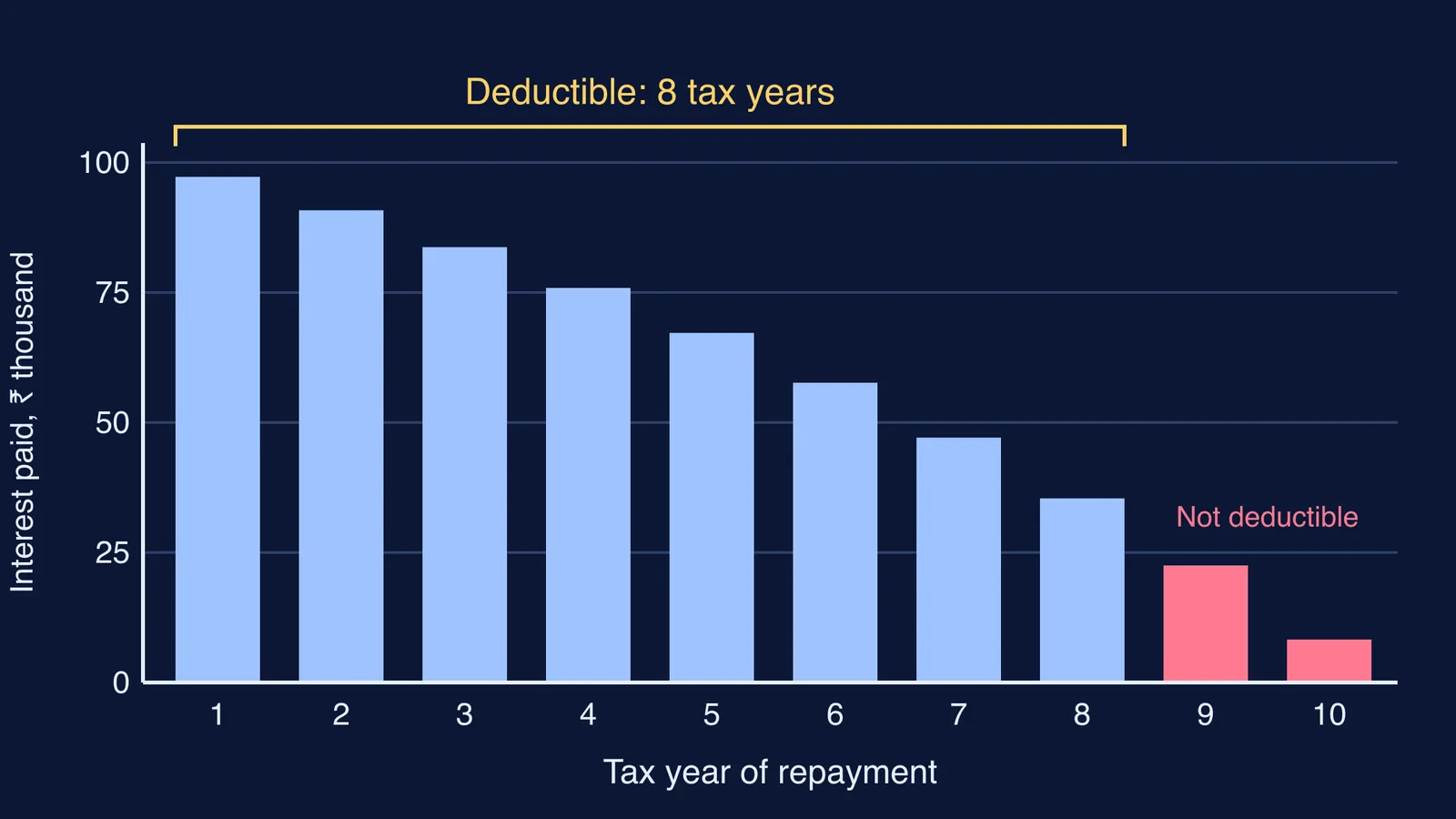
Section 129(2) of the Act allows the deduction for the initial tax year and the seven tax years after it (eight in all), or until the interest is fully paid, whichever comes first. The initial tax year is the year you start paying interest, not the year the loan is sanctioned or the course ends.
Only interest counts, not principal, and the Act sets no rupee limit. Interest paid after the eighth year gets no deduction.
It also works only in the old tax regime. Under section 202 of the Act, the new regime is the default, and income under it is computed without Chapter VIII deductions apart from a few named ones. Section 129 is not one of them. The department's AY 2026-27 guide also lists 80E only under the old regime.
How much tax does a parent save? A worked example
Take a parent who borrows ₹10 lakh from a bank in their own name for their child's B.Tech. Assume 10% interest a year and a 10-year EMI starting in April, so each loan year matches a tax year. The reducing-balance EMI formula gives an EMI of ₹13,215 a month. The parent files under the old regime and has ₹15 lakh of taxable income before this deduction.
In the old regime, income above ₹10 lakh is taxed at 30%, plus 4% health and education cess on the tax, according to the department's AY 2026-27 rates. So each rupee deducted saves 31.2 paise while income stays above ₹10 lakh.
Year 1: interest ₹97,239, tax saved ₹30,339.
Year 4: interest ₹75,881, tax saved ₹23,675.
Year 8: interest ₹35,412, tax saved ₹11,049.
Years 1 to 8 together: interest ₹5,55,030, tax saved about ₹1,73,169.
Years 9 and 10: interest ₹30,780, no deduction, so about ₹9,603 of possible saving is lost.
The 10% rate is an assumption, not a bank's quote, and slab rates can change. Work out your tax under both regimes: if the new regime still comes out cheaper, this deduction is worth nothing to you. If the old regime wins, finishing repayment within the eight years keeps all the interest deductible.
What should you keep for your tax return?
The department's AY 2026-27 guide asks for these details when you claim the deduction:
The lending institution's name.
The loan account number.
The date the loan was sanctioned.
The total loan amount.
The amount outstanding at the end of the year.
The interest you paid during the year.
Ask your bank for a yearly statement that splits interest from principal, and keep the loan agreement naming you as borrower.
Still choosing a loan? See how to apply for an education loan in India, and explain how the loan works to your teenager before college starts. For your child's own maths practice, the Fermi Problem Library has worked problems with a step-by-step solver that explains the reasoning.