
On this page
With an Indian education loan, you usually pay no EMIs while you study. But the interest clock keeps running, and what you do during those years shapes your EMI for the next decade.
What is the moratorium period in an education loan?
The moratorium, also called the repayment holiday, is the period before your EMIs start. Under the government's PM-Vidyalaxmi scheme it is the course period plus one year (PIB backgrounder on PM-Vidyalaxmi, July 2026), and repayment after it can run for up to 15 years.
Two details in bank terms matter. SBI's published terms for its Student Loan say the holiday lasts for the course period plus 1 year, "or 6 months after getting job, whichever is earlier", so an early job offer can start your EMIs sooner (SBI Student Loan terms). The same document allows the course to be extended by up to 2 years if you cannot finish on time.
Does interest accrue during the moratorium?
Yes. SBI's terms say simple interest is charged during the moratorium, and the interest that builds up is added to the principal when your EMIs are fixed (SBI Student Loan terms). SBI's student repayment page says the same about interest from the course and moratorium periods (SBI repayment page).
Simple interest is worked out on the amount borrowed only, not on earlier interest. So the amount you owe climbs in a straight line, by the same amount every month. Banks word this differently, so ask yours in writing.
Our explainer on how many years money takes to double at simple interest works through the formula. If principal, rate and time still feel shaky, the Fermi Concept Library has its own lesson for each concept in mathematics, so you can fix the basics before you sign anything.
How much interest builds up during the moratorium?
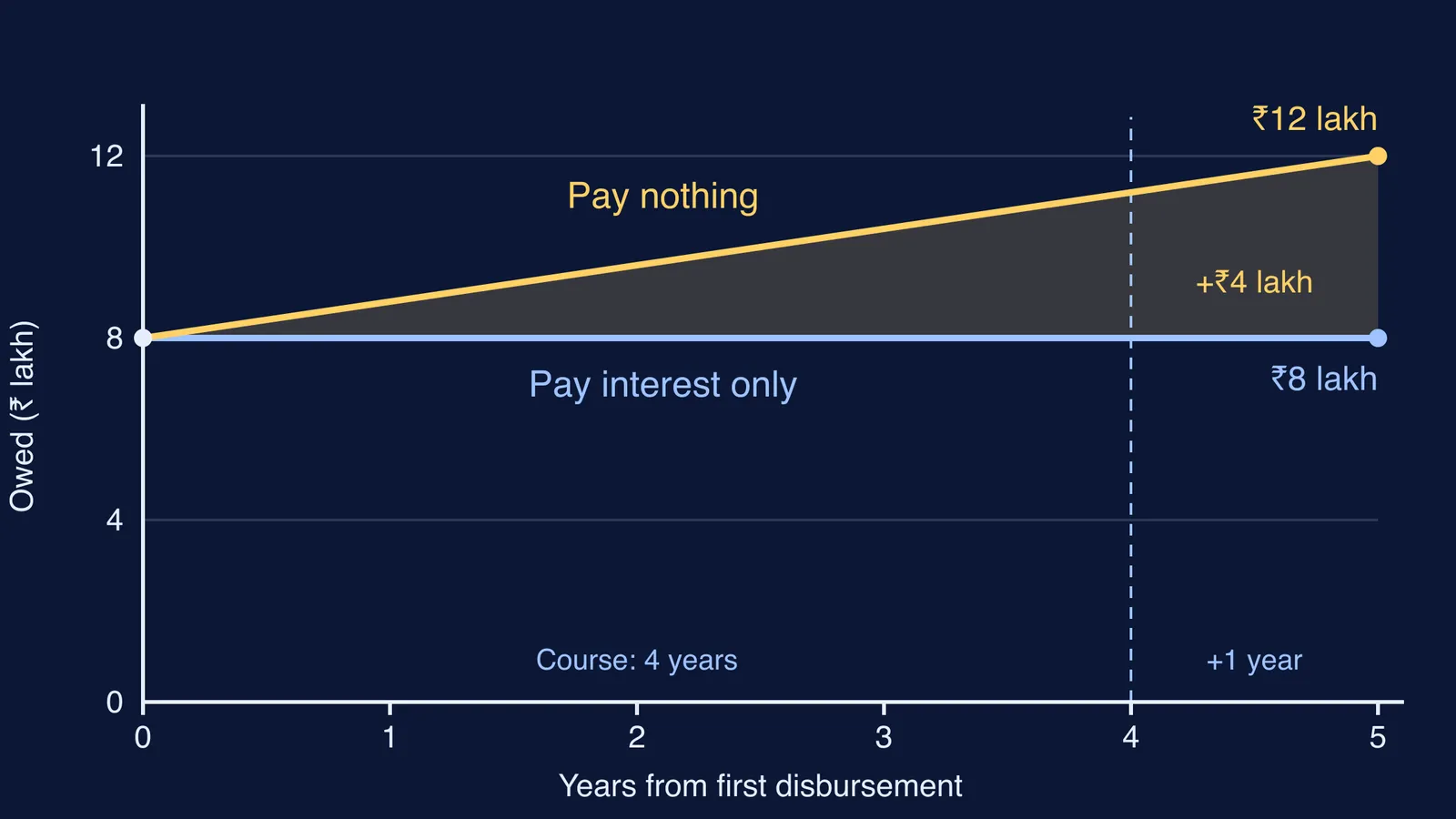
Take a four-year B.Tech, a loan of ₹8 lakh and an illustrative rate of 10% a year (check your bank's actual rate). To keep the arithmetic clear, assume the whole ₹8 lakh is paid out on day one. The moratorium is 4 years of course plus 1 year, so 5 years.
Simple interest = principal × rate × time = 8,00,000 × 0.10 × 5 = ₹4,00,000.
Option A: pay nothing during college. The ₹4 lakh is added to the loan, so your EMIs start on ₹12 lakh. Repaid over 10 years at 10%, that is an EMI of about ₹15,858, or roughly ₹19.03 lakh in total.
Option B: pay the interest only. Each month's interest is 8,00,000 × 0.10 ÷ 12, about ₹6,667. Over 5 years you pay ₹4 lakh, and the loan is still ₹8 lakh when EMIs begin. The EMI is about ₹10,572, or roughly ₹12.69 lakh over 10 years. Add the ₹4 lakh and you have paid about ₹16.69 lakh.
Paying interest as you go saves about ₹2.34 lakh here and lowers the EMI by about ₹5,286 a month. The saving is the interest you would otherwise pay on the unpaid ₹4 lakh once it joins the principal.
There is a second reason to pay interest during college. SBI gives a 1% concession on the interest rate for the whole loan if the full interest is paid during the course and moratorium (SBI repayment page). The PIB backgrounder says banks under PM-Vidyalaxmi may offer up to 1% additional concession on the same condition (PIB backgrounder).
Can the government pay the moratorium interest for you?
Possibly, depending on family income and the institution (PIB backgrounder):
Under PM-USP CSIS, students in technical or professional courses at approved institutions, with family income up to ₹4.5 lakh a year, get 100% interest subvention during the moratorium on loans up to ₹10 lakh.
Under PM-Vidyalaxmi, students admitted on merit to designated institutions, with family income up to ₹8 lakh, can get 3% interest subvention during the moratorium on loans up to ₹10 lakh.
Students receiving any other central or state scholarship, interest subvention or fee reimbursement are not eligible for either. Under PM-Vidyalaxmi, the subvention can be used only once.
What should you do before the first disbursement?
Ask the bank three questions in writing: is moratorium interest simple or compound, does the moratorium end early if I get a job, and what concession do I get for paying interest during the course?
Check whether you qualify for CSIS or PM-Vidyalaxmi. The PM-Vidyalaxmi portal handles loan applications and interest subvention requests.
Work out the monthly interest on each disbursement (amount × rate ÷ 12) and decide who in the family will pay it.
Log each disbursement and the interest charged monthly, and check it against the bank statement.
For the paperwork, see how to apply for an education loan in India, step by step. If the loan is still a family conversation, start with how to talk to your parents about college costs.