On this page
You finish a chapter, feel sure you have it, then lose marks on the first mixed test. Psychology has a famous name for one version of this gap, and an argument about how big it is.
What is the Dunning-Kruger effect?
The Dunning-Kruger effect is the idea that people with low skill in an area tend to overestimate their ability, partly because the missing skill also makes it hard to spot their own mistakes. It comes from a 1999 paper by Justin Kruger and David Dunning of Cornell University, Unskilled and unaware of it, published in the Journal of Personality and Social Psychology.
The authors described a "dual burden": people who lack a skill make errors, and their incompetence "robs them of the metacognitive ability to realize it", in the words of the paper's abstract on PubMed. The paper defines metacognitive skill as the capacity to distinguish accuracy from error: in practice, telling a right answer from a wrong one in your own work.
What did the 1999 study actually measure?
Across four studies, participants took tests of humour, grammar and logic, then estimated how their test performance and ability compared with other people's, according to the 1999 abstract. The headline results:
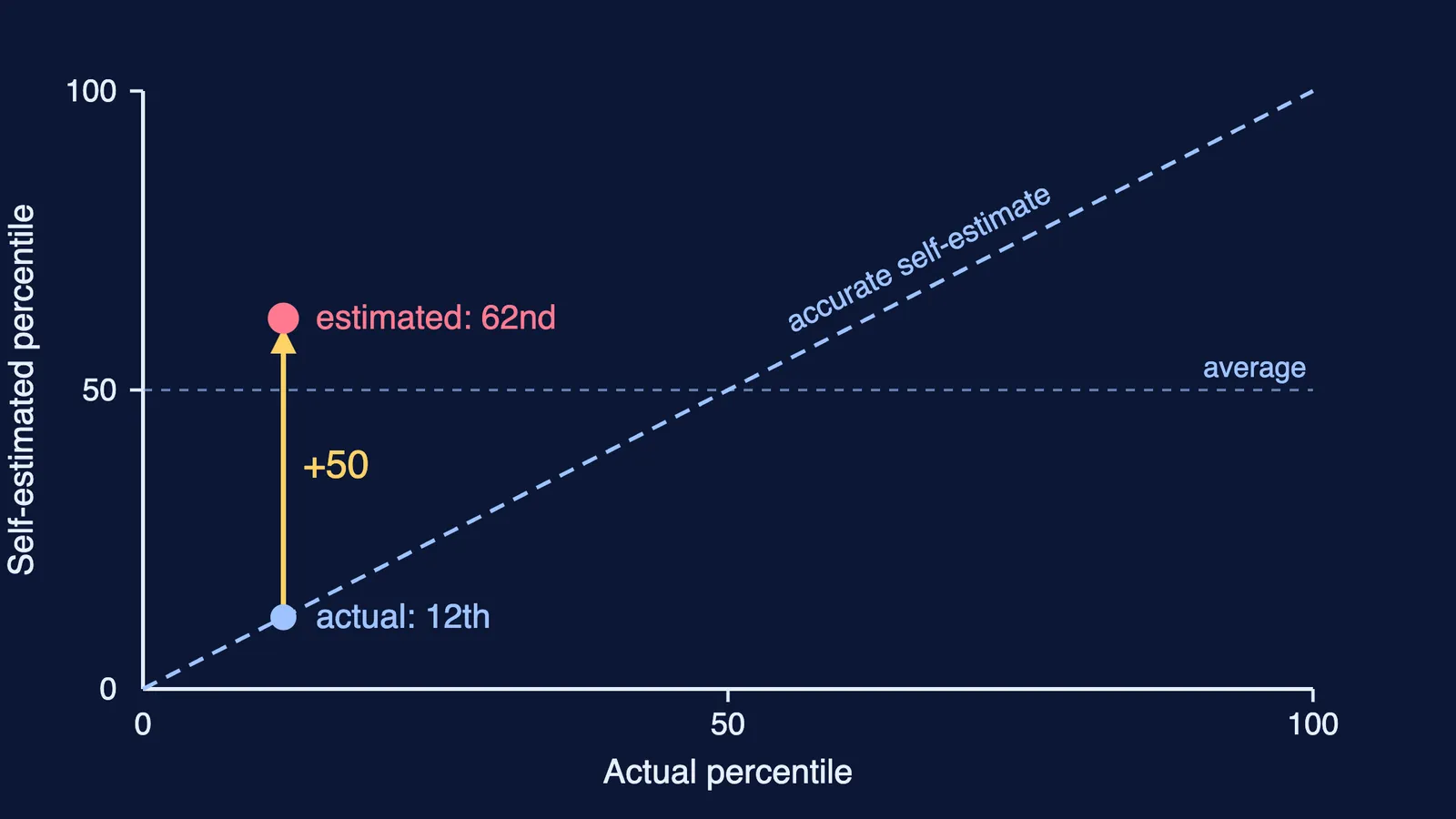
People scoring in the bottom quarter had test scores at the 12th percentile but estimated themselves at the 62nd.
The researchers linked this miscalibration to weaker skill at distinguishing accuracy from error.
When they improved participants' skills, those participants became better at recognising the limits of their abilities.
That last result is the hopeful part: more skill brought more realistic self-assessment. Note that the study compared groups of scorers sorted into quarters; it did not track one person's confidence over months of learning.
Is the Dunning-Kruger effect real or a statistical artefact?
Even critics find the basic pattern that low scorers overestimate themselves. The argument is about why.
In a 2002 replication, Joachim Krueger and R. A. Mueller found that low scorers overestimated and high scorers slightly underestimated their performance relative to others, but found no evidence that metacognitive skill or the other candidate variables they tested explained the gap (Krueger and Mueller, 2002). The errors were no longer lopsided once they statistically removed either of two ordinary effects:
Better-than-average: most people rate themselves above the middle. If everyone guesses around the 60th percentile, the person really at the 12th looks wildly overconfident and the person at the 90th looks modest.
Regression to the mean: any test score contains some luck. Sort people by score and the bottom group collects many who had an unlucky day, so their self-estimates look too high.
A 2016 study in Numeracy by Nuhfer and colleagues used random-number simulations and found that common graphs in this research, such as averages plotted by quarter, create patterns that invite misreading; their real dataset paired self-assessed and measured science literacy for 1,154 participants (Nuhfer et al., 2016).
In 2020, Gignac and Zajenkowski gave 929 members of the public a reasoning test, Raven's Advanced Progressive Matrices, and asked them to rate their own intelligence. The link between measured and self-rated intelligence was essentially a straight line; they concluded the effect may be plausible for some skills but much smaller than reported (Gignac and Zajenkowski, 2020). Famous findings have shrunk under closer checks before; see what the ego depletion replications found.
What does it mean for you before an exam?
Whichever explanation wins, the practical lesson is the same: the feeling "I know this" is a weak signal. The fix is to measure, not to feel. The error can also run the other way: in these studies, high scorers slightly underrated themselves. For a related feeling among strong students, see how imposter syndrome hits toppers and droppers alike.
A ten-question confidence check
Pick 10 mixed questions from a chapter you believe is finished, from a past paper or mock.
After solving each one, mark it Sure, Unsure or Guess before you look at the answer.
Check all ten and sort them into the groups below.
Repeat next week with fresh questions. The goal is that "Sure" reliably means right.
How to read the result:
Sure but wrong: your blind spots, the costliest kind. Write each one in your error notebook with the step that went wrong.
Unsure but right: you know more than you think. Practise for speed, not more theory.
Guess and wrong: a known gap. Revise the concept before doing more questions.
A worked example: say you mark 7 of 10 rotational motion questions as Sure and get 5 of those right. Your Sure is right only 5 times in 7. If both Sure-but-wrong answers used the wrong axis for the moment of inertia, that is a method error, not a memory one.
For method errors like that, rework the question in the Fermi Problem Library, whose step-by-step solver explains the reasoning rather than printing an answer, so you can find the step where your method went off. If a whole chapter comes back Sure-but-wrong, Fermi's AI tutor can work out what you already know and build a plan for the session.
Run the ten-question check on one chapter this week, before the next mock does it for you.