On this page
If you want to teach young children in India, the Diploma in Elementary Education (D.El.Ed) is the main formal route, and you can start it straight after Class 12.
What is the D.El.Ed course and who can join after 12th?
The D.El.Ed is a two-year professional programme that prepares teachers for Classes 1 to 8, according to Appendix 2 of the NCTE (Recognition, Norms and Procedure) Regulations, 2014, reproduced in NCTE's compendium of regulations in force. The same norms say older names such as BTC, JBT and D.Ed should now all be called D.El.Ed.
To join, you need at least 50% marks in Class 12 or its equivalent, with relaxation for SC, ST, OBC and PwD candidates as per central or state rules. The regulation does not name a stream. Admission is on merit, through marks, an entrance test or another process your state or UT sets.
What do you study in the two years?
The NCTE norms describe four strands:
Theory: child studies, contemporary studies, educational studies and language proficiency.
Compulsory pedagogy of language, mathematics and environmental studies for the primary stage, plus an optional upper-primary pedagogy course.
Practicum in areas such as craft, fine arts, work and education, drama and theatre, and children's physical and emotional health.
At least 20 weeks in schools: 4 weeks mainly for classroom observation in the first year and at least 16 weeks of internship in the second.
The same norms require at least 200 working days a year, 80% attendance for coursework, 90% for the internship, and completion within three years.
D.El.Ed vs B.Ed vs ITEP: which one leads where?
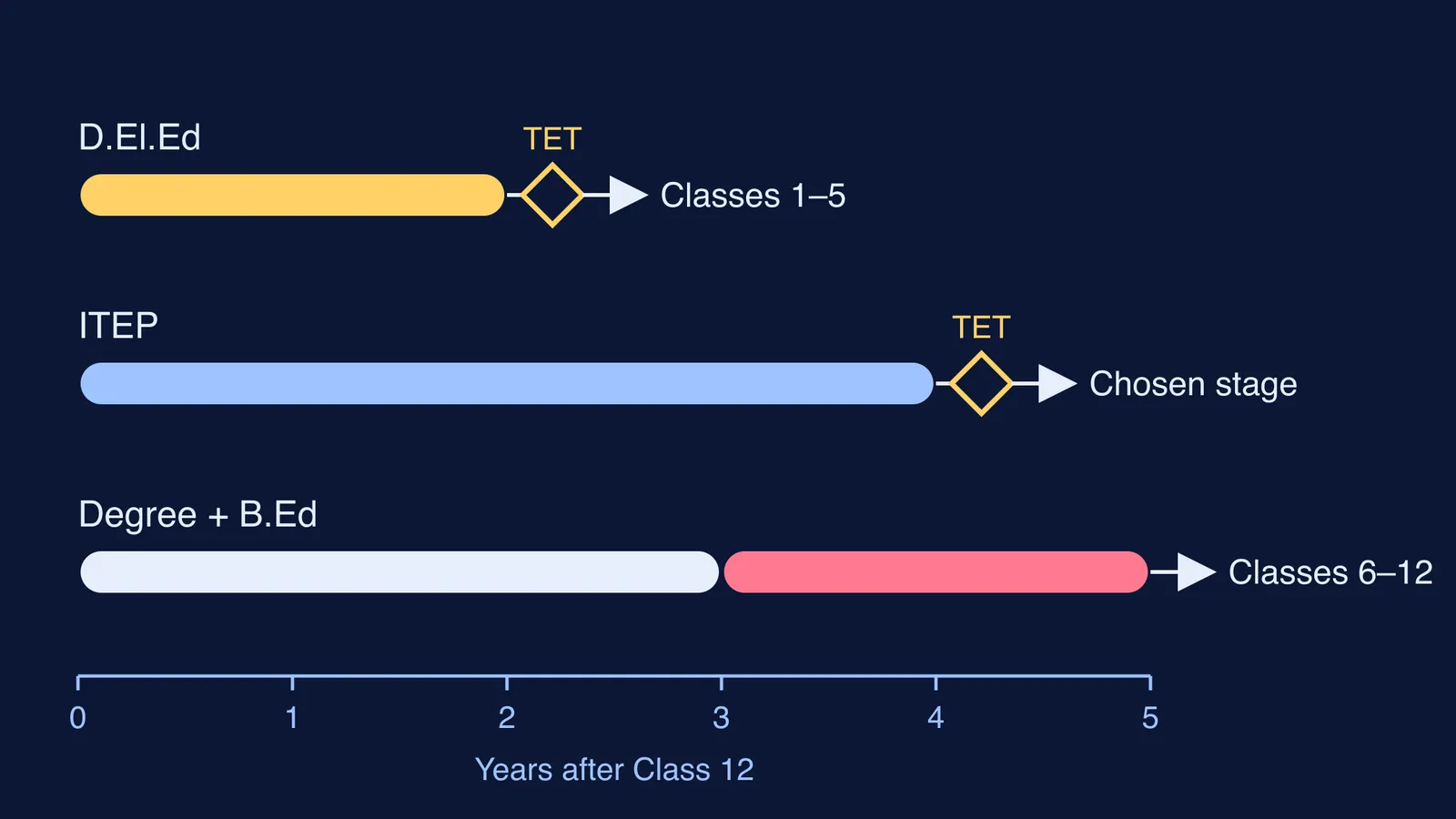
D.El.Ed: two years after Class 12; prepares teachers for Classes 1 to 8; the standard route to Classes 1 to 5.
B.Ed: two years after a bachelor's degree with at least 50% marks; prepares teachers for Classes 6 to 12, under Appendix 4 of the same regulations.
ITEP: a four-year dual-major programme, with education plus a school-stage specialisation as one major and a subject you choose as the other. Admission is through NCET, which NTA conducts for NCTE (NTA public notice, 12 February 2026). Our guide to ITEP and NCET after 12th covers that route.
In June 2018 NCTE let B.Ed graduates teach Classes 1 to 5 if they took a six-month bridge course. In August 2023 the Supreme Court, in Devesh Sharma v Union of India, upheld the Rajasthan High Court's decision striking that down, noting that the D.El.Ed gives the pedagogical training primary classes need (LiveLaw report).
Rules may change: the National Education Policy 2020 says that by 2030 the minimum degree qualification for teaching will be a 4-year integrated B.Ed. Read your state's latest recruitment rules before you choose.
Why do you need TET to teach Classes 1 to 5?
NCTE's notification of 23 August 2010 lists the minimum qualifications for Classes 1 to 5. The main route is Class 12 with at least 50% marks plus a two-year diploma in elementary education, and every route also requires a pass in a Teacher Eligibility Test (TET) (NCTE notification, in the compendium). Only a course recognised by NCTE counts.
The CTET February 2026 information bulletin sets out the central test:
Paper I is for anyone who intends to teach Classes 1 to 5.
It has 150 multiple-choice questions, 30 each in child development and pedagogy, mathematics, environmental studies, Language I and Language II, with no negative marking.
A score of 60% or more is a TET pass.
CTET applies to central government schools such as KVS and NVS; state government and aided schools use the state TET, though a state can choose CTET instead.
Qualifying gives you no right to a job.
Since NCTE changed the rule in 2021, announced in a CBSE public notice, a TET certificate stays valid for life unless the appropriate government notifies otherwise.
Paper I maths and EVS follow the Class 1 to 5 syllabus, but questions can link up to the secondary stage. If your own basics feel shaky, the Fermi Concept Library has a lesson for each concept in physics, chemistry, biology and mathematics, so you can fix the idea before you plan how to teach it.
How do you check that a D.El.Ed college is NCTE-recognised?
Before paying anything:
Confirm on the NCTE website that the institute is recognised for the D.El.Ed course.
Match the name, address and course exactly; a sister institute's recognition does not cover this one.
Ask which schools host the internship. The NCTE norms require an arrangement with at least ten schools.
Ask for the fee in writing. The norms allow only fees set by the affiliating body or state, and no donation or capitation fee.
Your route map from Class 12 to a primary classroom
Score at least 50% in Class 12, or less if your category gets a relaxation under the NCTE norms.
Apply in your state's D.El.Ed admission round.
Complete the two years, including the internship.
Pass TET Paper I: your state TET, CTET, or both.
Apply in state, KVS or NVS recruitment.
Weighing other teaching routes? Read about the physical education teacher course after 12th or how to become a college lecturer in India.