On this page
With a JEE Main score, a state CET rank and a university's own test result, you may hold offers from several kinds of institution at once. Three questions matter more than the label: is the degree valid, how do you get in, and what will four years cost?
What is a deemed university, and is its BTech degree valid?
Under the UGC Act, 1956, a "University" is one established or incorporated by or under a Central, Provincial or State Act (Section 2(f)).
Section 3 of the same Act lets the Central Government, on the UGC's advice, declare an institution "deemed to be a University", after which the Act applies to it as if it were a university.
Section 22 says the right to confer degrees belongs only to these universities, deemed universities and institutions specially empowered by an Act of Parliament. So a BTech from a recognised deemed university is a university degree, just as one from a state university is.
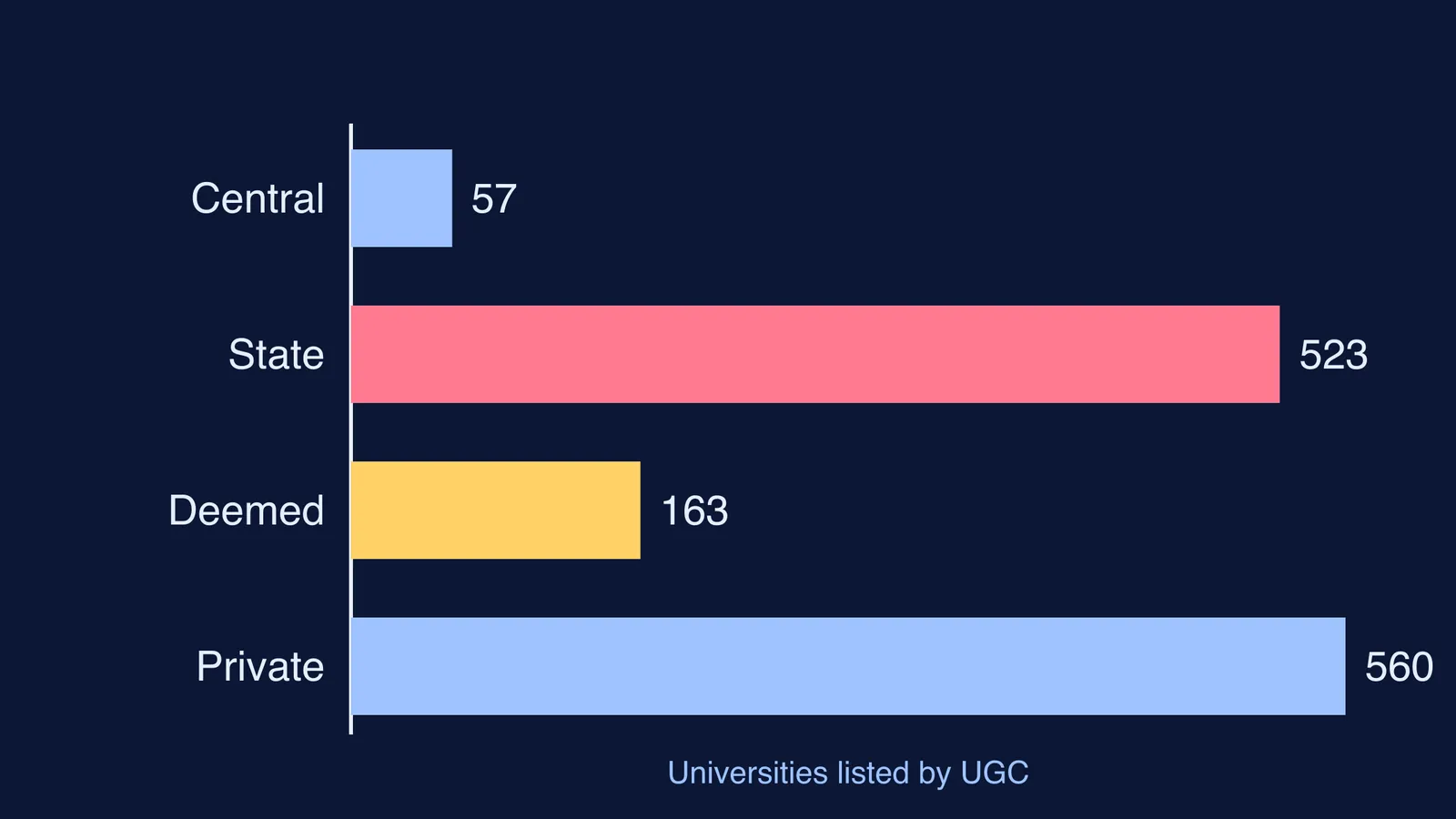
The UGC website currently lists 57 central universities, 523 state universities, 163 deemed to be universities and 560 private universities. One group can hold more than one type: VIT says its Vellore and Chennai campuses come under a deemed to be university, while VIT-AP and VIT-Bhopal are state private universities.
In a November 2017 case about distance-learning engineering degrees, the Supreme Court held in Orissa Lift Irrigation Corp. v Rabi Sankar Patro that deemed universities were not justified in introducing new technical courses without AICTE approval. Check that your programme is approved, not just the institution.
How do admission routes differ for BTech?
Centrally funded institutes. JoSAA runs one seat allocation for 138 institutes in 2026-27: 23 IITs, IISc Bengaluru, 31 NITs, IIEST Shibpur, 26 IIITs and 56 other government-funded technical institutes. Families often call these "central", though they are not on the UGC's central-university list.
State universities and their colleges. You go through the state's entrance test and counselling. In Maharashtra, for example, the State CET Cell conducts entrance tests and the centralised admission process for engineering. Home-state rules can affect which seats you can take.
Deemed and private universities. Read each one's own admission page. Some run their own test: VITEEE admits students to BTech programmes across four VIT campuses. Our guide on how to check a private university before admission lists what to verify first.
Every route starts with a test. If you keep choosing the wrong method on physics or maths questions, the Fermi Problem Library has worked problems with a step-by-step solver that explains the reasoning rather than printing an answer.
Why do fees differ between deemed and state universities?
The main difference is who sets the fee. For the IITs, a 2016 Ministry of Human Resource Development letter set undergraduate tuition at Rs 2 lakh a year from 2016-17, with a full waiver for SC/ST/PH students and for families earning under Rs 1 lakh a year, and a two-thirds remission for families earning Rs 1 lakh to Rs 5 lakh.
States regulate private professional colleges in their own way. Maharashtra's 2015 Act asks its Fees Regulating Authority to judge whether fees are reasonable and to check that they do not amount to profiteering or capitation fees. For a deemed or private university, take the figure from its own official fee notice.
Here is a worked example using the 2016 IIT rule. Four years at Rs 2 lakh is Rs 8 lakh in tuition. A student whose family earns Rs 3 lakh a year pays one-third, about Rs 66,700 a year, or about Rs 2.67 lakh over four years. Fees may have changed since 2016, so use current notices and repeat the sum for every offer:
Tuition for all eight semesters, from the official fee notice.
Plus hostel and mess for four years.
Plus one-time fees and deposits.
Minus any waiver or scholarship you qualify for.
Deemed or state university for BTech: how should you decide?
Before you pay any seat fee:
Find the institution on the UGC list under the right category, and make sure it is not on the UGC's list of fake universities, which named 32 institutions as of February 2026. Our explainer on checking fake university lists walks through it.
For a deemed or private university, confirm the BTech programme has AICTE approval for your year.
List the test, counselling body and deadline for each offer on one page.
Fill in the four-year cost sum above.
Compare the branch, faculty and placement record, and read NIRF data sensibly rather than by overall rank alone.
When you call an admission office, ask:
"Is this BTech programme AICTE-approved for this academic year, and can you share the approval?"
"Which body awards the degree: this institution or an affiliating university?"
"What is the total for all eight semesters, including hostel, mess and deposits, and is it revised each year?"
"What is the refund rule if I withdraw after a later counselling round?"
If preparing for three different tests leaves you unsure where to start, Fermi's AI tutor can work out what you already know and build a plan for the session.