On this page
You check your answer, it looks right, and you move on. Then the paper comes back with the mistake still in it. Often that is confirmation bias. A 1960 experiment with three numbers shows how to beat it.
What is confirmation bias?
Confirmation bias is "the seeking or interpreting of evidence in ways that are partial to existing beliefs, expectations, or a hypothesis in hand", in the words of psychologist Raymond Nickerson's 1998 review in Review of General Psychology.
The term itself is usually credited to the psychologist Peter Wason, who also designed the best-known test of it, the 2-4-6 problem (Peter Cathcart Wason, Wikipedia).
What did Wason's 2-4-6 task show?
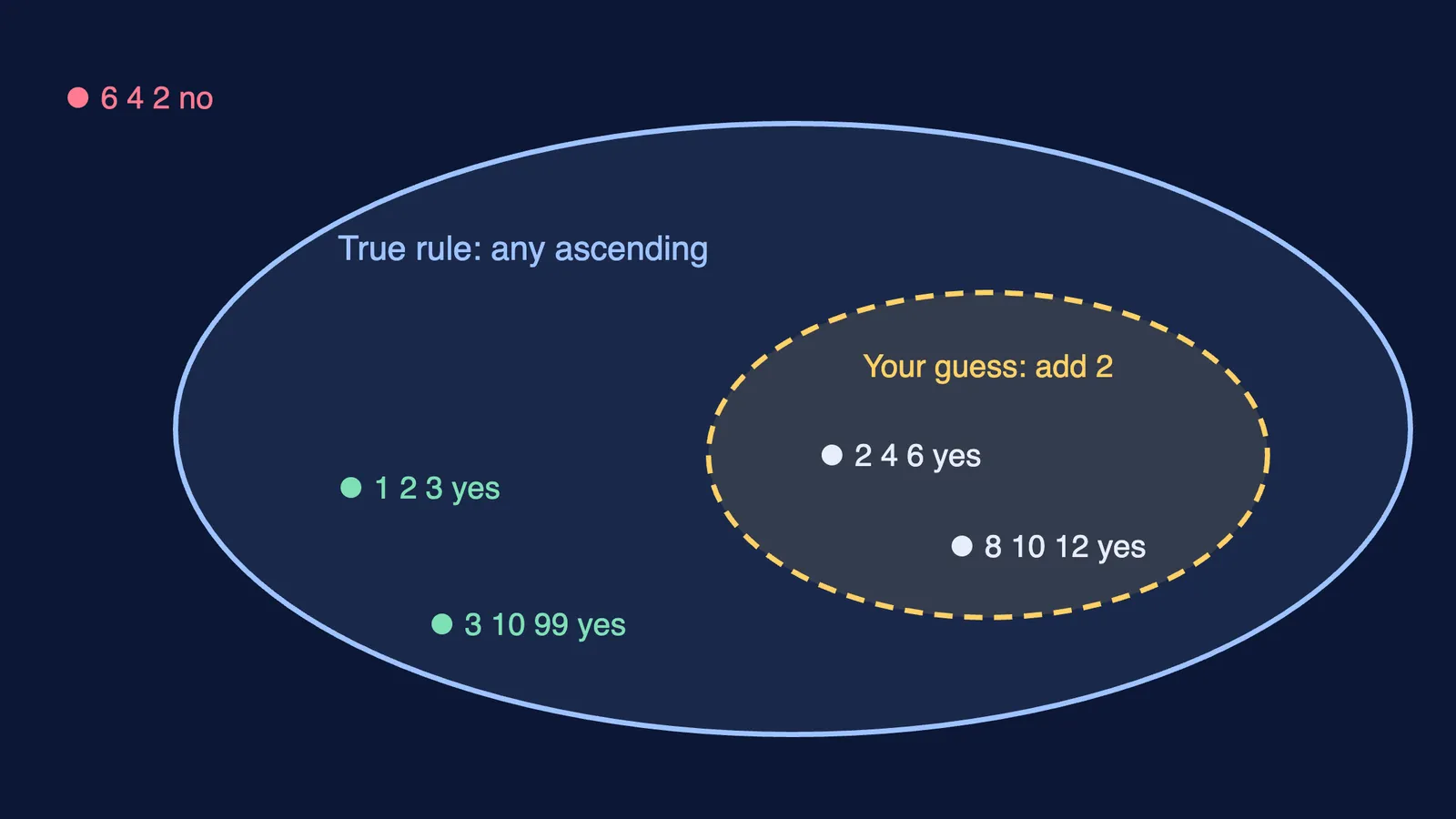
Volunteers were told that 2, 4, 6 fitted a hidden rule. They proposed their own triples, heard whether each fitted, and announced the rule when sure. The rule was simply "any ascending sequence", and most people formed a guess narrower than that and tested only examples of their guess (Peter Cathcart Wason, Wikipedia).
Say you guess "even numbers going up by 2" and try 8, 10, 12 and 20, 22, 24. Every answer is yes, so the guess feels confirmed. But those triples fit both rules, so they can never tell the two apart.
In Wason's 1960 paper in the Quarterly Journal of Experimental Psychology, only 6 of 29 participants reached the correct rule without first announcing a wrong one. The nine who announced two or more wrong rules were, Wason found, unable or unwilling to test their hypotheses.
The useful move is a triple your guess says should fail, like 1, 2, 3 or 3, 10, 99. One yes there breaks the wrong rule in a single step.
The pattern is not only human. A 2026 arXiv preprint adapted the game for eleven large language models and found that they, too, often proposed triples that confirmed their guesses. Prompting them to consider counterexamples raised rule discovery from 42% to 56% on average.
How does confirmation bias hide mistakes in your own solutions?
Rechecking usually means redoing the same steps with the same idea in your head. That is testing 8, 10, 12: it agrees with you because it repeats you.
Take a ball launched at 20 m/s at 30° above the horizontal over level ground (g = 10 m/s² and no air resistance). The range is R = u² sin 2θ / g, which gives 400 × sin 60° / 10, about 34.6 m. Suppose you wrote sin θ instead and got 400 × 0.5 / 10 = 20 m. Redoing the arithmetic gives 20 m again, and the answer feels confirmed.
Now test cases where you already know the answer:
At θ = 90° the ball goes straight up, so the range must be zero. Your formula gives 400 × 1 / 10 = 40 m. Wrong.
Launches at 30° and 60° at the same speed must land equally far away, because the two angles add up to 90°. Your formula gives 20 m and about 34.6 m. Wrong again.
Two quick checks, chosen to make your answer fail, found the error that rechecking never could.
If you cannot see why an answer fails, the Fermi Problem Library has worked problems with a step-by-step solver that explains the reasoning rather than printing an answer, so you can find the step where your method went off.
How do you counter confirmation bias when you study?
Each of these habits is a 2-4-6 move: a test that could say no.
Before checking, ask: what result would show I am wrong? Then look for exactly that.
Test extreme cases: an angle of 0° or 90°, a mass of zero or a very large one, n = 1. Your answer should behave sensibly at the edges.
Check units and rough size. A range in m/s, or a cricket ball thrown 3 km, is a no.
Solve again by a different route: energy instead of forces, or a sketch instead of algebra.
Recheck after a break, when the reasoning you used is less fresh in your head.
For practice sets with no solutions at the back, our guide on how to check your answers when the book has no answer key turns these habits into a routine.
Parents can help: instead of asking "Is it right?", ask "How could we tell if it was wrong?"
If you are not sure which weak spots to test, Fermi's AI tutor works out what you already know and checks understanding as it goes, so you are not the only one choosing which questions to try.
Why does science try to prove itself wrong?
Wason discussed the implications of his results for scientific thinking, and his 1960 paper cites Karl Popper's The Logic of Scientific Discovery (Wason, 1960). Science guards against the bias with the same kind of test: control groups, blinding and predictions that could fail. Our explainer on the placebo effect, trials and blinding shows one such design, and what scientific temper means under Article 51A(h) puts the habit in everyday terms.
Next time an answer looks right, ask yourself the 1, 2, 3 question first.