On this page
If you have just finished Class 10 and you would rather open up a computer than write an essay, a hardware and networking course is a direct route to hands-on technical work. There are three main doors: a one-year ITI trade, a three-year polytechnic diploma, and short certificates. Here is how to choose.
What hardware and networking courses can you do after 10th?
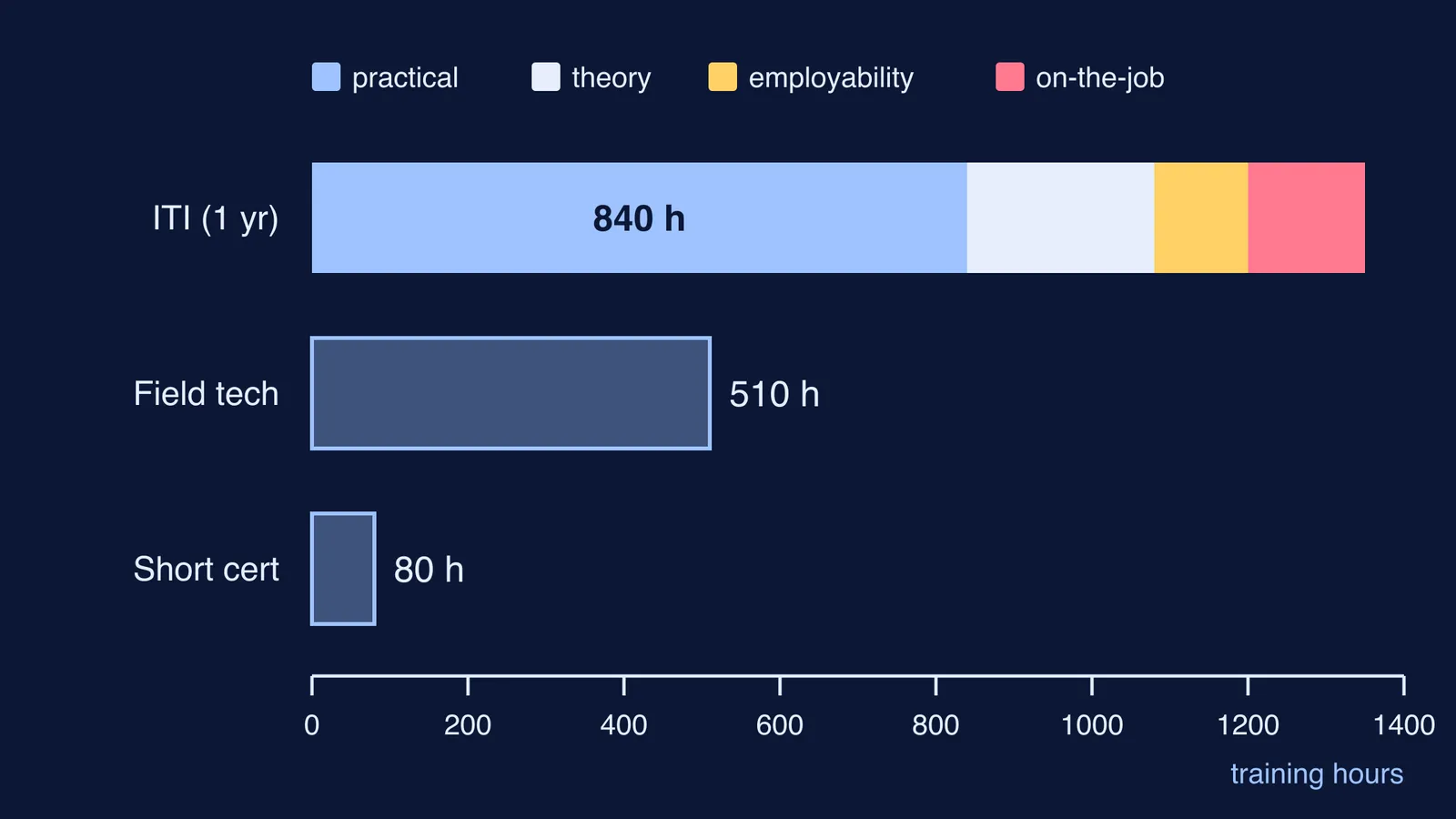
ITI trade. The Directorate General of Training (DGT) runs Computer Hardware & Network Maintenance (CHNM) as a one-year trade with 1,200 hours of training plus 150 hours of on-the-job training or a group project (DGT curriculum, revised March 2023). Entry needs a Class 10 pass with science and mathematics (or a vocational subject in the same sector), the minimum age is 14, and one batch is 24 trainees. Passing the All India Trade Test earns the National Trade Certificate (NTC), issued by DGT.
Polytechnic diploma. A three-year diploma in computer science, IT or electronics engineering after Class 10 is a recognised route; the same DGT curriculum lists one from AICTE or a state board of technical education among the qualifications for ITI instructors. It takes three years instead of one.
Short certificates. NIELIT lists a Certificate course in PC Assembly and Maintenance for Class 10 pass students that runs for 80 hours (NIELIT short-term courses). Its certificates in PC, Hardware & Networking and in Network Administration, also 80 hours each, ask for Class 12.
What does a computer hardware and networking technician do?
The National Qualifications Register describes a field technician for computing and peripherals as someone "responsible for visiting customer premises to install and carry out repair and maintenance of a desktop computer", who also installs and troubleshoots peripherals (NQR, Field Technician Computing and Peripherals).
The CHNM syllabus shows the tasks behind that. Trainees learn to assemble and repair desktops and laptops, install Windows and Linux, back up and recover data, set up printers and scanners, crimp and punch network cables, assign IP addresses, protect a network from attacks, and configure Windows and Linux servers (DGT curriculum).
DGT's description of a network administrator includes testing communications hardware and software, monitoring system performance, training users and helping them solve data communication problems. The same document lists where an NTC can lead: technician, then senior technician, supervisor and manager; an apprenticeship leading to the National Apprenticeship Certificate; or the Crafts Instructor Training Scheme to teach in ITIs.
The CHNM syllabus opens with electrical safety, power supplies and voltage regulators, so Class 10 electricity comes up early. If current, voltage or resistance still feel shaky, the Fermi Concept Library has a lesson for every concept in physics, mathematics and computing, so you can fix the gap before the course starts.
How do you judge a hardware and networking course?
Start with the hours, because this is a hands-on job. In the DGT CHNM curriculum, 840 of the 1,200 core hours are trade practical, with 240 hours of theory and 120 of employability skills (DGT curriculum). That is 70% practical, a useful yardstick for any course you compare it with.
Run every option through these six questions:
Who certifies it? An NTC from DGT, or a qualification with a code on the National Qualifications Register, can be checked by an employer. A certificate signed only by the institute is much harder to verify.
How many hours in total, and how many are practical on real machines?
How many trainees share one lab? DGT sets 24 per unit for CHNM.
Is there on-the-job training, an industry visit or an apprenticeship tie-up?
Does the syllabus cover networking (cabling, IP addressing, servers) or only PC repair?
Will the institute put you in touch with last year's trainees?
For more on reading government skill certificates, see our guide on whether national skill certifications help you get a job.
Which route fits you? A worked example
Three Class 10 students, three different answers:
Aman passed with science and maths and wants to start working within a year. The CHNM ITI fits: one year, an NTC, and the option of an apprenticeship afterwards.
Sana is strong in maths and may want engineering later. A three-year polytechnic diploma is the longer route; weigh it against Class 11 science.
Ravi has a seat in Class 11 but wants to try hardware work before committing. An 80-hour NIELIT certificate in the summer is a short test; it does not replace a full qualification.
One caution for all three: some industry qualifications are pitched as a next step, not a first course. The ESSC Field Technician Computing and Peripherals qualification (510 hours, NSQF Level 4) lists Class 12, or Class 10 plus an NTC or NAC and two years of experience, among its entry routes (NQR). For a Class 10 student, that usually means an ITI first, then this.
If you are a parent weighing this choice against Class 11, our guide for parents whose child wants ITI or polytechnic instead of Class 11 walks through that conversation. Pick two courses near you, ask the six questions, and compare the answers.