On this page
Two offers in hand feels like good news until you have to pick one by a deadline. Someone else's ranking can't settle it, because the right choice depends on your course, your family's budget and your plans. A side-by-side sheet puts the trade-offs where you and your parents can see the same facts.
What should you compare between two college offers?
Use six rows and two columns, and fill every cell before discussing.
Course: the exact programme and branch, not the college's name. Would you take this course if the college were unknown?
Total cost: tuition for all years plus hostel, mess, travel, books, a laptop and one-time fees.
Location: distance from home, travel time and cost, language and climate.
Hostel: a guaranteed first-year room, sharing, mess and rules.
Curriculum: the actual syllabus, electives, labs, internships and branch-change rules.
Your goals: a job, higher studies, research or a government exam. Which offer moves you closer?
How do you work out the real total cost of a college?
Ask for the fees for the whole programme, not just the first year. Under the UGC notification on refund of fees and non-retention of original certificates, institutions must publish the total fees payable for an entire programme on their website and in their prospectus. It bars them from collecting fees more than one semester or year in advance, and says caution money and security deposits must be refunded in full.
If you plan to borrow, look at PM-Vidyalaxmi. The Press Information Bureau says the scheme gives collateral-free, guarantor-free education loans to students admitted on merit to listed institutions. For families with an annual income of up to Rs 8 lakh, it provides 3% interest subvention on loans of up to Rs 10 lakh, for up to one lakh new students a year who get no other scholarship or subvention. The PM-Vidyalaxmi portal says the eligible institutions are chosen using NIRF rankings, so check whether each of your colleges is on the list.
A worked example: scoring two offers side by side
These numbers are made up. Meera has two engineering offers:
Offer A: electronics at a government college in her home city. Tuition Rs 1.2 lakh a year, plus a Rs 2,000 monthly bus pass for 10 months a year while she lives at home: about Rs 5.6 lakh over four years.
Offer B: computer science at a private university in another state. Tuition Rs 3.5 lakh plus Rs 1.4 lakh for hostel and mess each year: about Rs 19.6 lakh over four years.
She follows four steps:
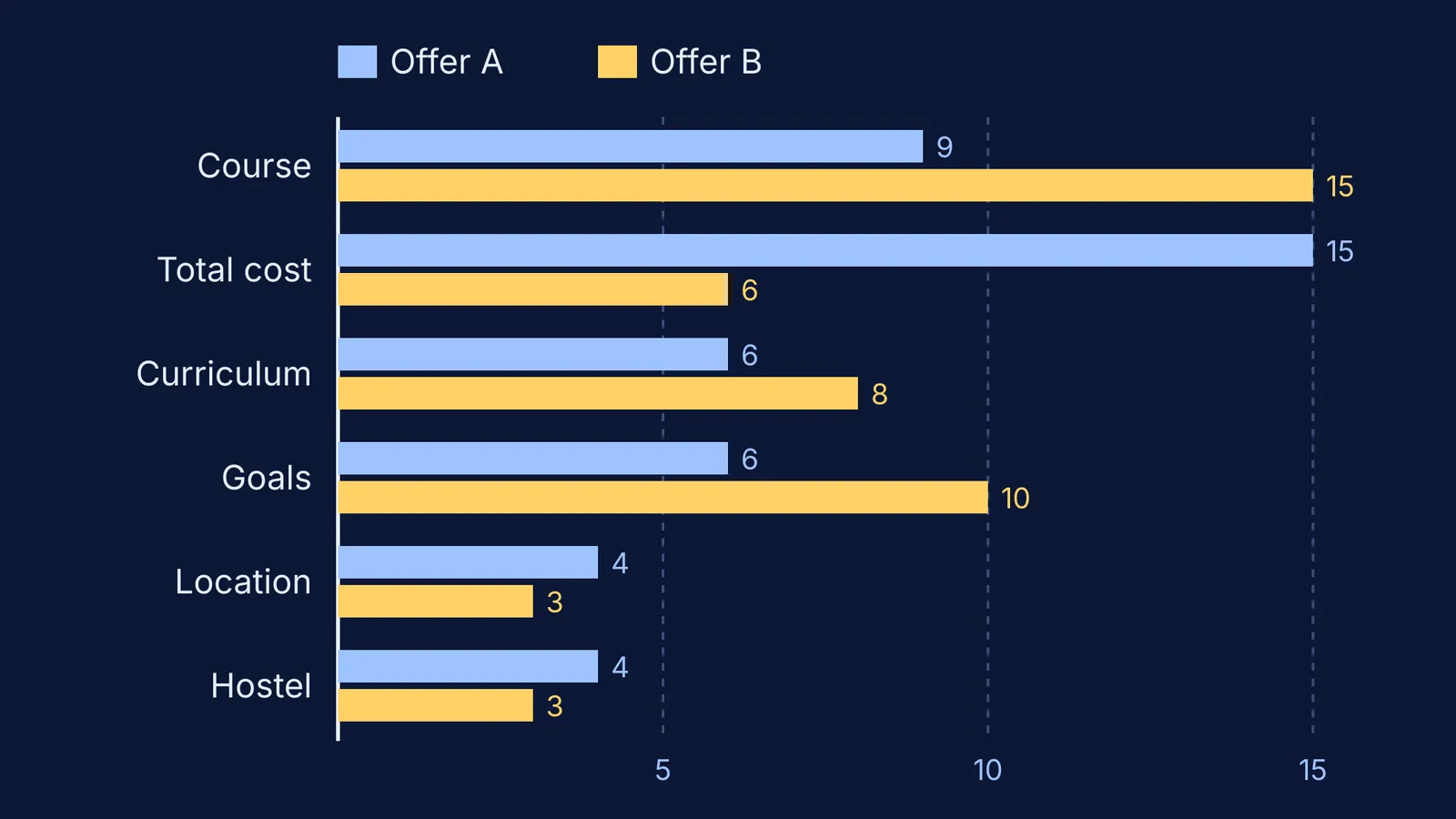
Give each row a weight from 1 to 3 before looking at the offers. Meera gives course and cost 3 each, curriculum and goals 2 each, and location and hostel 1 each.
Score each offer from 1 to 5 on each row. Course: A 3, B 5. Cost: A 5, B 2. Curriculum: A 3, B 4. Goals: A 3, B 5. Location: A 4, B 3. Hostel: A 4, B 3.
Multiply each score by its weight and add up the results. Offer A scores 44 and Offer B scores 45, out of 60.
Read the gap, not just the winner.
A one-point gap is a tie, but the sheet shows the real choice: a better fit for her course and goals at roughly Rs 14 lakh more. Can the family pay that, or repay a loan comfortably?
What should you check before paying the acceptance fee?
Is the institution recognised? UGC publishes a state-wise list of fake universities; check that neither college is on it.
What is the refund rule? The UGC refund notification sets out five tiers: a full refund, minus a processing charge of up to 5% (capped at Rs 5,000), if you withdraw 15 or more days before the formally notified last date of admission, then 90%, 80% and 50%, and nothing more than 30 days after that date. Eligible refunds are due within 15 days of your written application.
Who keeps your originals? The notification says the college checks them in front of you and hands them straight back.
If a seat comes through counselling, see our guide to JoSAA counselling rounds, choices and documents.
How do you decide when the scores are close?
Use the gap to start a family conversation: "Both offers scored about the same. B fits what I want to study, but it costs about Rs 14 lakh more. Can we look at the loan numbers together before we decide?"
Then read each course's syllabus. If it lists topics you have never met, try the lessons on two or three of them in the Fermi Concept Library, which covers every concept in physics, chemistry, biology, mathematics and computing. It is a quick way to test your interest in a branch before committing four years.
If the hostel row worried you, read how to set up studying in a hostel or PG. For what changes once classes start, see your first semester at science or engineering college.
If the decision is causing real distress, talk to someone you trust or call Tele MANAS on 14416.