On this page
Articleship is where CA students stop reading about audits and start doing them. You sign a deed of articles with a practising chartered accountant, your principal, and work in their office for two years. Here is what the current rules say, what the work looks like, and how to choose a firm.
When does CA articleship start?
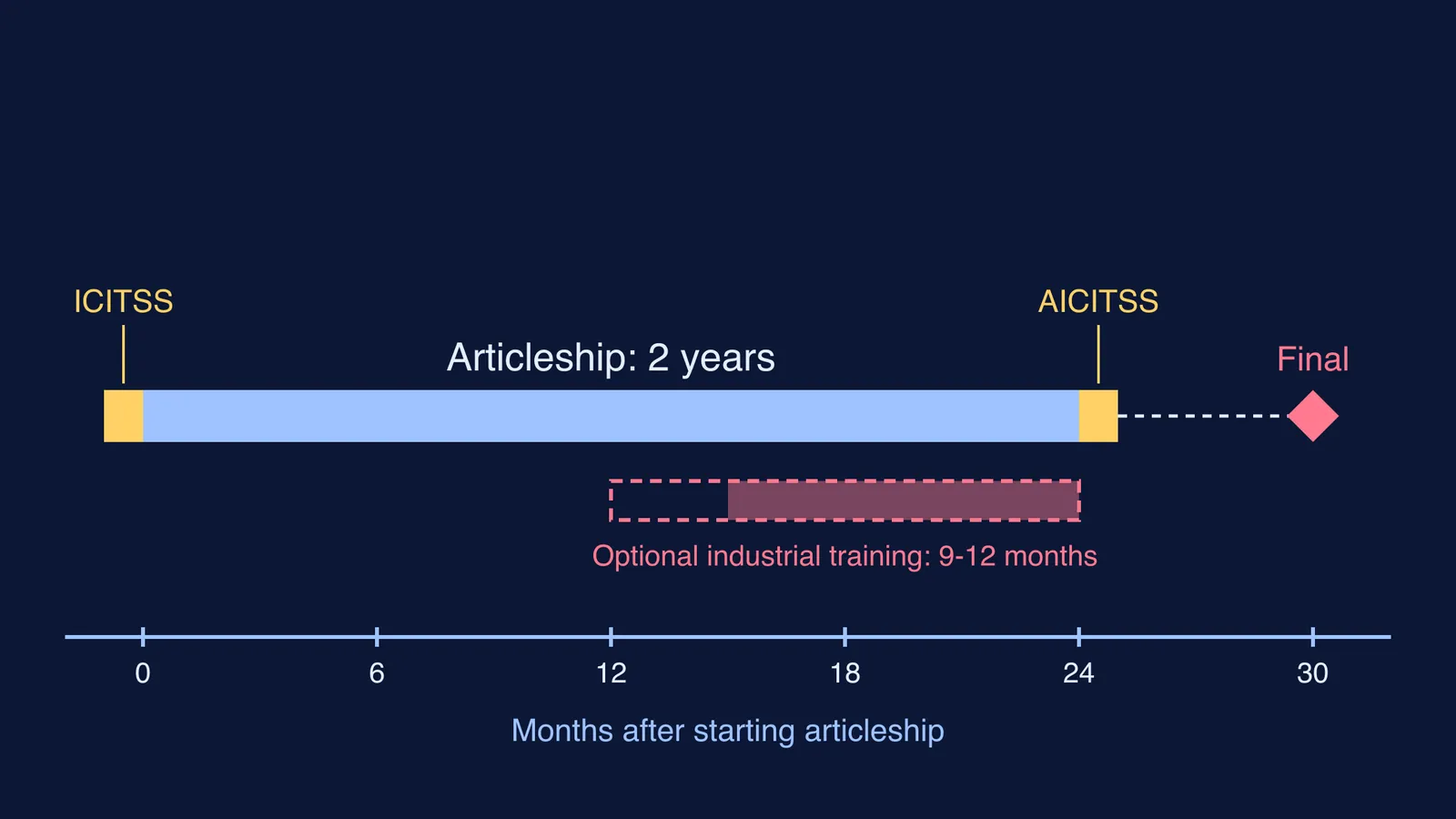
Under ICAI's current scheme, launched on 1 July 2023, you can start practical training after passing both groups of the Intermediate exam and completing the four-week Integrated Course on Information Technology and Soft Skills (ICITSS), according to the ICAI FAQ on the current scheme. Practical training lasts 2 years. After it, you complete the four-week Advanced ICITSS, and you can sit the Final only if your training was completed six months before the first day of the exam month. Students who registered as articled assistants on or before 30 June 2023 serve three years under the older rules, the Training Guide notes.
A worked example: you join a firm on 1 August 2027. With no excess leave, your two years end on 31 July 2029. A January 2030 Final would need training finished by 1 July 2029, so your first chance is a Final held in February 2030 or later, with Advanced ICITSS done in between. Excess leave pushes every date back. ICAI's education and training chart shows the whole sequence.
What does an articled assistant actually do?
The ICAI Training Guide lists categories of work from assurance, internal audit and insolvency to direct and indirect tax, corporate laws, IT and compliance. It treats accounting and auditing as the core and says it is desirable to be reasonably exposed to at least one other area too.
In practice that means:
On an audit, reading the client's previous audit reports, visiting the client where possible, and preparing working papers that a senior reviews with you.
On tax work, studying a client's past assessments and preparing draft tax returns.
In the office, in-house sessions on statutory accounts and internal controls.
The rules protect your time. Under Regulation 60 and the Council's guidelines, working hours are normally 35 a week, excluding lunch; only in exceptional circumstances can they reach 45, with compensatory leave or time off for the extra hours, per the Training Guide. You get 12 days of leave in each year under Regulation 59. You cannot attend college during working hours, and any other course needs ICAI's permission through Form 112.
For industry experience, you can spend 9 to 12 months of the last part of training as an industrial trainee, at a minimum stipend of ₹15,000 a month, says the ICAI FAQ.
How much is the CA articleship stipend?
Regulation 48 requires your principal to pay a minimum monthly stipend that depends on the city's population and your year of training. For the two-year scheme, the ICAI FAQ updated on 29 July 2026 lists ₹5,000 in the first year and ₹6,000 in the second in cities of 20 lakh people or more. The same FAQ lists ₹4,000 and ₹5,000 for cities of 5 to 20 lakh, and ₹3,000 and ₹4,000 below 5 lakh.
These figures were published as a draft amendment in the Gazette of India on 25 June 2026, with public comments invited. The draft comes into force only on final publication in the Gazette, and the Training Guide says the revised rates apply only once Regulation 48 is changed. We could not find a final notification as of November 2026, so check icai.org for the rates in force before you sign. The stipend must be paid by cheque or into a bank account in your own name.
How do you choose a CA firm for articleship?
Start from where you want to be after qualifying: audit or practice means a firm with real audit clients; tax means steady assessment work; industry means a principal who supports industrial training, which you must flag at least three months ahead, per the Training Guide.
Questions to ask at the interview:
What will I work on in my first six months, and who reviews my work?
How is the work split between audit, tax, accounting and compliance?
Do you run in-house training sessions?
What are normal office hours, and how is extra time compensated?
What stipend do you pay, and how?
Would you allow secondment or industrial training later?
Can I speak to someone doing articles here?
If you are earlier on the path and the business maths and statistics in the Foundation Quantitative Aptitude paper are where you stall, the Fermi Concept Library has a lesson for every concept in mathematics, so you can fill one gap at a time.
Still deciding? Read our guide to chartered accountancy for PCM students, compare it with the CMA course after Class 12, and see how BCom and BCom Honours differ if you plan to study alongside.