
On this page
If you like the part of a chemistry practical where you finally get a number, such as the end point of a titration or the mass of a precipitate, analytical chemistry is the job built around that moment. Here is what the work involves, which degrees employers ask for, and how to test the fit early.
What does an analytical chemist do?
According to the US Bureau of Labor Statistics, analytical chemists identify elements and compounds in a substance to determine its structure, composition and nature.
In practice that means answering questions like these: how much of the active ingredient is in this tablet? Is there lead in this water? Is this honey adulterated? The UK careers service Prospects describes the job as analysing substances so that products are safe and effective and pollutants are identified and controlled.
Much of the work runs on instruments rather than test tubes. Prospects lists gas chromatography (GC), high performance liquid chromatography (HPLC), ion chromatography, liquid chromatography-mass spectrometry (LC-MS), inductively coupled plasma mass spectrometry (ICP-MS) and spectroscopy. Chromatography separates a mixture into its parts; spectroscopy and mass spectrometry identify and measure each part.
The same Prospects profile lists where analytical chemists work: pharmaceutical and biotechnology companies, contract research organisations, environmental agencies, water companies, chemical manufacturers, food and drink producers, forensic science providers, universities and government laboratories. In India, many testing laboratories are accredited by NABL, a constituent board of the Quality Council of India, to the international standard ISO/IEC 17025. If you work in an accredited lab, you work to that standard's procedures.
What qualifications do you need to become an analytical chemist?
The Bureau of Labor Statistics gives a bachelor's degree in chemistry or a related field as the typical entry-level education. Prospects says you will usually need a good degree in chemistry or a closely related subject such as applied or analytical chemistry or biochemistry.
For an Indian student, a common route is a BSc in chemistry, often followed by an MSc. Research and method-development roles tend to ask for more. If you are weighing the MSc against starting work, our guide on whether to do an MSc or take a job after a BSc in chemistry sets out the trade-offs.
Some roles add a certificate on top of the degree. To sit the FSSAI Food Analyst Examination, for example, you need a bachelor's, master's or doctorate in chemistry or a listed related subject from an Indian university, plus at least three years' experience in food analysis after that degree. The certificate comes after time at the bench.
How does an analytical chemist get a result?
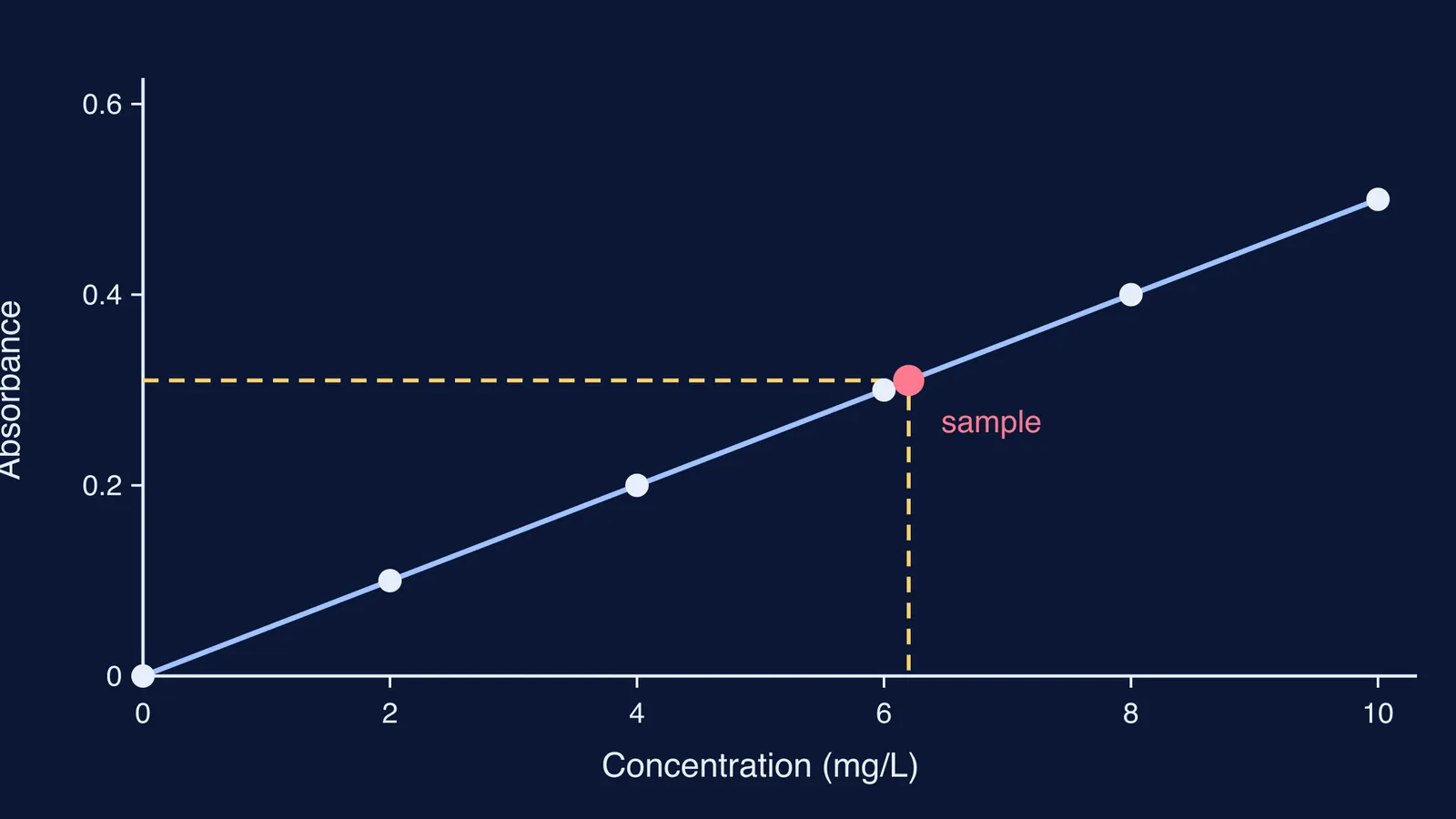
Much of the work comes down to one idea: compare the unknown with standards you made yourself. Here is how a spectrophotometer reading becomes a reported result. The numbers are illustrative.
Make standard solutions of known concentration: 0, 2, 4, 6, 8 and 10 mg/L.
Measure the absorbance of each. Under the Beer-Lambert law/Spectroscopy/Electronic_Spectroscopy/Electronic_Spectroscopy_Basics/The_Beer-Lambert_Law), A = εlc, so absorbance rises in a straight line with concentration.
Fit the line. Say it comes out as A = 0.050 × c, with c in mg/L.
Your sample, diluted ten times, reads A = 0.31. So c = 0.31 ÷ 0.050 = 6.2 mg/L in the diluted solution.
Undo the dilution: 6.2 × 10 = 62 mg/L in the original sample.
Record everything: the standards, the dilution, the instrument and who ran it, so someone else can check your number.
The step students most often skip is the last multiplication. If dilution factors and unit conversions trip you up, the Fermi Problem Library has worked problems with a step-by-step solver that explains the reasoning rather than printing an answer.
Which skills do employers expect?
Prospects lists strong analytical and technical problem-solving skills, clear spoken and written communication, a commitment to quality, data integrity and regulatory compliance, IT skills, and knowledge of GLP (good laboratory practice) and GMP (good manufacturing practice). Turned into a checklist you can start on now:
Accuracy: can you repeat a titration and get readings that agree?
Units and significant figures, handled without thinking.
Lab notes that a stranger could follow.
Spreadsheets: plotting a calibration line and reading off an unknown.
Concepts behind the instruments: equilibrium, light absorption, polarity, mole calculations.
If one of those concepts is shaky, the Fermi Concept Library has a lesson for every concept in chemistry, each with its place in the map.
How can you test this career before choosing a degree?
Treat every school practical as analysis: write down the method, readings, average and spread. Our guide on titration end points and practical vivas helps here.
In Class 12, read job listings for analytical chemists and note which instruments and degrees come up again and again.
In your BSc, ask for time on the department's UV-visible spectrophotometer or HPLC, and look for summer internships in testing or quality-control labs.
Compare neighbouring paths before you commit, using our map of careers for people who love chemistry.