
On this page
It is 10:40 pm, the lights are off, and your 16-year-old appears at your door: "Can I tell you something?" At dinner you got one-word answers. This is common, it has an explanation, and you can make good use of it without costing them tomorrow's sleep.
Why does my teenager want to talk only late at night?
Part of the reason is biology: the body clock moves later during puberty. A study that followed 94 young people every six months for 2.5 years found that each age group fell asleep later, and that dim-light melatonin onset (the evening signal that the body is getting ready for sleep) came later as they grew older (Crowley et al., PLOS ONE, 2014).
A review of sleep in adolescence also describes research suggesting that sleep pressure builds more slowly in more mature teenagers, "such that more mature adolescents could stay awake later" (Colrain and Baker, Neuropsychology Review, 2011). At 10:30 pm your teen may feel wide awake while you are running out of energy.
The rest comes from the setting. Late at night:
The house is quiet, and siblings, phones and homework have stopped competing for attention.
In dim light nobody has to keep eye contact, so hard things are easier to say.
Nothing is due straight afterwards, so it does not feel like an interview squeezed in before tuition.
Why are these late-night talks worth protecting?
Most of what parents know about a teenager's life comes from what the teenager chooses to tell them. In a study of 703 14-year-olds in Sweden and their parents, parents' knowledge "came mainly from child disclosure" rather than from their own tracking (Stattin and Kerr, Child Development, 2000).
How you react decides whether they come back. A study of 982 young people found that negative reactions from parents went with teens feeling more controlled and less connected, which predicted more secrecy; positive reactions predicted more sharing (Tilton-Weaver et al., Journal of Adolescence, 2010). So the late talk matters less for what you fix tonight than for whether they knock again next week.
How do you have a bedtime talk without wrecking sleep?
The American Academy of Sleep Medicine says teenagers aged 13 to 18 should sleep 8 to 10 hours per 24 hours on a regular basis (Paruthi et al., Journal of Clinical Sleep Medicine, 2016).
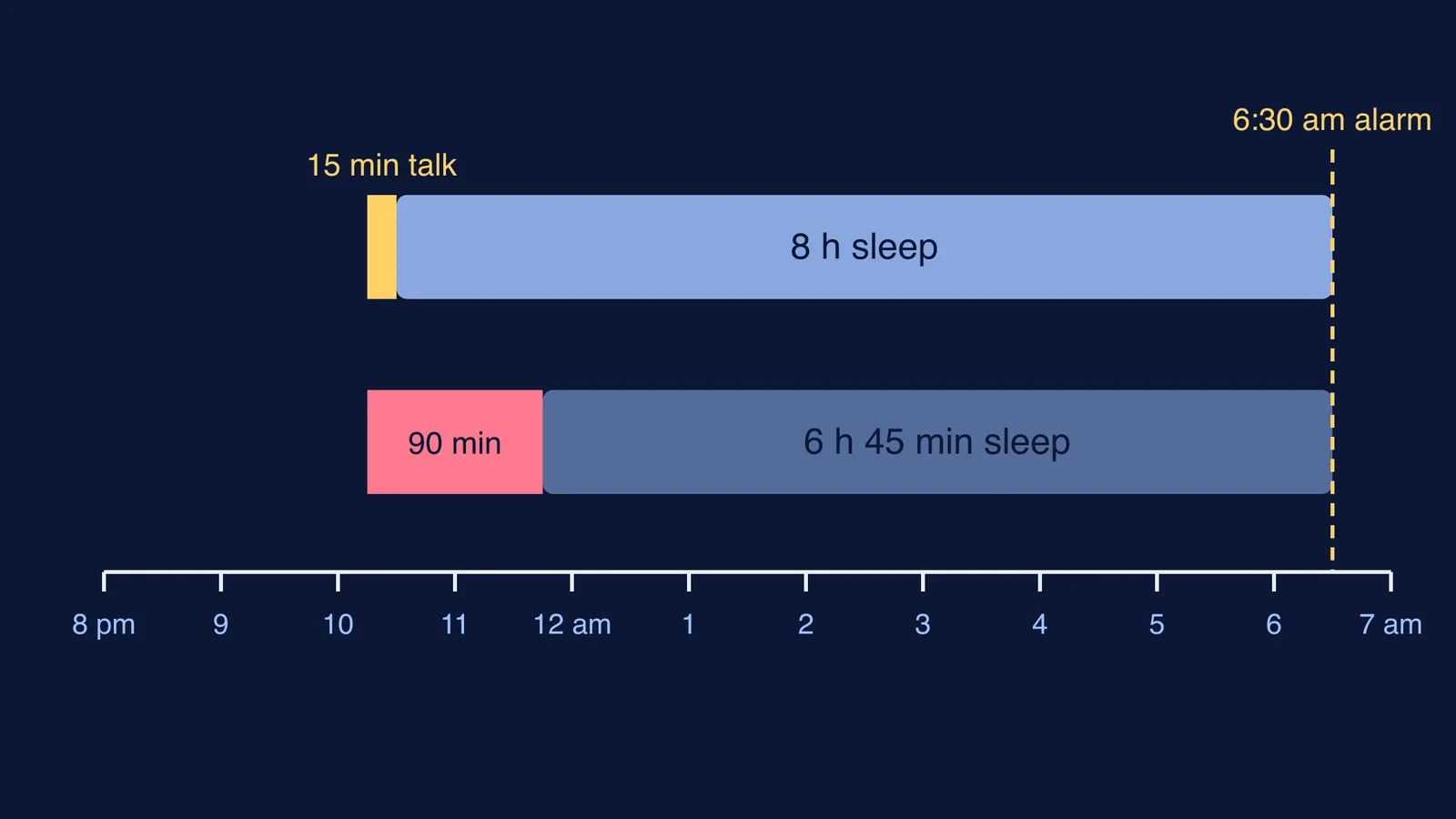
Here is a worked example. Your daughter's school alarm is at 6:30 am, so lights-out at 10:30 pm gives her 8 hours, the minimum. A talk from 10:15 pm to 10:30 pm costs nothing. If the same talk runs to 11:45 pm, she gets 6 hours 45 minutes of sleep. Do that three nights a week and she is losing close to 4 hours of sleep every week.
A simple plan for the evening:
Stop and sit down. Put your phone face down. Do not stand in the doorway.
Listen first. Reflect back what you hear ("So the group chat turned on you today") before giving any advice.
Keep tonight small. Ask "Do you need me to just listen tonight, or help to fix something?"
Close kindly and book a time. Name a specific time tomorrow, then keep it.
If your teen is often awake past midnight, our guide to helping a night-owl teen with an early school start covers how to shift the routine gently.
What can you say to end the talk and keep the door open?
The aim is to end tonight's talk while making it clear you want to hear the rest. Try:
"I'm really glad you told me. I want to hear all of it properly, not half-asleep. Can we pick this up at 7 tomorrow?"
"Tonight, is there one thing that would help you sleep? We'll sort the rest tomorrow."
"You don't have to finish the whole story now. I'm not going anywhere."
Then follow through. A short message the next afternoon ("Still on for our chat after dinner?") shows them the promise was real. Some teenagers talk more easily side by side, so try the second talk during a drive. See why car rides work for conversations with teens. If the talk is about studies, read how to listen when your teen vents about studies. If they are worried about a chapter they cannot get started on, Fermi's AI tutor can work out what they already know and build a plan for the session, so tomorrow starts with a clear first step.
Some things cannot wait until tomorrow. Tele MANAS is a free, 24x7 national helpline launched by the Ministry of Health and Family Welfare, on 14416 or 1800-891-4416 (IIT Kanpur Centre for Mental Health and Wellbeing).
Tonight, try one thing: listen for 15 minutes, then say "Tomorrow at 7?" and turn up.