On this page
The score card arrives, the number is lower than the mock tests promised, and the house goes quiet. Before anyone decides what it says about your child, know what the number measures, what is still open, and what to say tonight.
What does a JEE Main percentile actually mean?
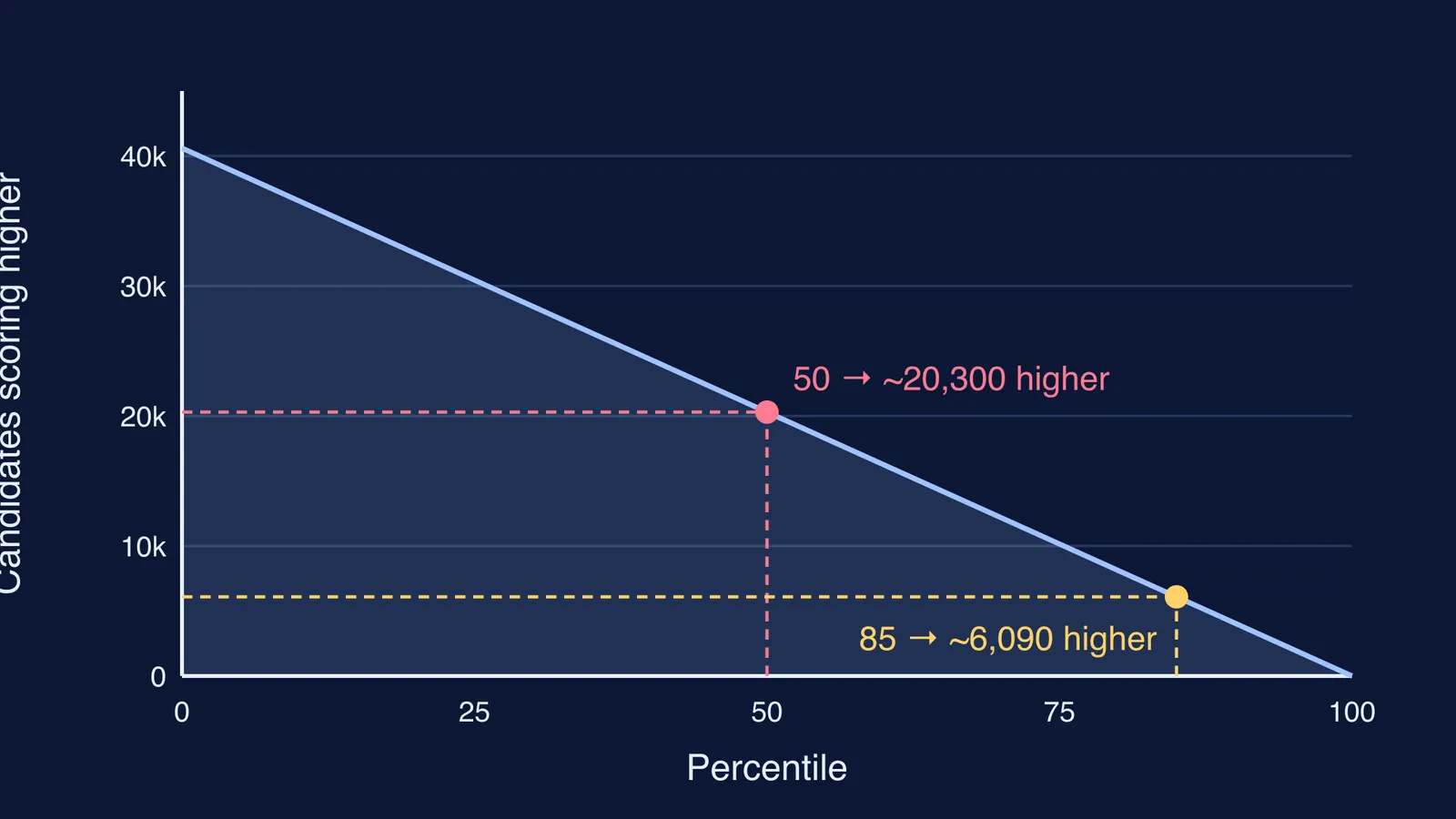
A JEE Main percentile is the percentage of candidates in your shift who scored equal to or below you, as defined in NTA's JEE (Main) 2027 Information Bulletin (Appendix IV). The bulletin states plainly that the percentile score is not the same as the percentage of marks obtained. It is worked out separately for each shift, so the topper of every shift gets 100, and it is calculated to seven decimal places to reduce ties.
Here is a worked example using a shift size from the bulletin's own illustration, where 40,603 candidates appeared in one shift. If your teen's percentile is 85, then 85% of that shift scored at or below them, and about 15%, roughly 6,090 students, scored higher. At 95 percentile, about 2,030 scored higher. For the full method, read our explainer on how JEE Main percentile and shift normalisation work.
Is a low Session 1 percentile the end of the road?
No. NTA's public notice of 24 October 2026 confirms JEE Main 2027 has two sessions, in January and April 2027. The Information Bulletin says that for candidates who sit both, the better of the two total NTA scores is used for the merit list. A weak January result can therefore be replaced, not averaged in.
Three more facts from the same bulletin are worth knowing:
The Common Rank List is declared only after Session 2.
To be eligible for JEE (Advanced) 2027, a candidate must be among the top 2,50,000 successful candidates (all categories) in the B.E./B.Tech paper.
There is no re-evaluation or re-checking of the result, so energy is better spent on preparation than on appeals.
Our guide to planning your year around JEE Main's two sessions covers the calendar side.
What are the options besides Session 2?
JEE Main is one route, not the only one. The bulletin notes that JEE Main scores may also be used by other central and state government bodies under their own rules, and that institutions outside the centralised seat allocation process prepare their own rankings from JEE Main performance and other criteria they set. State engineering entrance exams and university tests run on their own calendars. List together every exam your teen is eligible for, and check each date on the official website, not in forwarded messages.
What should a parent say after a disappointing result?
Keep the first conversation short, calm and free of comparisons. A script you can adapt:
"I saw the result. How are you feeling about it?" Then listen, without fixing.
"This is one shift, and the better of your two sessions is what counts. Nothing is decided yet."
"You don't need a plan tonight. Let's look at it together on Saturday."
"Whatever happens with this exam, I'm on your side."
Avoid "Sharma ji's son got 99", "we spent so much on coaching", or sharing the score with relatives before your teen is ready.
Letting worry out can help. In a study published in *Science*, Gerardo Ramirez and Sian Beilock found that a brief exercise, writing about worries over an upcoming exam, helped students do better on it (Ramirez and Beilock, 2011). Trying a few minutes of writing before a mock costs nothing.
A two-week reset before Session 2
Days 1 to 3: rest, sleep and normal meals. No mocks.
Days 4 to 5: go through the response sheet and sort every lost mark into one of three buckets: did not know the concept, used the wrong method, or careless slip under time pressure.
Days 6 to 10: work on the biggest bucket first. Concept gaps need re-learning from the idea up; wrong-method errors need worked problems where each step is explained.
Days 11 to 14: one full mock under exam timing, then compare the bucket counts with the first paper.
For concept gaps, the Fermi Concept Library has a lesson for every concept in physics, chemistry and mathematics. For wrong-method errors, the Fermi Problem Library has worked problems with a step-by-step solver that explains the reasoning rather than printing an answer.
When should you get outside help?
Sadness after a result is normal. If it does not lift, help is a phone call away: Tele MANAS is a 24x7 tele-mental health service on the toll-free number 14416, according to the Health Ministry's launch announcement.
Our guide to exam stress in teenagers and when to get help has more on the signs to watch.
This weekend, sit with your teen, sort the lost marks into the three buckets, and pick the first one to work on together.