On this page
Your child says they studied for three hours. But what got done? An hour target measures time in the chair, not learning, and three hours fill easily with rereading and highlighting.
Should you set study targets in hours or topics?
Topics, broken into questions. Hours help you find time in the day, but they do not show whether that time worked.
The clearest evidence comes from a 2005 study by E. Ashby Plant, K. Anders Ericsson and colleagues, titled "Why study time does not predict grade point average across college students". They found that the amount of study only became a significant predictor of cumulative grade point average once the quality of study and earlier performance were taken into account.
In Maria Theobald's study in the British Journal of Educational Psychology, 231 university students reported their study time and study strategies every day for 30 days. More time did help, but on days they planned, checked their progress, concentrated well and procrastinated less, they needed less time to reach their goals. Negative mood was especially high on days of many hours with low concentration.
Both studies are of university students, so treat them as a strong hint rather than a rule.
Why do hour targets reward sitting rather than learning?
An hour target is met when the clock runs out, whatever happened in between, so it quietly rewards the easiest activities. A large review of study techniques by John Dunlosky and colleagues (2013) rated rereading and highlighting as low utility, and practice testing and spreading study out over time as high utility. Rereading fills an hour comfortably; testing yourself is harder, so a timer gives no reason to choose it.
There is a confidence trap too. In Roediger and Karpicke's 2006 experiment, students who repeatedly studied a passage recalled more after 5 minutes, but students who were tested on it remembered more after 2 days and after 1 week. Restudying still made students more confident they would remember.
In their review of 35 years of goal-setting research, much of it on work tasks, Edwin Locke and Gary Latham report that specific, difficult goals consistently led to higher performance than urging people to do their best. "Study for three hours" is a do-your-best goal in disguise: it never says what done looks like.
How do you set a topic-and-question target?
Give each target three parts:
Topic: one named section of the syllabus, not a whole chapter. "Nature of roots using the discriminant", not "quadratics".
Question count: a number of questions to answer without looking at notes.
Check: how it gets marked, against the answer key or the textbook, with mistakes redone.
Keep a rough time slot so the work has a place in the day, but stop when the target is met. If it takes far longer, the topic needs help, which is worth knowing early. If plans keep falling apart, our piece on why children make a timetable and never follow it suggests planning smaller, and if-then study plans help a target turn into action.
What does a weekly plan look like for Class 10?
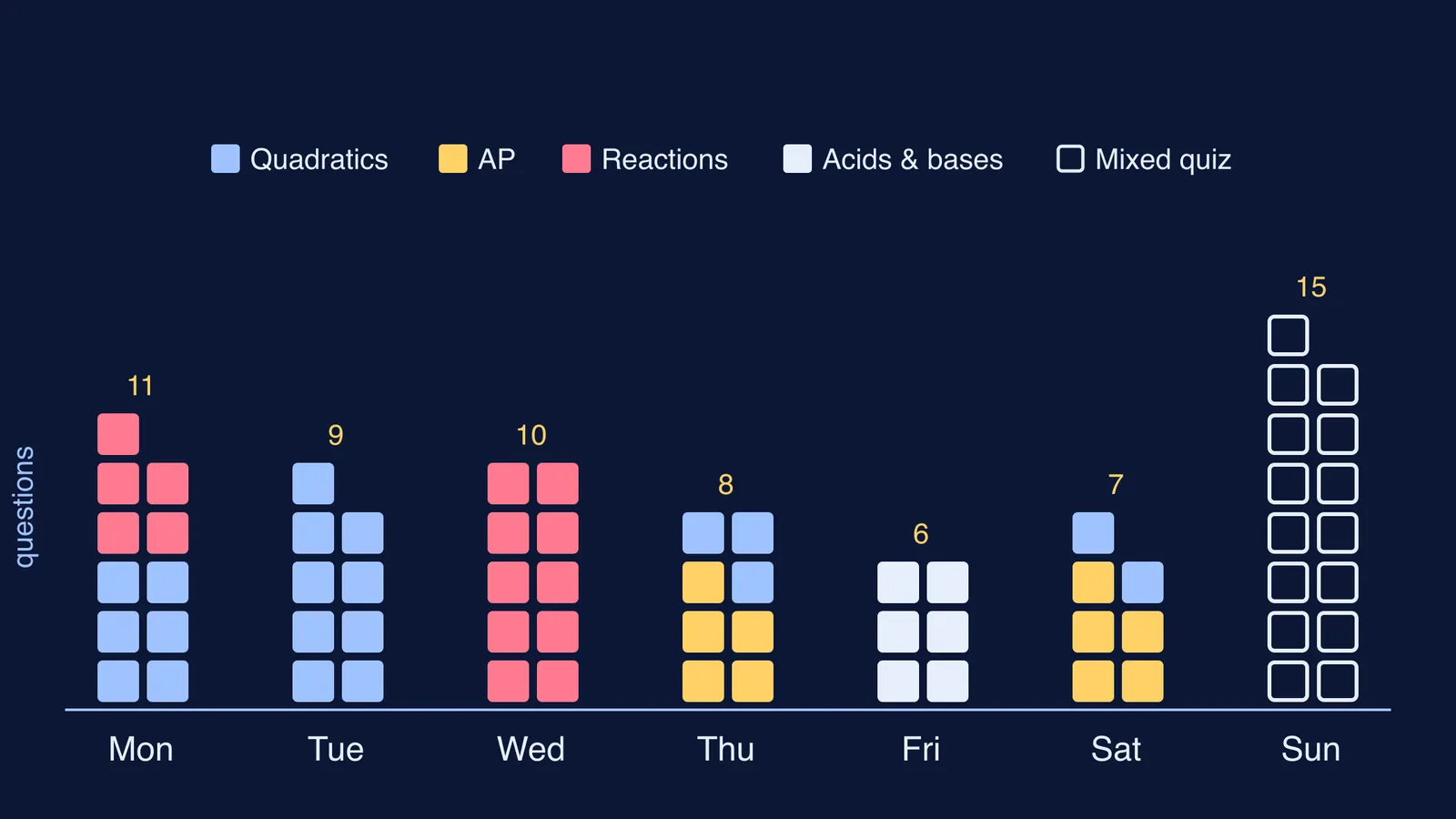
Here is one week for a CBSE Class 10 student working on maths and science. The topics come from the CBSE 2026-27 Class 10 Mathematics curriculum and Class 10 Science curriculum. Question counts are our suggestion; adjust to your child's pace.
Monday: Quadratic equations by factorisation, 6 questions. Write 5 balanced chemical equations from memory.
Tuesday: Quadratic formula, 6 questions, plus 3 on the nature of roots using the discriminant.
Wednesday: Types of chemical reactions. Classify 8 reactions, then explain 2 aloud to a parent or sibling.
Thursday: Arithmetic progressions, nth term, 5 questions. Redo 3 quadratic questions from Monday without notes.
Friday: Acids, bases and salts, 6 questions, including the pH scale from memory.
Saturday: Sum of the first n terms of an AP, 5 questions, plus 2 quadratic word problems.
Sunday: A 15-question mixed quiz from the whole week, closed book. Mark it and carry the misses into next week.
That is 66 checkable questions. Thursday and Sunday bring back earlier topics on purpose, for the self-testing and spacing the review above rated highly.
For the checking step, the Fermi Problem Library has worked problems with a step-by-step solver that explains the reasoning rather than printing an answer, so your child can find the exact step that went wrong. And if they do not know where to start on a topic, Fermi's AI tutor can work out what they already know and build a plan for the session.
What should parents ask instead of "how long did you study?"
Try these at dinner:
"Which questions did you get right without help today?"
"Which one beat you? Which step did it break on?"
"What is going on Sunday's quiz?"
They reward what got learned, not time spent sitting. If your child seems constantly anxious or worn out around studies, talk to their school counsellor or a doctor. Tele MANAS, the government's mental health helpline, is toll-free on 14416 or 1800-89-14416.
For more on practice that builds skill, see Ericsson's deliberate practice and what critics found.