On this page
Switch off the lights, point a torch at a wall, and hold up your hand: you have a physics lesson a five-year-old can run. A shadow show teaches two ideas under most school optics: light travels in straight lines, and a shadow forms where something blocks it. Here is how to set one up and what to say.
How do shadows form, and how do you explain it to a child?
A shadow is an absence of light, formed where an opaque object blocks light travelling from a source; that is the simple model used in a 2018 study of preschool shadow lessons by Alice Delserieys and colleagues. Opaque means light cannot pass through it.
The same paper reviews earlier research finding that young children often think a shadow belongs to the object, rather than seeing it as a patch where light is missing. So the goal is to let your child see, again and again, that no torch means no shadow.
In that study, 52 children aged 5 to 6 in three French kindergartens had a short shadow lesson of 15 to 20 minutes in groups of five or six. Before the lesson, 2 of the 52 could correctly predict and explain where a shadow would fall from a lamp and an object; in interviews within two weeks after it, 25 could (Delserieys et al., 2018). The researchers compared the same children before and after the lesson, without a separate comparison group, so read it as encouraging rather than proof.
What do you need for a shadow puppet show at home?
A torch. A phone torch works well because its small light gives sharp edges.
A plain light wall, or a white bedsheet hung over a doorway.
Old cardboard, scissors, tape and a few straws or ice-cream sticks for handles.
A table to rest the torch on, so the light stays still.
Optional: coloured cellophane for windows in the puppets.
In Tholu Bommalata, the shadow theatre of Andhra Pradesh, Telangana and part of Karnataka, puppets are cut from leather treated until it is translucent, so the audience watching the white screen sees coloured shadows. A cellophane window in a cardboard puppet shows the same idea at home: opaque card makes a dark shadow, while translucent material lets some light through.
Why does a shadow get bigger when you move closer to the torch?
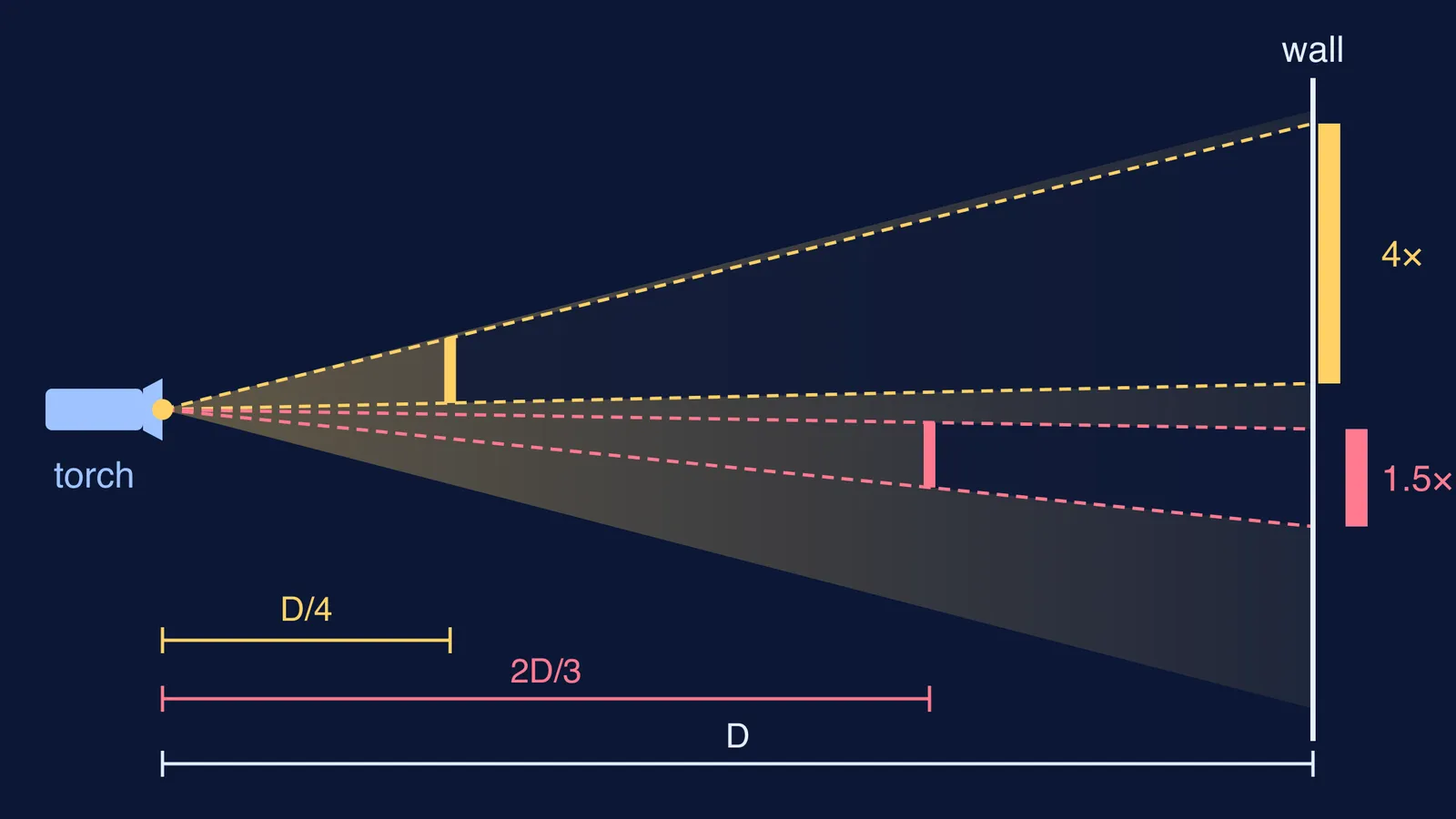
Because light spreads out in straight lines from the torch. The rays grazing the top and bottom of the puppet keep spreading until they reach the wall, so the closer the puppet is to the torch, the bigger the shadow.
For a small torch, shadow size = puppet size × (torch-to-wall distance ÷ torch-to-puppet distance), from similar triangles.
Worked example, with the torch 2 metres from the wall and a puppet 10 cm tall:
Puppet 150 cm from the torch: 200 ÷ 150 is about 1.3, so the shadow is about 13 cm.
Puppet 50 cm from the torch: 200 ÷ 50 = 4, so the shadow is 40 cm.
Puppet 25 cm from the torch: 200 ÷ 25 = 8, so the shadow is 80 cm.
Halve the gap between torch and puppet and the shadow doubles. You will also notice the edges go fuzzy close to the torch. That is because a real torch is not a single point, so light arrives from slightly different directions.
What should you say during a 15-minute shadow show?
Steps 1 to 4 follow the activities of the shadow lesson in the Delserieys study, adapted for home; step 5 is our own addition.
Make any shadow. Ask: "Where is the light coming from? Can it go through your hand?"
Predict, then test. Point to a spot on the wall and ask, "Where should the puppet go to put its shadow here?" Let your child try before you help.
The impossible challenge. Ask them to make the shadow appear between the torch and the puppet. When it will not work, ask why. The answer you are after: the shadow is always on the side away from the light.
Two torches. Switch on a second light and ask how many shadows there will be before anyone looks.
The size game. Make a tiny mouse into a giant by walking it towards the torch, then ask your child to explain the trick to someone else.
Stop while it is still fun. Questions matter more than correct words.
Where does this lead in school science?
Shadows come back in school science, alongside mirrors and pinhole cameras; our guide to shadows, mirrors and pinhole cameras in Class 7 covers that chapter. The same straight-line idea explains why the image in a pinhole camera is inverted, and the same torch can show why we have day and night.
If your older child wants to keep exploring, the Fermi Simulation Lab has interactive simulations for ideas that are easier to see than to read. Tonight, though, a torch and a wall are enough.