On this page
Placement season packs aptitude tests, group discussions and interviews into a few weeks, and results often arrive the same evening. If you want to know how campus drives usually run, start with how campus placements work in Indian colleges. This guide is about your part: the few things worth saying, the ones worth holding back, and a plan for the days after a result.
What should parents say during placement season?
Less than you think, and more through actions than words. In a daily diary study of couples, Niall Bolger, Adam Zuckerman and Ronald Kessler found that many acts of support reported by the supporter were not reported by the person receiving them, and that this unnoticed support helped people adjust to a major stressor (Journal of Personality and Social Psychology, 2000). That study was about partners, not parents, but the lesson travels: a hot meal, a quiet room and a cab booked for the 7 a.m. test often help more than a pep talk.
Research on careers points the same way. In a survey of 641 Chinese high school students, parents' career support was linked to a stronger sense of autonomy and, through it, more confidence in making career decisions, while interference from otherwise engaged parents was linked to less of both (Zhang and colleagues, Frontiers in Psychology, 2019). Those were school students rather than final-year engineers, so treat it as a pointer, not proof.
Lines that usually help:
"I'm around if you want to talk it through, and fine if you don't."
"What do you need from me this week?"
"Which round are you most worried about?" Then listen without fixing.
"Whatever happens today, dinner is at nine."
What should you not say after a placement rejection?
Most hurtful lines are well meant. Hold these back:
"Your cousin got placed in the first week." Comparison tells your child the result matters more than they do.
"What did you do wrong?" on the same night. A debrief is useful, but on their timing.
"Just take whatever comes." The choice is theirs; ask what they are weighing instead.
"Don't tell anyone yet." It signals that a rejection is shameful.
Repeated calls asking "Any update?" Agree once on how and when they will share news.
What should you do in the days after a rejection or an offer?
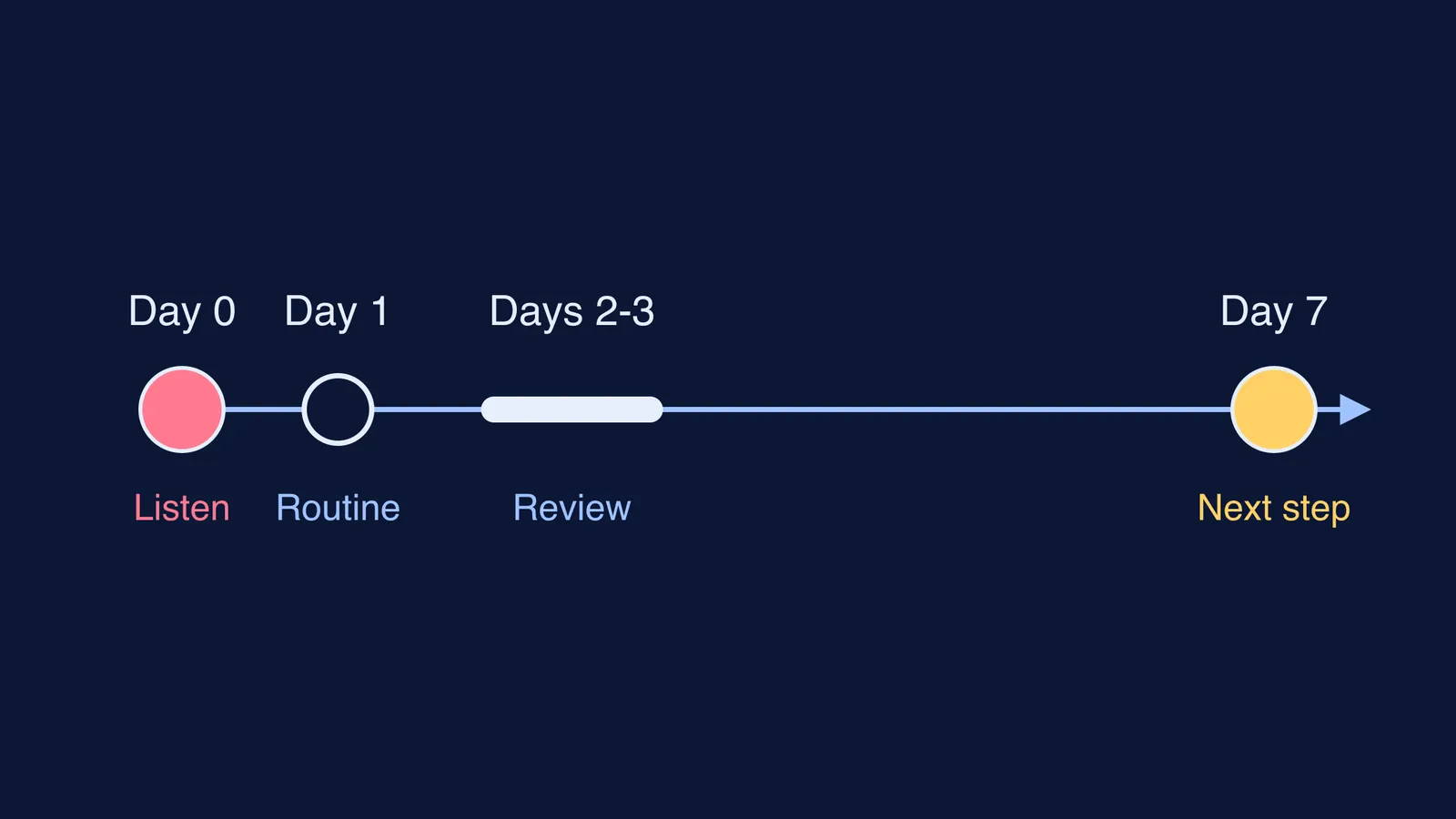
Use this plan for either result. It keeps you useful without taking over.
Day 0, the result: listen. Ask "Do you want to talk, or do you want a distraction?" Offer food, not analysis.
Day 1: keep the normal routine. Sleep, a walk, a call with a friend. No job portals before lunch.
Days 2 to 3: review together only if they ask. One sheet: which round, what was asked, one thing to change. Our post on what to do after a campus placement rejection has a fuller debrief.
Day 7: pick the next step. List upcoming drives, off-campus options and a date to check in again.
If the technical round exposed a shaky topic, the Fermi Problem Library has worked problems with a step-by-step solver that explains the reasoning, so your child can rebuild the method rather than memorise an answer.
Here is an illustrative case. Ananya, a final-year electronics student, clears the aptitude test but is turned down after the technical interview at 8 p.m. Her father does not ask about it. He texts: "Coming home this weekend? Making your favourite." On Saturday she brings it up herself: she froze on a signals question. They write it on the one-page sheet, and she sets up two mock interviews with friends for the next week. He checks in on Day 7 with one question: "What's the next drive?"
How should you respond if your child gets a job offer?
Celebrate the person first and the package second. Then help with the dull checks: read the offer letter together, confirm the company with the placement cell, and be wary of any request for money. Our guide on how to identify fake job offers for freshers lists the warning signs. If your child wants to keep interviewing, talk through the college's rules before they accept.
When is it more than placement stress?
Disappointment that lasts a few days is normal. If your child stops eating or sleeping, pulls away from everyone for weeks, or talks about feeling hopeless or not wanting to live, contact a doctor or counsellor and the college's counselling cell. Tele MANAS, the free national mental health helpline launched by the Ministry of Health and Family Welfare, answers round the clock on 14416 or 1800-891-4416 (IIT Kanpur counselling service). In an emergency, go to the nearest hospital.
You cannot sit the interview for your child, but you can make the week around it easier. Start with dinner at nine.