
On this page
When two children are close in age, their college fees often fall in the same years. Find the overlap years now, plan each child in their own column, and use the same rules for both.
How many years will both children be in college at once?
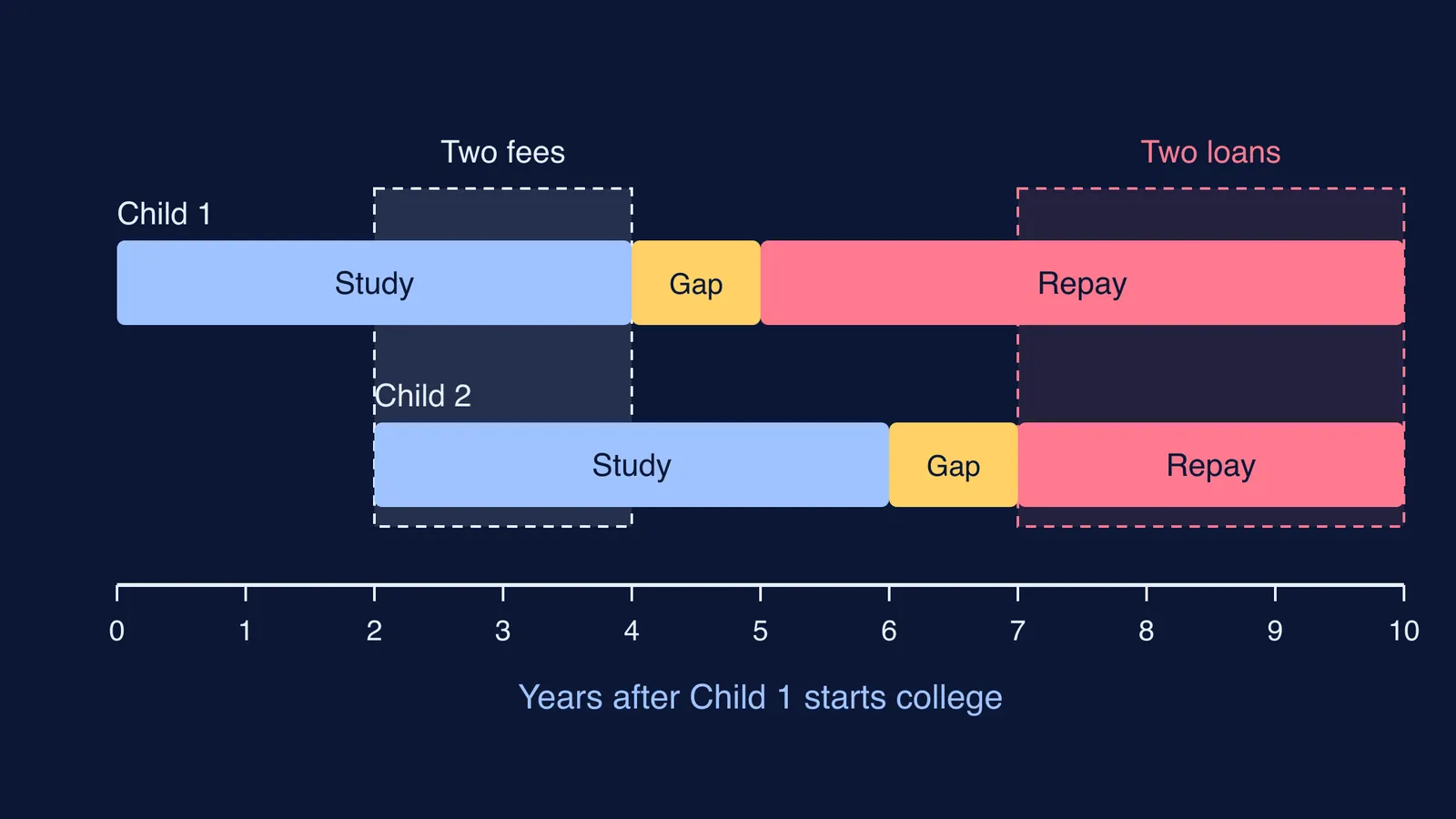
Take the length of the elder child's course and subtract the gap between their admission years. Two four-year degrees started two years apart overlap for two years. A one-year gap means three years of two fees.
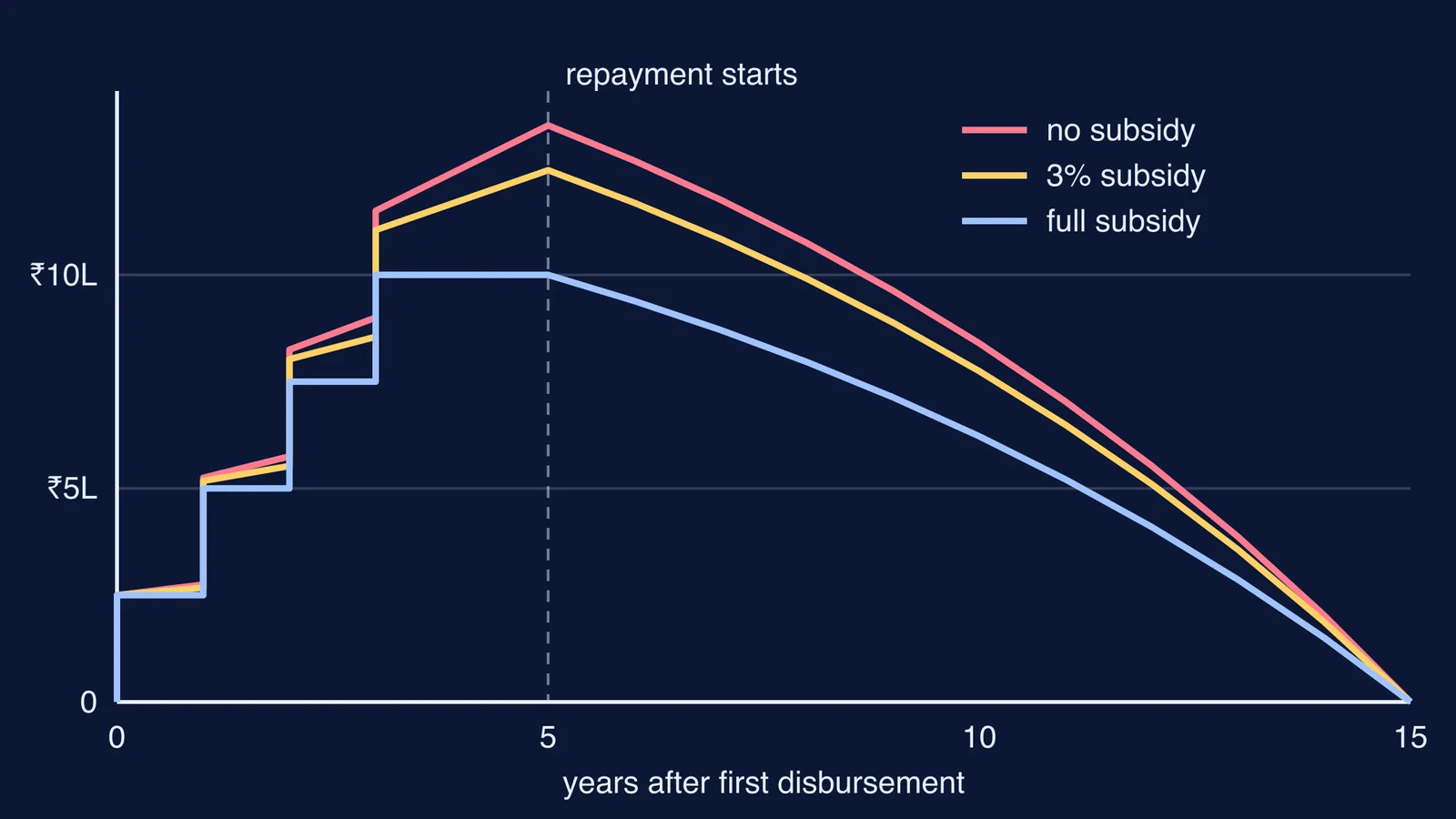
The loans overlap too. Under the SBI Student Loan Scheme, repayment starts one year after the course ends and runs for up to 15 years. With a two-year gap, the elder child's repayments begin in year six while the younger is still studying, and from year eight both loans are being repaid.
How do you plan college fees for two children close in age?
Use one column per child and take fees from each college's own fee page, not an agent's estimate.
Admission year and course length.
Tuition per year, plus hostel, mess, books, travel and a laptop.
Scholarships to apply for, with the deadline and renewal rule for each.
What the family can pay each year from income and savings.
The gap that is left: this is the loan, if any.
Who repays, when repayment starts and the likely monthly instalment.
Add the two columns year by year. The years with two fees are your pinch points, so aim savings at them.
A worked example
These numbers are illustrative. Each degree costs ₹2 lakh a year in all, the children are two years apart, and the family can pay ₹2.5 lakh a year.
Years 1 and 2: one fee of ₹2 lakh. Save the extra ₹50,000 each year, so ₹1 lakh is set aside.
Years 3 and 4: two fees, ₹4 lakh a year. The shortfall is ₹3 lakh over two years. Savings cover ₹1 lakh, leaving ₹2 lakh to borrow.
Years 5 and 6: one fee again, and the elder child's repayments begin in year 6.
Borrowing ₹1 lakh for each child keeps it even.
Which education loans help when two children study at the same time?
Each child borrows for their own course, so check each one's eligibility. The Press Information Bureau release on PM-Vidyalaxmi (6 November 2024) sets out the main government support:
Students admitted to listed quality institutions, chosen from NIRF rankings, can get collateral-free, guarantor-free education loans.
Loans up to ₹7.5 lakh carry a 75% government credit guarantee to banks.
Students with annual family income up to ₹8 lakh and not eligible for another government scholarship or interest subvention scheme can get 3% interest subvention during the moratorium on loans up to ₹10 lakh. This is capped at one lakh students a year.
Under the separate CSIS scheme, students with family income up to ₹4.5 lakh on technical or professional courses get full interest subvention during the moratorium on loans up to ₹10 lakh.
You apply on the PM-Vidyalaxmi portal.
Bank rules matter more with two loans. On SBI's Student Loan Scheme page, loans up to ₹7.5 lakh need only a parent or guardian as co-borrower, and interest that builds up during the course is added to the loan unless you pay it as you go. You may co-borrow on both loans, so add the two instalments together when you check what you can repay. Our guide on applying for an education loan in India, step by step covers the paperwork.
Where do scholarships fit in?
Apply for every scholarship each child qualifies for before you finalise a loan. The National Scholarship Portal lists central schemes such as the PM-USP Central Sector Scheme of Scholarship for College and University Students, and says it is open for the 2026-27 academic year from 1 June 2026. Many need renewing every year, so add each renewal date to the worksheet. Our explainer on need-based and merit scholarships shows how to apply for both kinds.
How do you keep it fair between the two children?
Fair means the same rules, agreed early and written down, not always the same rupees. One simple set:
The family puts the same amount into each child's education each year.
Anything above that is a loan in that child's name, for their own course.
A scholarship one child wins reduces their own loan first.
You could say: "We can give each of you the same amount every year. If your college costs more, we will help you plan a loan for the rest, just as we would for your sibling." Our post on being fair when siblings have different abilities helps with that conversation.
If the younger child is preparing for entrance exams and is not sure where to start, Fermi's AI tutor works out what they already know and builds a plan for the session.
Fill in the two columns this weekend and start the elder child's scholarship applications first.