On this page
Walking out of a campus placement interview after a rejection email or an uncalled roll number hurts. On Indian campuses, placement drives happen under an intense social microscope. Seeing peers celebrate offers while you return to an empty room is disheartening. That initial sting is completely natural, but treating rejection as a permanent verdict on your intelligence or career potential is a cognitive trap.
Why do campus placement rejections hit so hard?
In the International Journal of Selection and Assessment, Robert E. Ployhart and Crystal M. Harold introduced Applicant Attribution-Reaction Theory (AART). The theory explains that when candidates attribute rejection to internal, permanent traits—such as believing they lack problem-solving ability—their confidence and motivation drop sharply. But when they attribute rejection to unstable, controllable factors—such as missing an edge case or speaking too fast during a project overview—they retain their self-efficacy and prepare more effectively for subsequent drives.
Placement rejections are also a standard reality of campus recruitment. With fierce competition for roles, even strong candidates routinely navigate multiple interview cycles before converting an offer. If the emotional weight feels overwhelming, confidential support is available around the clock through the Government of India's Tele MANAS helpline at 14416 or 1800-891-4416.
How should you conduct a 24-hour post-interview debrief?
The most important step after a rejection is capturing details while memories are fresh. In the Journal of Applied Psychology, Shmuel Ellis and Inbar Davidi showed that structured After-Event Reviews analyzing both failed actions and successful moves accelerate learning far more than unstructured rumination.
Within 24 hours of your interview, audit your performance across three clear areas:
Technical problem framing: Did you ask clarifying questions and state assumptions before writing code or formulas? Did you explain complexity clearly?
Project explanation: Did you articulate your personal contribution and trade-offs, or stick to generic summaries? Benchmark your responses against our guide on internship interview preparation.
Behavioural answers: Did you answer situational questions with concrete examples, or meander without resolution?
When this debrief reveals recurring gaps in your problem solving, Fermi's AI tutor can notice where you are stuck, decide whether to explain, ask or show, and build a plan for the session to work through the reasoning.
Can you ask the recruiter or interviewer for feedback?
Many candidates wonder whether to ask recruiters why they were rejected. In high-volume campus hiring, companies rarely provide individualized notes. Talent Board benchmark research published on ERE.net found that 57% of job applicants receive zero feedback after screening and interviews, and only 37% of those who do find it actionable. Tight schedules and legal liability usually prevent interviewers from sharing candid remarks.
Even so, sending a polite, non-defensive follow-up email through approved placement channels is reasonable. If you have the recruiter's contact details, send a brief note within two days:
Dear [Recruiter Name], Thank you for the opportunity to interview for the [Role Name] role during the campus drive at [College Name]. While disappointed by the outcome, I valued learning about the team's work. If you have one recommendation on an area or skill I should strengthen, I would be grateful for your guidance. I wish your team continued success.
Keep your note brief and professional. Never dispute the evaluation or demand a re-interview. If they share a constructive suggestion, apply it; if they send a form response or stay silent, move forward.
How do you prepare differently for the next company drive?
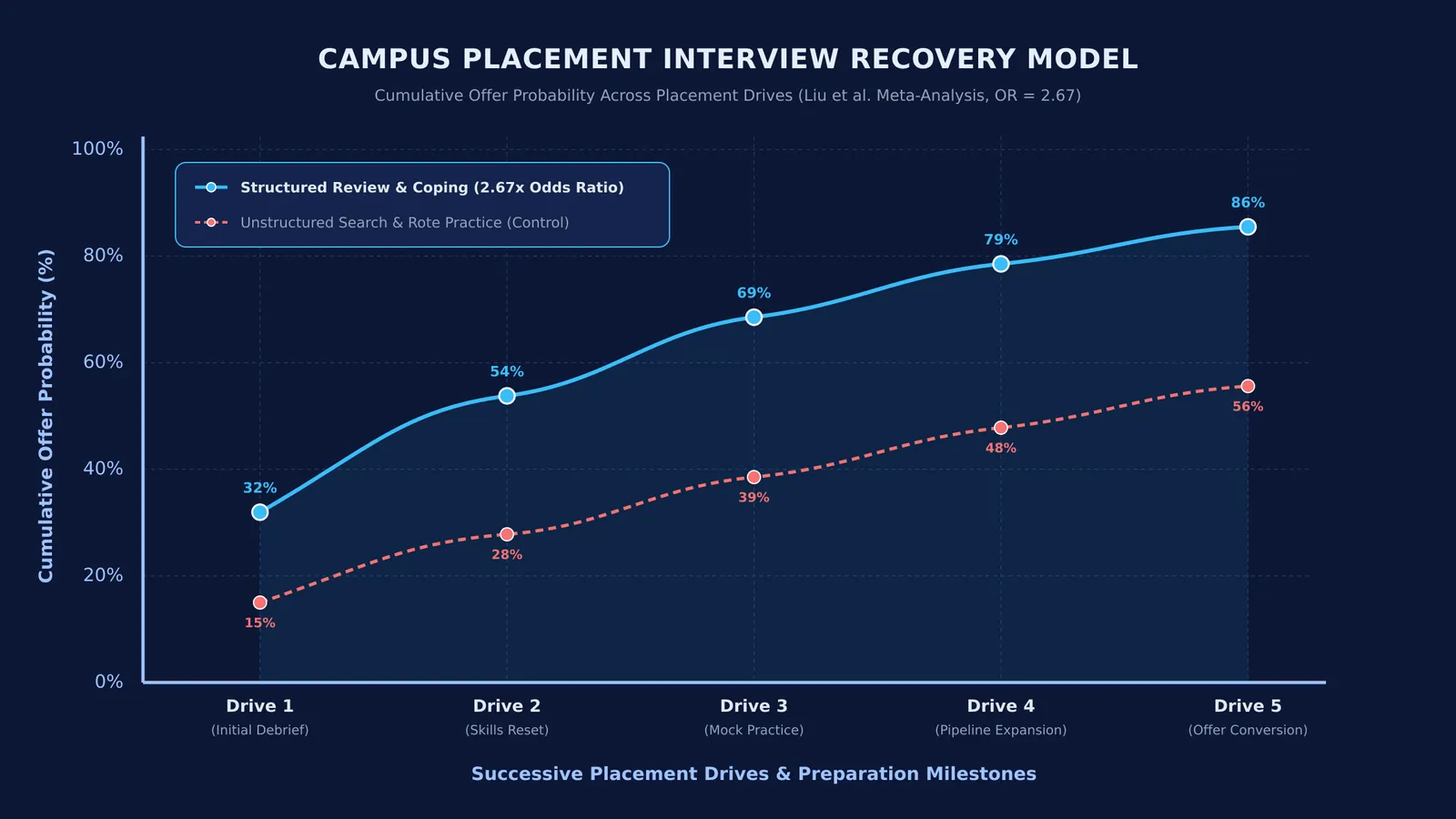
Recovering from rejection requires changing how you practice rather than simply putting in longer hours. A meta-analysis of 47 studies by Songqi Liu, Jason L. Huang, and Mo Wang in Psychological Bulletin demonstrated that job-search programmes combining technical skill development with motivational coping interventions increased employment odds by 2.67 times over control groups. Passive re-reading does not build interview stamina.
To build genuine readiness for upcoming drives, apply a targeted reset:
Target wrong-method errors: Rather than memorising solutions, practice decomposing problems into basic principles. The Fermi Problem Library provides worked problems with a step-by-step solver that explains the reasoning rather than printing an answer.
Re-anchor foundational concepts: If questions exposed gaps in core principles, the Fermi Concept Library covers concepts in mathematics, computing, and science, each with its own lesson and its place in the map.
Conduct timed peer mock sessions: Partner with a classmate to practice explaining your reasoning out loud under timed constraints before writing code or formulas.
Expand your pipeline off campus: Broaden your search using our guide to off-campus job search for freshers, and learn how to evaluate college placement records to keep expectations grounded.
Placement season is an iterative process. Every rejection delivers diagnostic data on where your preparation needs focus. Correct the specific deficiency, rebuild your daily routine, and approach the next interview ready to demonstrate your progress.