On this page
Securing an internship is one of the most effective steps you can take toward launching your career. According to the National Association of Colleges and Employers (NACE), 63.1% of eligible interns are successfully converted into full-time employees. However, the interview process for these roles has shifted significantly over the last few years. Companies are placing less weight on your grades and looking much closer at how you approach real-world challenges. Whether you are interviewing for a software engineering role or a business position, knowing what to expect and how to frame your answers is crucial.
What do employers look for in internship interviews?
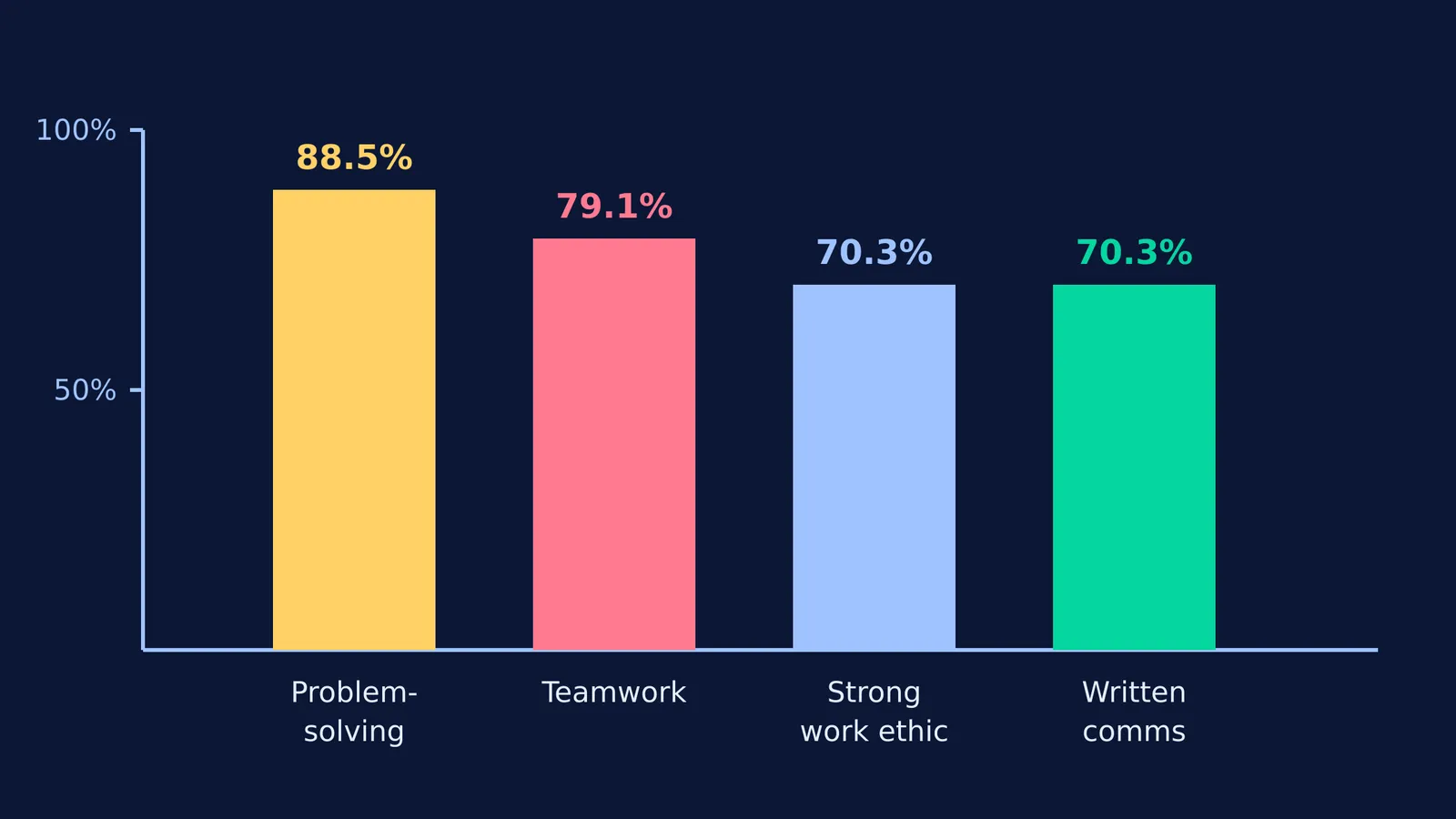
Many college students assume their academic transcript is the most important part of their application. However, according to the NACE Job Outlook 2024 report, 88.5% of employers are seeking evidence of problem-solving skills on candidates' resumes, while only 38.3% plan to use GPA as a screening tool.
Interviewers want to see how you think when you do not have an answer key. They are assessing your ability to collaborate, adapt to new information, and communicate clearly. If you lack formal work experience, they will look for these traits in your academic projects, hackathons, or student club activities. For example, if you built a mobile app for a class and the requirements changed halfway through, explaining how you handled that pivot is exactly what an interviewer wants to hear. The skills that matter most as the workplace changes are often those that show you can learn quickly and work with others. As we discussed in our guide on which skills matter more as AI spreads, adaptability and critical thinking are highly prized.
How do you explain projects using the STAR method?
Behavioral questions (those that start with "Tell me about a time when...") are standard in modern interviews. According to a 2026 survey by the Society for Human Resource Management (SHRM), 67% of large enterprises use structured behavioral interviews to gauge candidate fit. To answer these effectively, use the STAR method.
The STAR framework gives your response a clear, predictable structure:
Situation: Set the scene briefly. Name the class, the project, or the club.
Task: Explain the specific problem you needed to solve or the goal you had to reach.
Action: Describe the steps you took. This is the most important part. Use "I" instead of "we" to clarify your specific contribution, even in a group project.
Result: Share the outcome. If possible, quantify it (e.g., "reduced the code's run time by 20%" or "received an A grade").
For instance, if asked about a challenge: "In my software engineering class (Situation), I had to build a database for our final project (Task). I taught myself SQL over a weekend and structured the schema (Action), which allowed our app to load 40% faster (Result)." This is far more compelling than simply saying you are a fast learner.
How should you prepare for technical questions?
Technical rounds test your foundational knowledge and your logic. Interviewers care more about your process than whether you arrive at the perfect final answer immediately. Do not rush to code or calculate. Take a minute to clarify the problem. Ask questions to define the edge cases. Technical interviews are dialogues, not written exams.
If you get stuck on a technical problem, talk through your reasoning out loud. State your assumptions, outline the steps you would take to find a solution, and explain why you chose a specific method. This mirrors how you will work on the job. To build this habit before the interview, you can use the Fermi Problem Library. It provides worked problems with a step-by-step solver that explains the reasoning rather than printing an answer, helping you learn how to articulate your own thought process.
Additionally, if you want to practice explaining concepts clearly, Fermi's AI tutor can act as a practice partner. It works out what you already know and checks your understanding as it goes, forcing you to defend your logic just as an interviewer would.
What are the best questions to ask the interviewer?
At the end of the interview, you will almost always be asked, "Do you have any questions for me?" Saying no signals a lack of interest. Asking thoughtful questions shows you are engaged and evaluating whether the company is a good fit for you.
Here are a few questions you can ask:
"What does a typical day look like for an intern on this team?"
"Can you describe a project that a previous intern worked on?"
"How does the team handle feedback and mentorship for interns?"
"What is the biggest challenge the team is currently facing?"
Pay attention to how they describe the work environment. Do they talk about throwing interns in at the deep end, or do they mention structured onboarding? These questions provide a clear picture of the support you will receive and the actual work you will do, setting you up for a successful transition from student to professional. If you are exploring different fields and wondering how to position yourself, our article on talking about STEM careers offers a broader perspective on early career choices.