On this page
A pendulum is one of the cheapest real physics experiments you can do at home: a piece of thread, a metal nut from the toolbox and the stopwatch on a phone. One rule turns it from a craft activity into science. Your child says what will happen before you test it.
Why ask your child to predict first?
In a 2004 study of physics lecture demonstrations, Catherine Crouch, Eric Mazur and colleagues found that students who only watched a demonstration understood the idea no better than students who did not see it at all, while students who predicted the outcome first showed significantly greater understanding (Crouch et al., American Journal of Physics). Teachers call this routine predict, observe, explain. Richard White and Richard Gunstone described it in 1992, and it works best with demonstrations whose results show up straight away (NZCER Assessment Resource Banks).
A pendulum fits: a wrong guess gets checked before anyone forgets making it.
What do you need for a pendulum experiment at home?
A metre of thin string or strong sewing thread
Three identical metal nuts or washers
Tape, and a table edge, door frame or curtain rod to hang from
A measuring tape and a phone stopwatch
A notebook with three columns: what we changed, what we predicted, time for 10 swings
Tape the string firmly so the top cannot slip, and tie one nut to the bottom. Measure the length from the point where the string leaves the edge to the middle of the nut. Nuts are small, so keep them away from toddlers who still put things in their mouths.
How do you time a pendulum swing accurately?
In this experiment one swing means there and back: the nut starts on one side, crosses over and returns to where it began. Pull the nut aside only a little, about a hand's width for a 50 cm string, and let go without pushing.
Keep the swing small. The standard pendulum formula holds well when the swing stays within about 15 degrees of vertical, and the period is then nearly independent of how far you pull it (OpenStax University Physics).
Count 10 complete swings while your child runs the stopwatch, then divide by 10. Timing 10 swings instead of one shares a late thumb on the stopwatch across all ten. Do each timing three times and write all three down.
Does a heavier pendulum swing faster?
Many children, and plenty of adults, guess yes. Ask this one first, using a short script:
"We are going to add two more nuts. Will 10 swings take more time, less time, or the same? Write it down."
"Why do you think so?" Write the reason too; it is the most interesting part.
Tape the extra nuts beside the first so the middle of the bunch stays at the same length. Time 10 swings, three times.
"Was your prediction right? What would you change in your explanation?"
The times should come out nearly the same. For a simple pendulum, the period depends on length and gravity and "is completely independent of other factors, such as mass" (OpenStax University Physics). If your times do differ, look for the real cause: the nuts may hang lower, or one swing started wider.
Does a longer string make the pendulum slower?
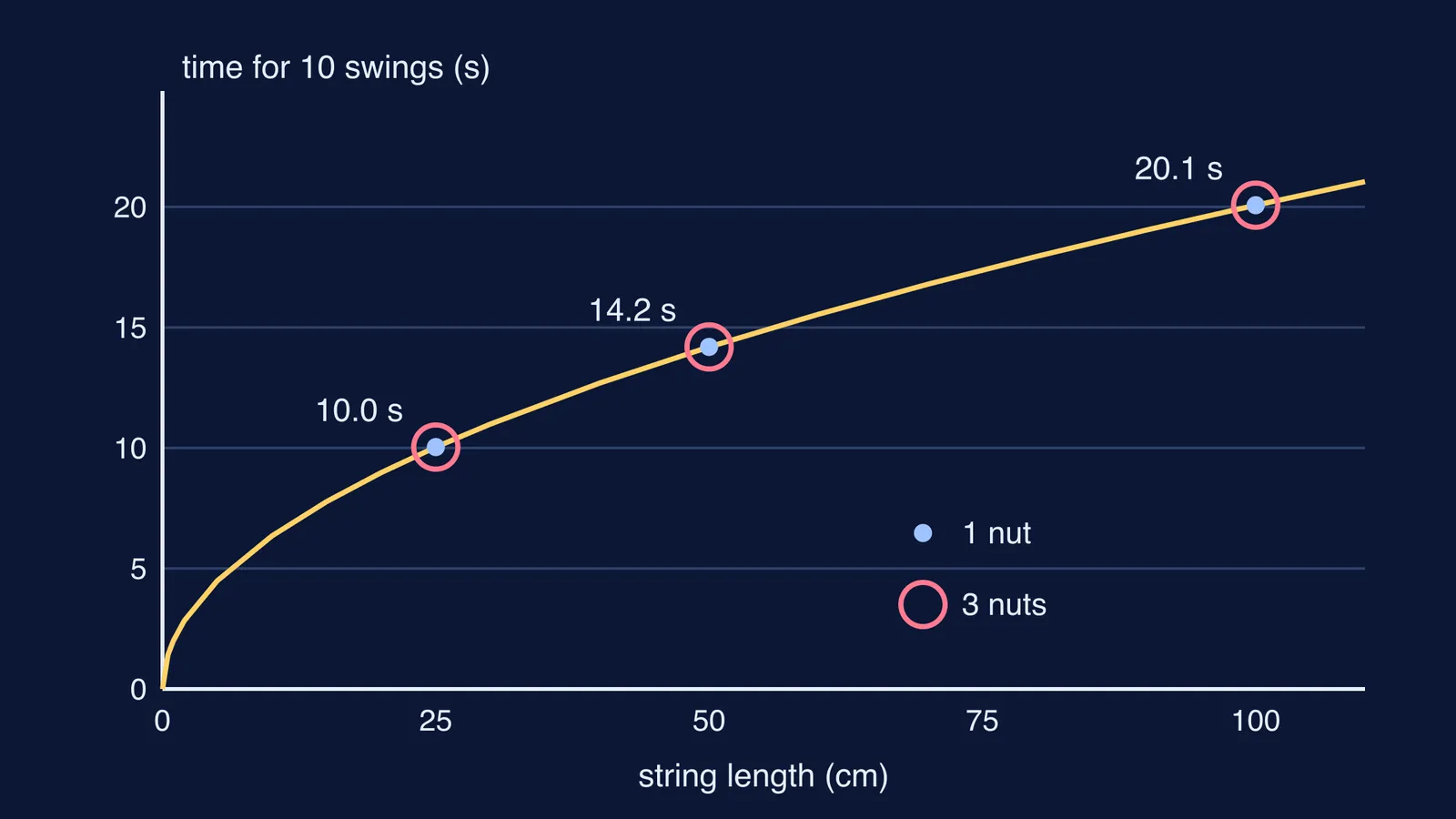
Yes, but not in a straight line. For small swings the period is T = 2π√(L/g), where L is the length and g is the acceleration due to gravity (HyperPhysics). The square root means a string four times longer takes twice as long, not four times.
Here is what the formula predicts with g = 9.8 m/s², so you can check your child's results:
25 cm string: about 1.0 s per swing, about 10.0 s for 10 swings
50 cm string: about 1.4 s per swing, about 14.2 s for 10 swings
100 cm string: about 2.0 s per swing, about 20.1 s for 10 swings
Try this order. Time the 25 cm and 100 cm strings first, then ask your child to predict the 50 cm time. The halfway guess, 15 s, is tempting; the answer lands near 14.2 s, a first concrete meeting with a curve that is not a straight line.
Strings stretch and thumbs are slow, so being a little off is normal; a big gap is a clue to chase.
What can older children do next?
An older student can plot length against the square of the period and get a straight line, which is how school labs measure g; our guide to measuring g with a simple pendulum using the L–T² graph walks through it. For the history, read how Galileo noticed that small swings take nearly the same time.
Some ideas are hard to set up on a door frame, such as a ten-metre string. The Fermi Simulation Lab has interactive simulations for ideas that are easier to see than to read, and the predict-first habit works there too.
For another kitchen-table experiment with the same predict-then-check routine, try making a bottle thermometer at home with a straw.