On this page
Many families first hear about the "partial drop" from a cousin or a senior: take the seat you got, attend classes, and prepare for JEE again on the side. It can end in a weak attempt and a first-year backlog, so look at the rules and the hours before deciding.
What is a partial drop year, and is it allowed?
A partial drop means enrolling in a college degree while preparing to reattempt JEE Main and JEE Advanced in the same year.
The JEE (Advanced) 2026 eligibility rules allow a candidate a maximum of two attempts in two consecutive years. The same page makes you ineligible if you have already been admitted to an IIT or accepted an IIT seat by reporting. It does not list studying at another college as a bar. It also sets an age cut-off and a Class XII year limit; check these, and the NTA bulletin for JEE Main, every year.
How much college attendance is required?
Under the UGC regulations for first-degree programmes (2003), each university sets the attendance you need to sit its exams, and it "ordinarily shall not be less than 75%" of lectures, tutorials, seminars and practicals.
The same UGC regulations ask for at least 180 teaching days a year, at least 30 hours of contact teaching a week, and at least 10 hours a week for practicals, library and computer work.
So most weekdays are spent on campus. Fall short and you can be barred from semester exams, and a partial drop can then cost both the semester and the attempt. Our guide to the 75% attendance rule in college and how to track it explains how to read your own college's rules.
How many hours does a partial drop really leave for JEE?
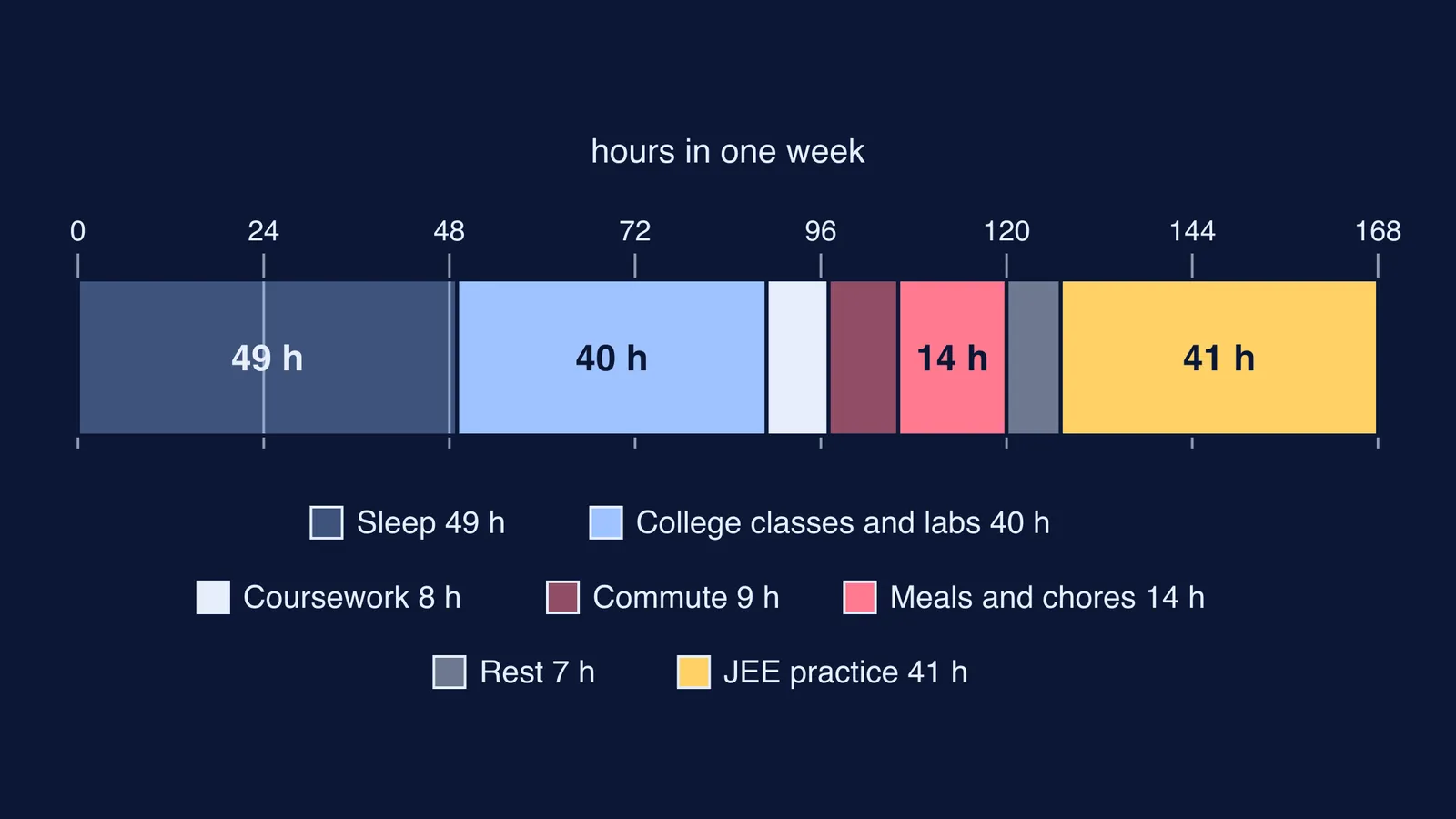
Here is a worked week for a first-year student. The college hours are the UGC minimums of 30 contact hours plus 10 hours of practicals and library. The sleep figure follows the CDC's guidance of 7 or more hours a night for adults (8 to 10 for teens aged 13 to 17, so a 17-year-old needs more). The other numbers are our assumptions, so put in your own.
Sleep, 7 hours a night: 49 hours
College classes and labs: 40 hours
Coursework, assignments and internal tests: 8 hours
Commute, 1.5 hours on six days: 9 hours
Meals, bathing and chores, 2 hours a day: 14 hours
Rest, exercise and family, 1 hour a day: 7 hours
That adds up to 127 of the 168 hours in a week. About 41 hours are left for JEE: roughly 4.5 hours on each of the six college days and about 14 hours on Sunday. Those evening hours come when you are tired, and shrink in exam weeks.
What makes a partial drop work, or fail?
In our judgement, it has a better chance when:
the gap is narrow and specific, such as a few chapters or exam technique, not the whole syllabus
the college is close to home or has a hostel, so travel does not eat the evenings
the student would be content with this degree, so a good first year counts as a real result too
It is harder when:
the seat is treated as a throwaway, so attendance and internal marks slide
the plan is "study whenever there is time", with no fixed blocks
the reattempt is mainly about family or peer expectations
With only a few hours on a college evening, how you practise matters most. If marks went on wrong methods, work through problems with a step-by-step solver that explains the reasoning, such as the Fermi Problem Library, so a short evening block goes on fixing the method. If a full year off still looks better, our post on whether to take a full drop year for JEE covers that route.
A decision checklist to fill in together
With the college calendar and JEE dates open, answer each together:
What went wrong last time: chapters, accuracy, timing or nerves?
What score would make the reattempt worth it, and do mock scores make it realistic?
What is the college's attendance rule, and what happens below it?
How long is the commute, door to door?
Do internal tests or semester exams fall close to JEE Main or JEE Advanced?
Which attempt is this, and do the current rules allow another?
If both go only partly well, would the student happily continue this degree?
In a clash week, which comes first, and who decides?
On what date (say, after first-semester results) will you review the plan?
If the answers to 2, 4 and 7 are shaky, a partial drop may be the hardest of the options rather than the safest. Whichever you choose, our guide to supporting your child through a JEE drop year covers the conversations at home.
When should a family get outside help?
If a student sleeps badly for weeks, pulls away from friends or talks about feeling hopeless, speak to a doctor or counsellor. Tele MANAS, the government's tele-mental health helpline, offers 24x7 support on toll-free 1800-89-14416 or short code 14416.