

On this page
A stealth aircraft is not invisible to radar. It is built so that very little of the radar's energy comes back to the receiver, so an enemy radar has to be much closer before it notices anything. Two pieces of Class 11 and 12 physics do most of the work: the law of reflection, and interference in thin layers.
What is radar cross section?
A radar sends out a pulse of microwaves and listens for the echo. How strong that echo is depends on the target's radar cross section, written σ.
Radar cross section is the area that, if it scattered the radar's power equally in all directions, would give the echo the radar actually receives; it is measured in square metres (US Air Force Academy reading on the radar range equation).
So σ is not the size of the aircraft. A big object can have a small radar cross section if it sends its echo somewhere else.
The echo also fades fast with distance: received power falls as 1/R⁴, because the wave spreads as 1/R² on the way out and again as 1/R² on the way back (USAFA).
How do angled surfaces hide an aircraft from radar?
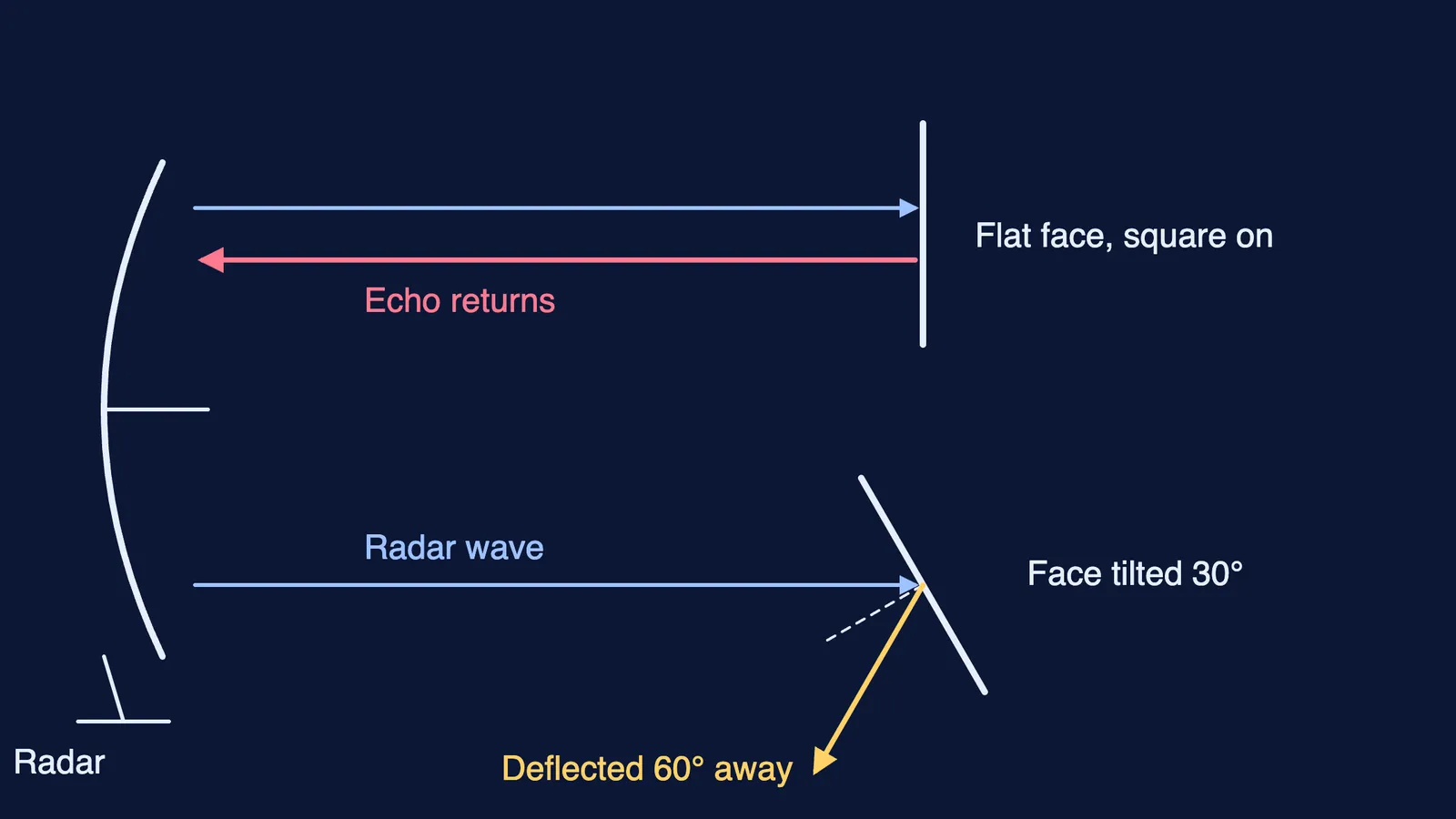
Microwaves obey the same law of reflection as light: the angle of incidence equals the angle of reflection (OpenStax University Physics on the law of reflection). A flat metal panel facing the radar square on works like a mirror held straight at a torch, and the echo comes straight back.
Tilt that panel by 30° and the reflected beam turns by 60°, twice the tilt. The strong reflection now goes off to one side, and the radar hears only a faint echo. That is the idea behind the angular look of early stealth aircraft.
A corner does the opposite. Surfaces at right angles send a wave back the way it came, as we showed in why a corner reflector sends light straight back. Stealth designers avoid such corners.
Lockheed says the F-117 had “angular panels bolstered by an external coating of radar-absorbent material”, and traces it to the Have Blue demonstrator, first flown in 1977 (Lockheed Martin F-117 history). Edges scatter waves too; Lockheed's bid drew on a 1962 text by Soviet physicist Pyotr Ufimtsev on edge waves in diffraction (stealth technology overview). He later set out the theory in a 2007 book, Fundamentals of the Physical Theory of Diffraction.
Stealth lowers the echo; it does not remove it. A single F-117 was shot down over Serbia on 27 March 1999, and the fleet was retired on 22 April 2008 (Air and Space Forces Magazine F-117 page).
How do radar-absorbing coatings work?
Electromagnetic absorbers turn the wave's energy into heat, which cuts the reflection back toward the radar, according to a review by Tirkey and Gupta of BIT Mesra, Ranchi (International Journal of Microwave and Wireless Technologies, 2019).
One of the oldest designs, the Salisbury screen, is a thin resistive sheet held a quarter of a wavelength above a metal ground plane by a lossless dielectric layer (Tirkey and Gupta). The same review notes its weakness: it absorbs only a narrow band of frequencies and is bulky.
Why a quarter wavelength? The wave that bounces off the metal travels an extra half wavelength, so it returns to the sheet out of step with the wave reflected there, and the two cancel. It is the same idea as the quarter-wave anti-reflection coating on spectacles, with minimum thickness λ/4n.
Worked example: how much does a smaller radar cross section help?
Because power falls as 1/R⁴, the maximum detection range grows only as the fourth root of σ. The USAFA reading's example radar sees a 1 m² target at about 474 km, and a 0.001 m² target, a thousand times smaller, at about 84 km (USAFA).
Check the in-between cases yourself with R = 474 × σ^(1/4):
σ = 0.1 m²: the fourth root of 0.1 is 0.562, so R ≈ 267 km.
σ = 0.01 m²: the fourth root is 0.316, so R ≈ 150 km.
σ = 0.001 m²: the fourth root is 0.178, so R ≈ 84 km, matching the reading.
The lesson: to halve the distance at which a radar sees you, you must cut σ by 2⁴ = 16 times.
How can you use this in exams?
Rotating mirrors: a mirror turned by θ turns the reflected ray by 2θ.
Thin films: the quarter-wave condition λ/4n links coatings and absorbers.
Power laws: practise fourth roots and ratios, as in how Doppler weather radar tracks storms.
If reflection angles are easier to see than read, the Fermi Simulation Lab has interactive simulations for ideas like this. If you want to work through a radar or thin-film problem step by step, Fermi's AI tutor notices where you are stuck and decides whether to explain, ask or show.
Next time you see a sharp-edged jet, look for the flat faces and the missing right angles: that is physics you already know.


