On this page
Your child says they want to stop going to the coaching centre and study online instead. It is a fair request and a big one, because online preparation puts far more of the work on the student. You do not have to decide on the spot. You can test it first.
Why does a NEET aspirant want to leave offline coaching?
Start with the real reason. Common ones:
Travel time that leaves little energy for self-study
A pace that is too fast or too slow
Doubts that never get asked in a large batch
Pressure from test ranks or classmates
Wanting more control over the day
Online classes solve some of these; others, such as unasked doubts, may follow your child home. A useful opener is: "Tell me what a bad day at coaching looks like, from start to finish."
If the answer points to stress that is not lifting, or to changes in sleep or appetite, talk to a doctor or counsellor. You can also call Tele MANAS, the government's free mental health helpline, on 14416.
How much self-discipline does online NEET preparation need?
More than offline. In a classroom, the timetable, teacher and classmates keep you on task. At home, your child has to do that alone.
Jaclyn Broadbent and W. L. Poon reviewed 12 studies of online higher education. Four strategies were linked to better grades: time management, metacognition (checking your own understanding), effort regulation (keeping going when work is dull or hard) and critical thinking (Broadbent and Poon, 2015). The authors added that these effects appeared weaker online than in face-to-face classes, so good habits help but do not cover everything.
Open online courses show what can happen without that structure. In Harvard and MIT courses on edX, low completion rates did not improve over 6 years (Reich and Ruipérez-Valiente, Science, 2019). Those were mostly free courses, not paid NEET batches, but the lesson holds: signing up is easy; finishing is hard.
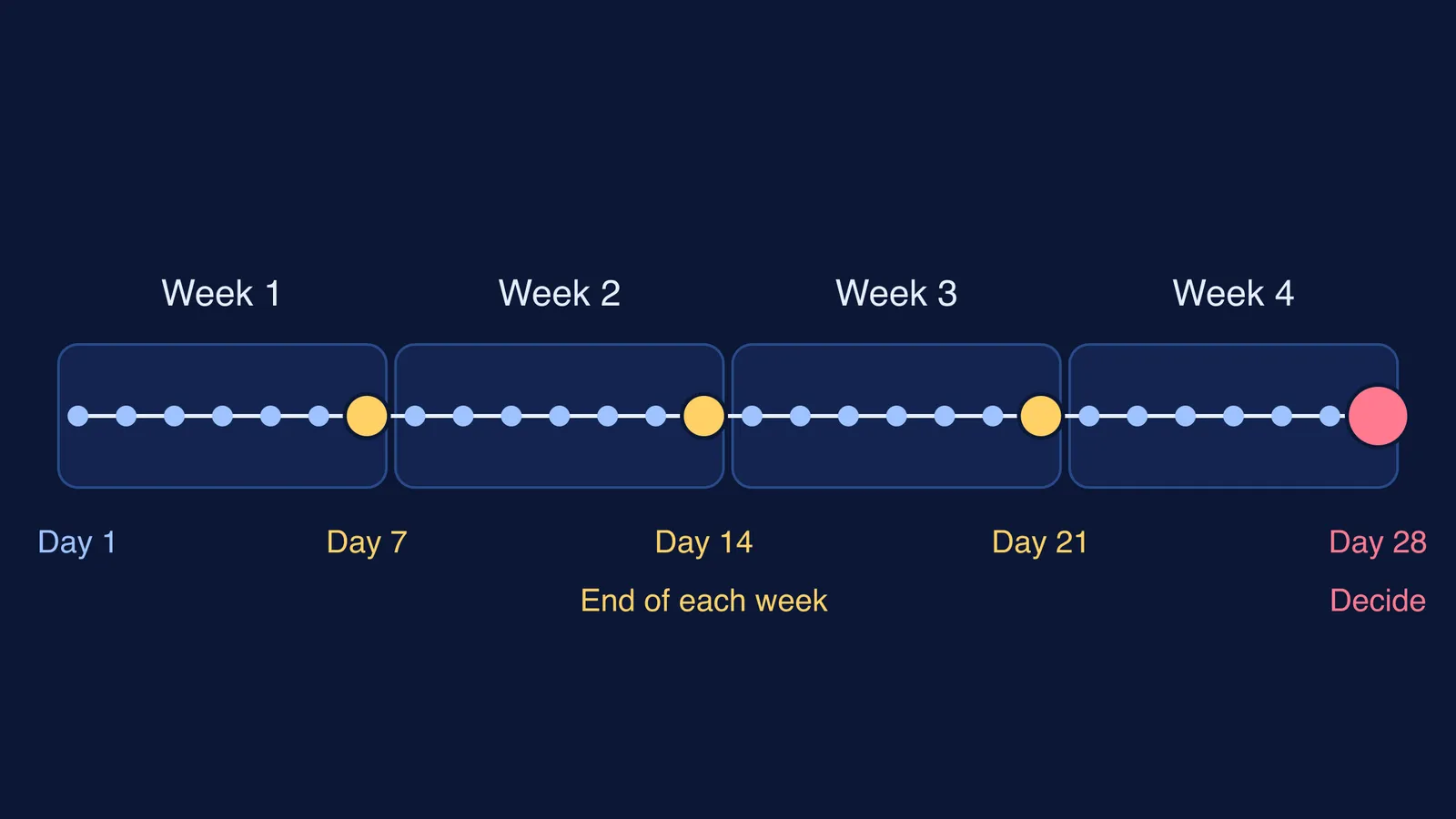
How do you run a four-week trial before switching?
Pick a stretch when switching back would cost little, such as a holiday break, or ask the institute about a short online trial. Agree on the plan in writing.
Week 1: set the day. Your child writes a fixed timetable (classes, self-study, meals, sleep) and logs each session's actual start time next to the planned one.
Week 2: add tests. One timed chapter test on the same day each week, then the three costliest mistakes written down, with why.
Week 3: track doubts. Keep a doubt list and note how many get answered within two days.
Week 4: review together. Sit down for 20 minutes with the log, the tests and the doubt list.
On day 28, decide on three signals rather than a feeling:
Most sessions started within 15 minutes of the planned time
Test mistakes were analysed, and the same ones are not repeating every week
Doubts are getting cleared, not just collected
Three yes answers make a strong case for switching. One or none suggests offline structure is still doing real work. A mix points to a blend, such as online classes plus fixed library hours.
At home, agree on quiet hours for a NEET aspirant; your child can use these four rules for staying disciplined in online coaching at home.
If the doubt list is what keeps growing, the Fermi Concept Library has a lesson for every concept in physics, chemistry and biology. Fermi's AI tutor can also work out what your child already knows and build a plan for the session.
What should you check before leaving the coaching centre?
Check the money first. The Ministry of Education sent its Guidelines for Regulation of Coaching Center to states and union territories on 16 January 2024. The guidelines say a coaching centre should have a website that lists its fees, an easy exit policy and its fee refund policy (PIB, Ministry of Education). States make their own rules, so read your centre's written policy before your child stops attending. Our guide on how to read a coaching fee refund policy before you pay explains what to look for. If you can, pay for online coaching month by month during the trial, not for a full year upfront.
If a refund you are owed is refused, complain to the National Consumer Helpline on 1915. In February 2025, the Department of Consumer Affairs said it had secured refunds of ₹1.56 crore for more than 600 coaching students through grievances filed there (PIB, Department of Consumer Affairs).
What can you say to your child tonight?
Try something like this:
"I'm not saying no. I'm saying let's test it. For four weeks you run your own day, keep a log and take a test every week. On the last Sunday we look at it together, and we decide on what the log shows, not on what either of us feels."
That puts your child in charge of the evidence. Write the plan on one page tonight and stick it where you will both see it.