On this page
Your child's first salary credit is a small, proud moment, and it is also the best time to set money habits. The conversation works best when it starts with the payslip they already have, not with advice they did not ask for. If you have already talked about salaries, costs and jobs with your teen, this is where that talk becomes real.
What should I tell my child about their first salary?
Tell them three things, in this order: where the money went before it reached them, what they will do with it now, and what they owe the household, if anything. Keep it to one sitting of about half an hour, with the payslip and their bank app open. Let them do the reading and the arithmetic; your job is to ask questions.
Agree on one principle before any numbers: the salary is theirs. A plan they helped make will last longer than one handed to them.
How do you read a payslip together?
Start with the gap between gross pay and the amount that arrived in the bank. The two usual deductions are provident fund and tax.
Under the Employees' Provident Fund scheme, the employee contributes 12% of basic wages plus dearness allowance, and the employer contributes a matching 12% (EPFO). Explain that this money is not lost: it is saved in your child's own account, which they can track with their UAN (Universal Account Number), usually printed on the payslip.
Tax is the second line. Under the new tax regime announced in Budget 2025-26, the government said no income tax is payable on income up to ₹12 lakh a year, and the limit is ₹12.75 lakh for salaried taxpayers because of the ₹75,000 standard deduction (PIB). The Income Tax Department's guide for salaried individuals (AY 2026-27) lists the new-regime slabs, starting with nil tax up to ₹4 lakh, and a rebate of up to ₹60,000 where taxable income does not exceed ₹12 lakh (Income Tax Department). Rules can change in any Budget, so open the current page together rather than relying on memory.
Even when no tax is due, show them where their PAN appears on the payslip and ask the employer whether they will issue Form 16. Filing a first return with a parent beside them is a skill they keep for life.
How should a first salary be split?
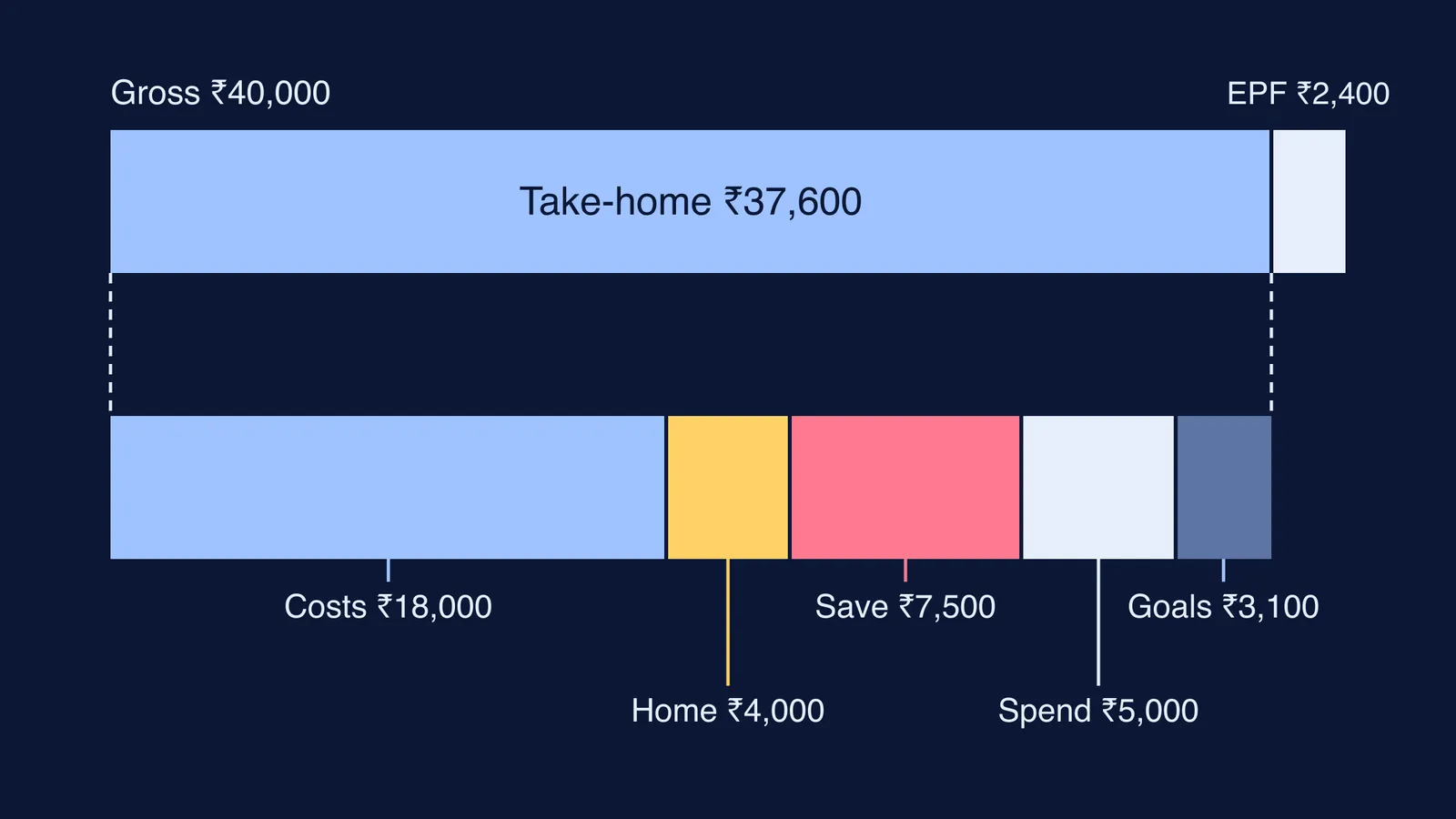
Use five buckets and write the numbers down. Here is the ₹37,600 take-home from the example above:
Fixed costs: ₹18,000 for travel, phone, food at work and rent if they live away.
Home contribution: ₹4,000, agreed in advance.
Savings first: ₹7,500, moved on salary day into a separate account for emergencies.
Spending money: ₹5,000, with no questions asked.
Goals: ₹3,100 towards something they choose, such as a course, a laptop or a trip.
The numbers are ours, not a rule; change them to fit the city and the job. What matters is that savings move on salary day, before spending starts, and that the spending bucket is genuinely free. If your family has already involved your teenager in the household budget, they will recognise this exercise.
Should my child contribute at home from their first salary?
There is no single right answer, and families differ. What helps is deciding it openly and early, before the money arrives, rather than leaving it as an unspoken expectation. Some families take a fixed amount, some ask their child to pay one bill such as the internet, and some ask them to save that amount instead.
A script that keeps it calm:
"This salary is yours, and we are proud of you."
"We'd like you to put ₹4,000 towards the house. Does that feel fair?"
"If you'd rather pay the electricity bill instead, that works too."
"Let's look at it again in six months."
If the family is short of money, say so plainly; a young earner often wants to help. If it is not, keep the contribution small enough that it feels like belonging, not rent.
What money mistakes should we warn them about?
Buying on EMI in the first month because the credit limit is there.
Sharing an OTP, PIN or screen with anyone who calls about a "refund" or a "KYC update".
Lending money they cannot afford to lose.
Investing on a friend's tip before an emergency fund exists.
The percentages on a payslip are the same Class 10 maths a younger sibling is learning now; if they want to practise it, the Fermi Problem Library has worked problems with a step-by-step solver that explains the reasoning. The habits you set with pocket money in the teenage years carry straight into this first salary.
Book a short review for three months from now, and let your child lead it.