On this page
Most teenagers have heard a big number: a cousin's placement package or an influencer's income. Few have heard the typical number. A good talk about money and careers gives them both, and makes the typical one feel useful rather than deflating.
What does a typical job in India actually pay?
The most reliable place to start is India's official labour survey, because it is a large national sample of households, not just the people who post offer letters online. The Periodic Labour Force Survey (PLFS) Annual Report 2025, released by the National Statistics Office on 27 March 2026, surveyed about 11.5 lakh people between January and December 2025. Its headline figures:
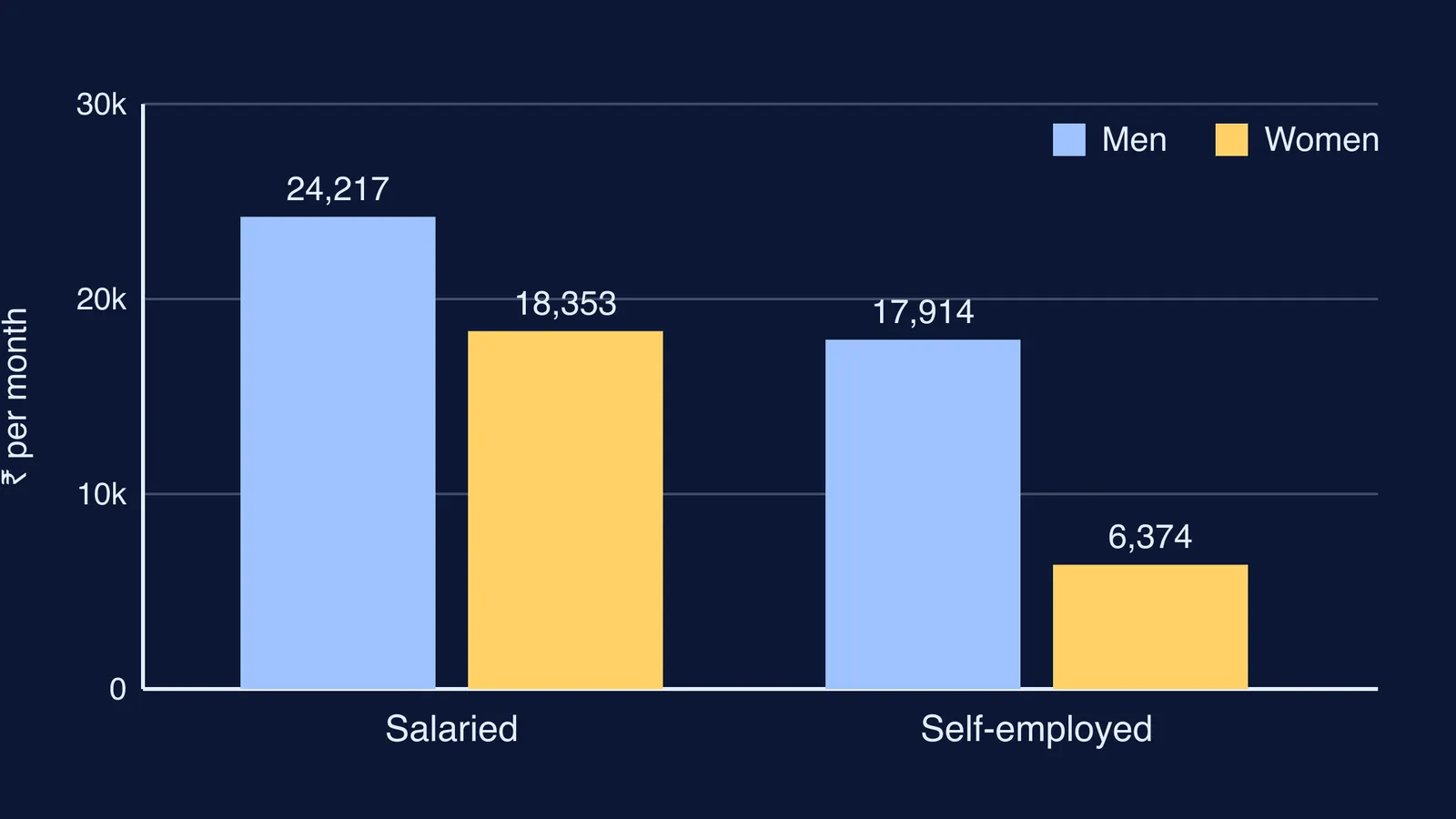
Men in regular salaried jobs earned ₹24,217 a month on average in 2025, and women ₹18,353.
Self-employed men earned ₹17,914 a month on average, and self-employed women ₹6,374.
Casual labourers earned about ₹455 a day (men) and ₹315 a day (women).
Only 23.6% of workers had a regular wage or salaried job; 56.2% were self-employed and 20.2% did casual labour.
These are averages across every kind of work, so the job your teen has in mind may pay far more or far less. The useful lessons: a steady salaried job is not the norm for most Indian workers, and the gap between men's and women's earnings is real and worth discussing.
Is it hard for young people to find a job?
It is harder than for adults. The same PLFS 2025 press note found:
The unemployment rate for 15-29-year-olds was 9.9% in 2025, down from 10.3% in 2024.
Among urban youth it was 13.6%; among rural youth, 8.3%.
25.0% of people aged 15-29 were not in employment, education or training.
Only 5.0% of 15-29-year-olds had received formal vocational or technical training.
The honest message for your teen: a certificate alone is not a plan. Skills people will pay for, early experience and knowing how the job market works matter too.
Why do teenagers' career ideas need a reality check?
Not because their dreams are wrong, but because they are often narrow. The OECD's Dream Jobs report, based on PISA 2018 data, found that nearly half of 15-year-olds expected to work in just 10 jobs. Its follow-up, The State of Global Teenage Career Preparation (2025), drawing on PISA data from 2000 to 2022 across more than 80 countries, reports that students' job expectations have changed little and remain misaligned with actual labour market demand, and that uncertainty about careers has grown since 2018.
The same report points to what helps. Students who take part in career development activities, such as workplace visits, job fairs, career conversations and part-time or volunteer work, tend to have clearer career plans and better employment outcomes later.
How do you talk to a teen about money and careers without scaring them?
Try a three-part plan over a few weeks, not one big lecture.
Three numbers. Write down the headline number your teen has heard, the typical number from the PLFS 2025 press note, and a cost number: what a month of independent life costs. Build that last one from your own household's real bills for rent, food, transport, phone and electricity, not from guesses.
One person. Find one adult who does the job your teen is curious about, a relative, neighbour or alumnus, and ask them three questions: what they earned at the start, what a normal Tuesday looks like, and what they wish they had known at 16.
One experiment. Let your teen try the work in a small way: a short project, a volunteering stint, or a week spent on the subject behind the career.
What to say, and what to skip:
Say: "This is the average across India. Let's find out what your job pays at the start and ten years in."
Say: "Money matters, and so does whether you'll enjoy the work on an ordinary day."
Skip: "There's no money in that." Ask "How do people in that field earn a living?" instead.
Skip comparisons with cousins or classmates; they shut the conversation down.
For the experiment, if your teen is drawn to engineering, research or another science-heavy path, the Fermi Concept Library gives every concept in physics, chemistry, biology, mathematics and computing its own lesson, so they can check whether the ideas behind that career actually interest them.
Where can families get free, reliable career help?
The government's National Career Service portal, run by the Ministry of Labour and Employment, offers free career counselling, job listings and job fair information. Your teen's school counsellor is another first stop.
If career worries start to affect your teen's sleep, mood or eating, talk to a doctor or counsellor, or call the government's free Tele MANAS helpline on 14416.
Start small this week: pick one number from this page and ask your teen what they make of it.