

On this page
A temperature diary is a cheap science project you can run at home. Your child reads a thermometer twice a day for a week, writes the numbers down and turns them into a line graph. Along the way they practise measuring carefully, keeping records and reading graphs.
What do you need for a temperature recording activity at home?
One thermometer that measures air temperature: a simple room thermometer, a lab-style glass one or a cheap digital one. A fever thermometer will not do, because it is made to read body temperature.
A notebook with five columns: date, time, indoor reading, outdoor reading, and a short weather note (sunny, cloudy, rain, fan on).
Graph paper, a ruler and two coloured pens.
If your child is new to thermometers, start with how to read a thermometer correctly: eyes level with the reading, and wait until the number stops changing.
Where should you put the thermometer outside?
The Hong Kong Observatory explains that air temperature should be measured between 1.25 and 2 m above ground, inside a screen that keeps off sun and rain but lets air move freely around the thermometer. The UK Met Office houses its thermometers in Stevenson screens, white louvred boxes, with the sensors 1.25 m above the ground.
You can copy the idea at home:
Outdoors, hang the thermometer at about shoulder height on a balcony or window grille that stays in shade, away from an AC outdoor unit, a kitchen exhaust and sun-baked walls.
Indoors, pick one spot in the middle of a room, away from windows, the fridge and the TV.
Never move either spot during the week.
When should your child take the readings?
The same two times every day. A University of Georgia Extension climate note explains that the day's lowest temperature usually comes close to sunrise, and that air keeps warming until late afternoon. So a reading soon after waking (say 7 am) and one after school (say 4 pm) come close to the low and the high. With one thermometer, read outdoors first, carry it inside and let it settle before the indoor reading.
A worked example: one week in a flat
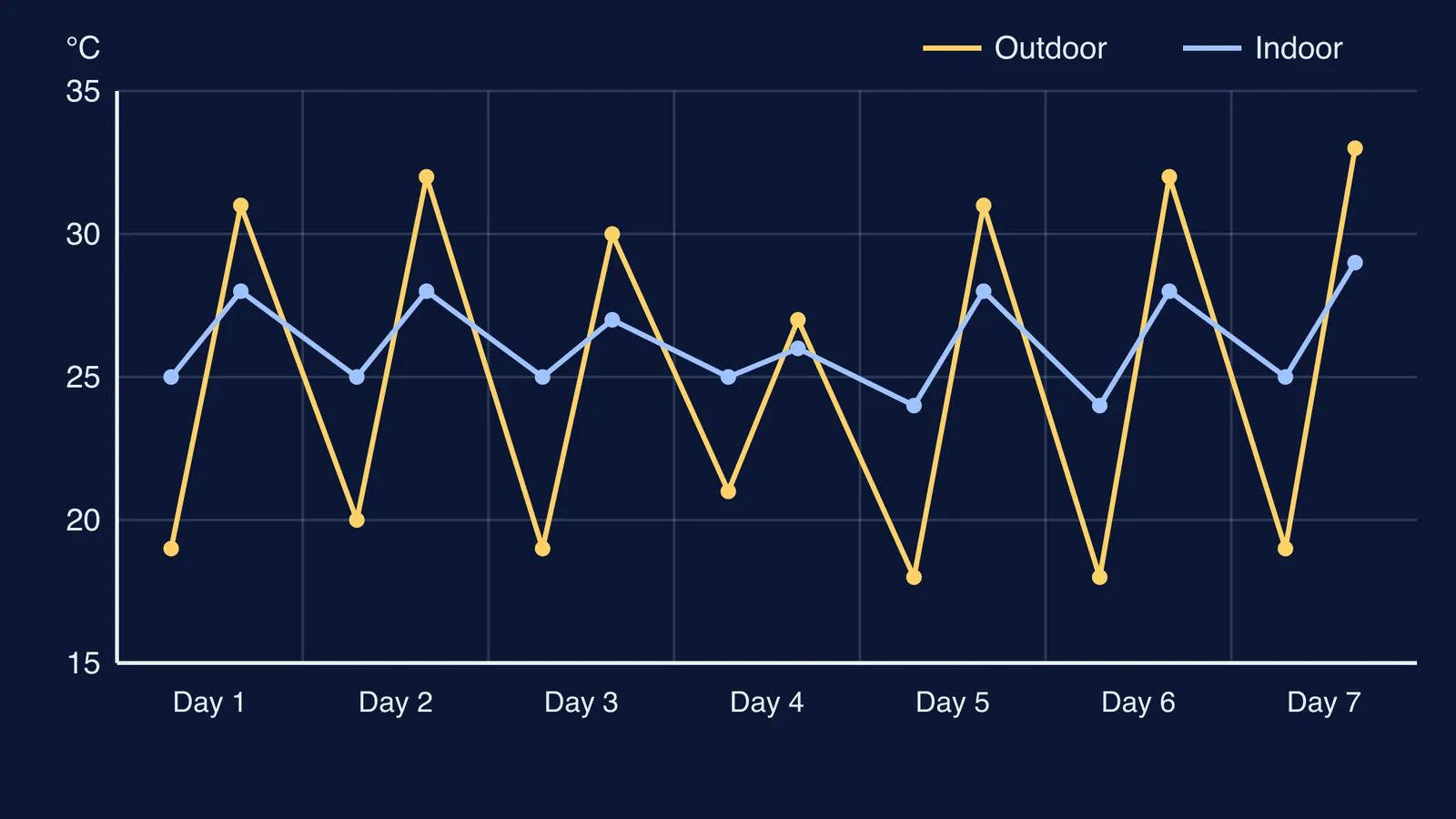
These numbers are made up to show the method. Say your child writes down the outdoor and then the indoor reading, in °C, at 7 am and 4 pm:
Day 1, sunny: outdoor 19 and 31, indoor 25 and 28
Day 2, sunny: outdoor 20 and 32, indoor 25 and 28
Day 3, hazy: outdoor 19 and 30, indoor 25 and 27
Day 4, cloudy with rain: outdoor 21 and 27, indoor 25 and 26
Day 5, sunny: outdoor 18 and 31, indoor 24 and 28
Day 6, sunny: outdoor 18 and 32, indoor 24 and 28
Day 7, sunny: outdoor 19 and 33, indoor 25 and 29
Now work out each day's range: afternoon minus morning. On Day 1 the outdoor range is 31 − 19 = 12 degrees and the indoor range is 28 − 25 = 3 degrees. Across the week the outdoor range runs from 6 to 14 degrees, while indoors it never goes above 4.
How do you turn the diary into a line graph?
Draw the horizontal axis for time: seven days, with two marks for each day (morning and afternoon).
Draw the vertical axis for temperature in °C. Starting at 15, not 0, is fine if it is labelled.
Plot the outdoor readings as dots in one colour, then join them in order with straight lines.
Plot the indoor readings in the second colour and join them the same way.
Add a key that says which colour is which, and a title such as "Our home, one week in October".
The outdoor line zigzags; the indoor line barely moves. If reading slopes is new to your child, this guide to reading line graphs and trends helps.
What patterns should you look for?
Ask, and let your child point at the graph:
"Which line goes up and down more? Why might that be?" (Walls and a roof slow heat getting in during the day and getting out at night.)
"Look at Day 4. What was different?" (Clouds blocked the sun, so the afternoon stayed cooler and the swing was smaller.)
"If we did this again in May, what would you expect?" Write the guess down.
If a heat-flow question stumps you both, the Fermi Concept Library has a lesson for every concept in physics, so you can look up conduction or insulation together instead of guessing.
How can you take it further?
Run the diary for a month, or repeat it in another season. Compare your outdoor reading with the nearest city's current weather on the India Meteorological Department website and talk about why they differ. For more projects built on real observations, try these citizen science projects for kids.


