

On this page
In short To read a thermometer correctly, find the value of one small division by counting the marks between degrees. The NCERT Class 7 syllabus notes that a clinical thermometer, used for human bodies from 35°C to 42°C, must be read at eye level. A laboratory thermometer, however, must be read while it remains in contact with the substance.
When measuring temperature in a science experiment or checking for a fever, getting an accurate reading depends on how you handle the instrument. The rules for using a thermometer depend entirely on whether you are working with a clinical or a laboratory model.
This guide explains the correct techniques for reading both types, how to avoid common errors, and what the small marks on the scale mean.
What is the difference between a clinical and a laboratory thermometer?
Thermometers are designed for specific uses. According to the official NCERT Class 7 Science textbook (Chapter 4: Heat), a clinical thermometer is designed solely to measure human body temperature. It has a range from 35°C to 42°C, because a healthy person's temperature stays within these limits, typically around 37°C. Crucially, a clinical thermometer features a small kink (or constriction) near the bulb. This kink stops the mercury thread from falling on its own, giving you time to take the thermometer out and read it.
A laboratory thermometer is used to measure the temperature of other objects, such as boiling water or ice in an experiment. Its scale is much wider, usually ranging from –10°C to 110°C. Because it does not have a kink, the liquid level will drop as soon as you remove it from the heat source.
If you are exploring the physical concepts of heat and temperature, you can review the definitions in the Fermi Concept Library, where every concept in physics and chemistry has its own lesson and its place in the map.
How do you find the value of one small division?
Before using any thermometer, you must understand what its scale represents. Not all thermometers have the same markings, as noted in the NCERT guidelines.
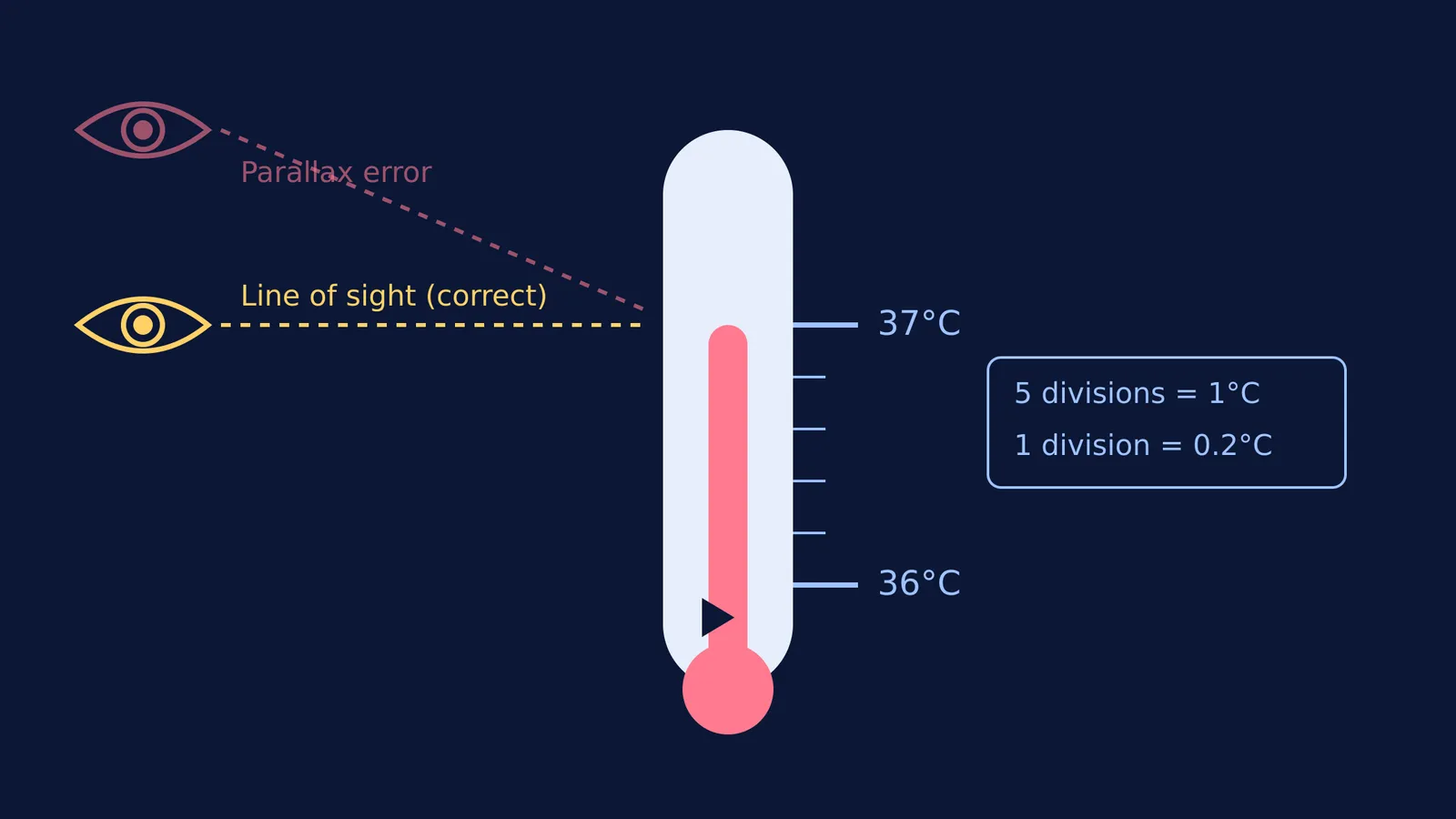
Find two consecutive larger marks on the scale, for example, 37°C and 38°C. The difference between them is 1 degree.
Count the number of small divisions between these two large marks.
Divide the temperature difference by the number of divisions.
For instance, if there are 5 small divisions between 37°C and 38°C, one small division equals 1/5, or 0.2°C. If the mercury level sits two small marks above 37°C, the correct reading is 37.4°C. Understanding how to calculate this division value is crucial before attempting any measurement, as getting it wrong will lead to an incorrect result.
How do you read a clinical thermometer correctly?
To take a body temperature reading accurately and safely, follow these steps from the NCERT Class 7 manual:
Wash the thermometer before use, ideally with an antiseptic solution.
Hold it firmly and give it a few sharp jerks to ensure the mercury level drops below 35°C.
Place the bulb under the tongue or in the armpit, and wait until the mercury level stops rising.
Remove the thermometer to read the temperature.
Hold the thermometer horizontally so that the top of the mercury thread is perfectly aligned with your line of sight. This prevents parallax errors, where viewing from above or below makes the reading look higher or lower than it really is.
Never hold a thermometer by the bulb while reading it, as the heat from your fingers will alter the reading and give you an inaccurately high measurement.
How do you use a laboratory thermometer correctly?
Because a laboratory thermometer lacks a kink, you cannot remove it from the substance to take a reading. If you take it out, the reading will immediately drop as it cools in the air.
To measure the temperature of a liquid accurately, keep the thermometer perfectly upright; it must not be tilted. The bulb must be completely surrounded by the substance you are measuring and should never touch the bottom or sides of the container. You must wait until the mercury thread becomes steady and read the temperature while the bulb remains immersed in the liquid.
Why are digital thermometers used today?
Traditional clinical thermometers use mercury, which is a highly toxic substance. If a glass thermometer breaks, the mercury is extremely difficult to dispose of safely. For this reason, modern digital thermometers are widely recommended. They do not contain mercury, and they display the temperature directly as a number on a small screen, making them easier and safer to read.


