

On this page
Class 6 workbooks, olympiad papers and school apps lean heavily on multiple-choice questions (MCQs), and many parents wonder whether ticking A, B, C or D teaches anything. Memory research, mostly with university students plus one study of seven-year-olds, suggests MCQs can be a useful practice tool, with one condition and one partner. The condition is feedback. The partner is written answers.
Do MCQs actually help children learn?
Answering a question from memory is a well-studied way to strengthen learning, and MCQs can count. In a study by Henry Roediger and Elizabeth Marsh, facts tested earlier on a multiple-choice test were recalled better on a later test than facts that had not been tested, which the authors called a large positive testing effect (Roediger and Marsh, 2005).
Well-written MCQs can do more than that. Jeri Little and colleagues found that properly constructed multiple-choice tests trigger productive retrieval, and also improved recall of information linked to the wrong options, which a fill-in-the-blank test did not (Little and colleagues, 2012). A good MCQ makes a child think about why each option is right or wrong.
What is the risk of MCQs for younger kids?
Every four-option question shows a child three wrong answers that were written to look right. The same 2005 study found that reading more wrong options shrank the benefit and made people more likely to give those wrong options as answers later. Its abstract warns: "Multiple-choice testing may inadvertently lead to the creation of false knowledge" (Roediger and Marsh, 2005).
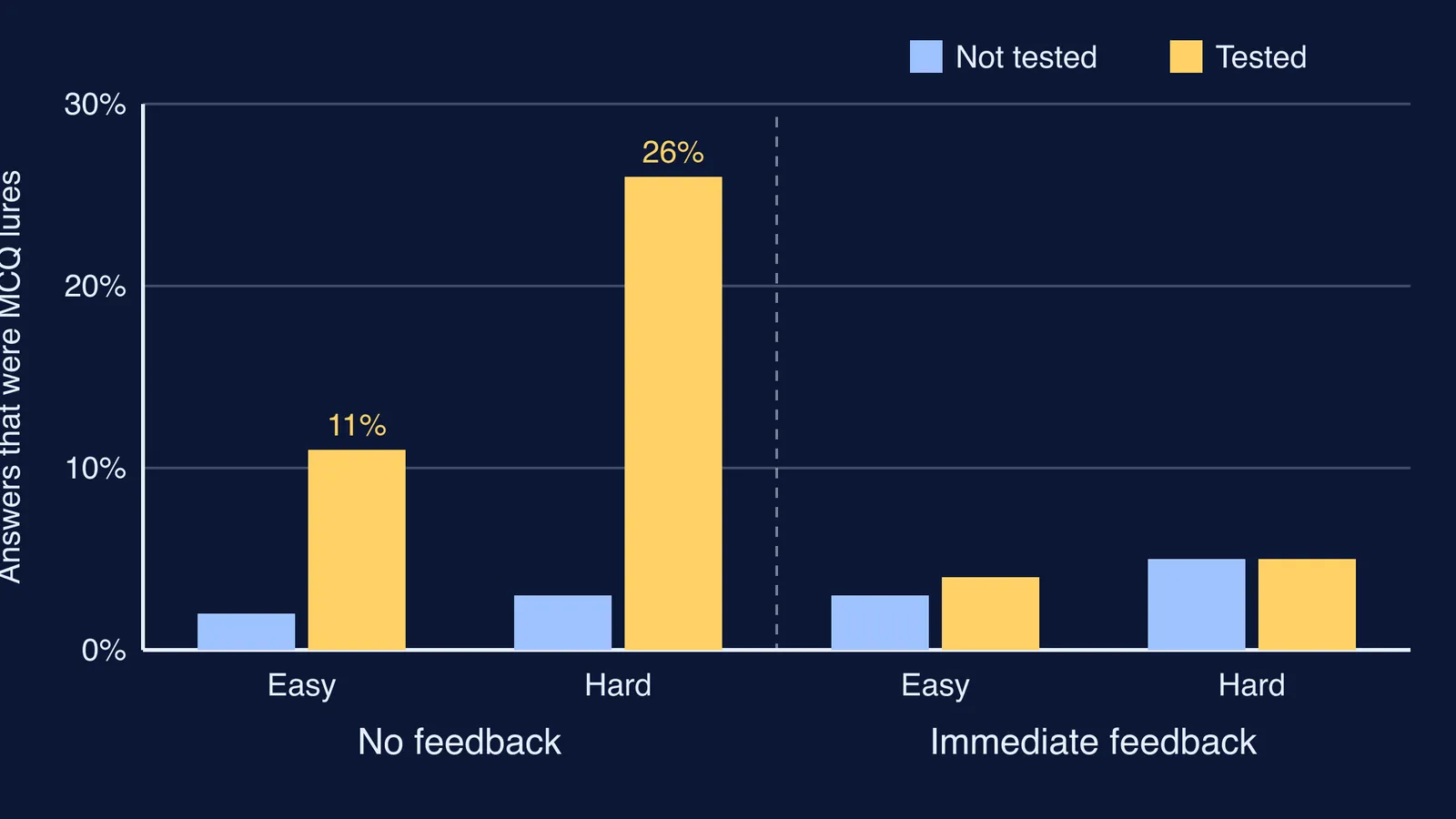
Elizabeth Marsh, Lisa Fazio and Anna Goswick tested this with 36 second graders, aged about seven to eight (Marsh, Fazio and Goswick, 2012). Without feedback, children later answered 26% of hard questions they had seen as MCQs with one of the wrong options, against 3% for questions they had not seen. On easy questions the figures were 11% and 2%. When each answer was followed straight away by the correct one, wrong-option answers stayed at 3 to 5% whether or not the question had been seen.
This is not only a small-child problem. A study of university students found the same two effects, with the benefit always larger than the harm; the authors recommend frequent tests given with feedback (Fazio and colleagues, 2010).
Should a Class 6 child write answers instead of MCQs?
Write answers as well, not instead. In a study of university students, short-answer practice with feedback led to the best scores on a final test three days later, and the authors suggest that harder retrieval brings a bigger benefit (Kang, McDermott and Roediger, 2007). Written answers also show you the reasoning. A child can tick the right option for the wrong reason, and an MCQ will never tell you.
School exams in India use both formats. The CBSE Class X Science sample paper for 2025-26 has 39 questions in three sections and opens with one-mark, four-option questions before moving to written answers (CBSE sample paper). A child who practises only one format will be underprepared for the other.
How to balance MCQs and written answers at home
Try a three-step routine we call Pick, Say why, Write. It takes about 15 minutes, a few times a week. Those numbers are our suggestion, not a research finding.
Pick: your child answers 5 to 8 MCQs on this week's chapter. Check each one before moving on.
Say why: for every wrong pick, your child explains why the right answer is right and what made their option tempting.
Write: two or three short written answers on the same idea, from memory, before opening the book.
Here is a worked example from the Class 6 magnets chapter.
MCQ: Which of these is attracted by a magnet? A. copper B. iron C. aluminium D. plastic.
Your child picks A. You show straight away that the answer is B.
Say why: "Copper is a metal, so I thought magnets pull all metals."
Write: "Name two metals a magnet does not attract, and describe how you would test an object at home."
The MCQ alone would have marked one answer wrong. The follow-up steps found the real misconception, that all metals are magnetic, and had your child correct it in their own words.
Two phrases that keep this calm:
"That option was made to look right. What makes it look right?"
"Good. Now explain it to me without the options."
If a wrong option keeps coming back in maths or science and neither of you can see why, the Fermi Problem Library has worked problems with a step-by-step solver that explains the reasoning rather than printing an answer.
Next, read our guide to practice tests at home for children, or, for MCQ-heavy competitions, whether school-level olympiads are worth it. Later exams that cut marks for wrong answers call for a strategy on negative marking and guessing.


