

On this page
A short quiz can help your child remember more than rereading the chapter. The trick is to treat it as practice, not a verdict.
Should I give my child practice tests at home?
Yes, if the test is short and nothing rides on the score. Psychologists call this the testing effect: pulling an answer out of memory strengthens it more than reading the material again (Roediger and Karpicke, Psychological Science, 2006).
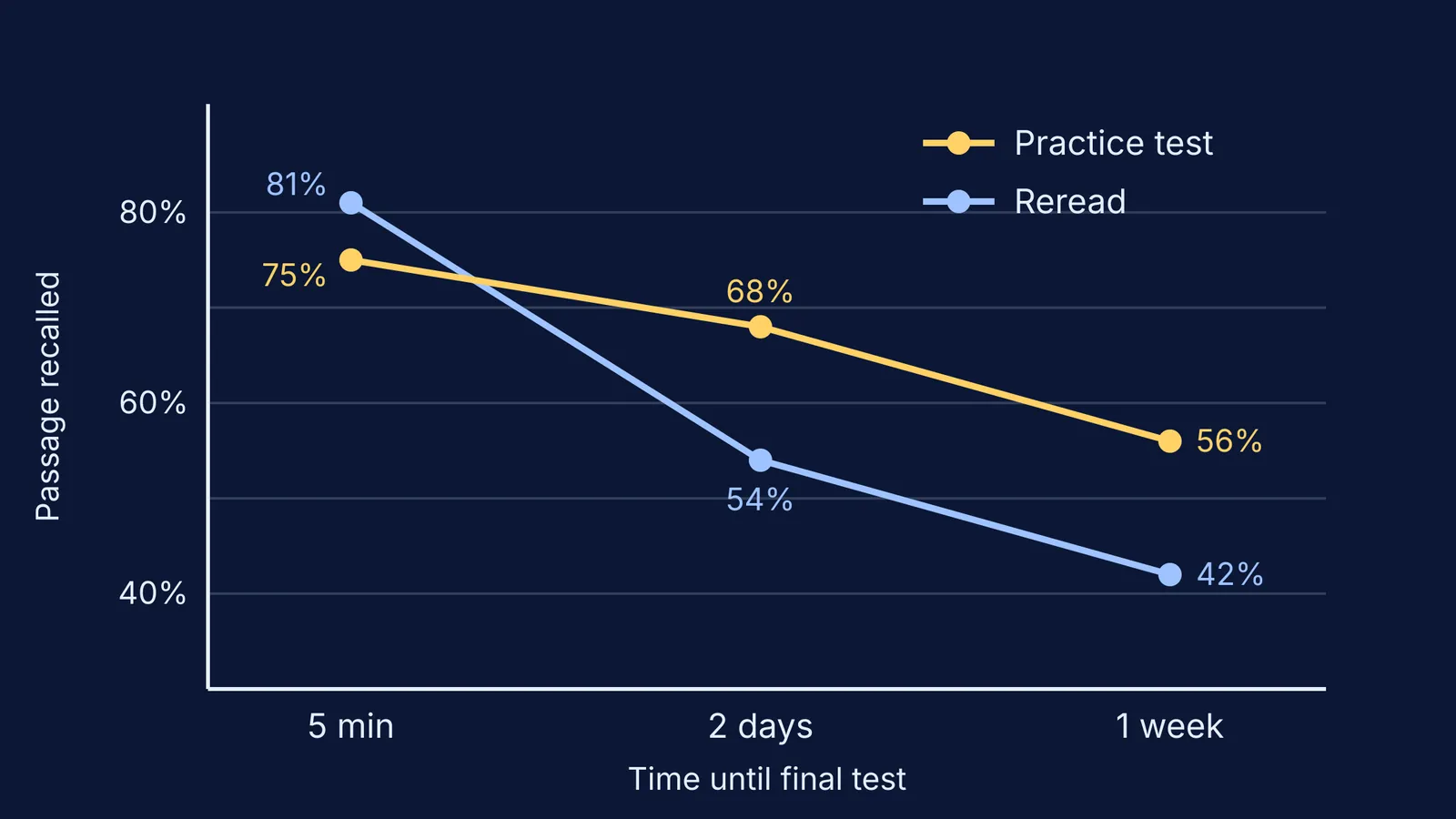
In that study, students who took a recall test instead of rereading a passage remembered 56% of it a week later, against 42% for those who reread (Roediger and Karpicke, 2006). Five minutes after studying, the rereaders were ahead (81% against 75%), which is why rereading feels like it works. The participants were university students; the reviews below point the same way.
A 2013 review of ten study techniques gave practice testing one of only two “high utility” ratings, alongside spacing practice out over time (Dunlosky and colleagues, Psychological Science in the Public Interest). A 2017 meta-analysis found practice tests helped learning more than restudying (Adesope and colleagues, Review of Educational Research). See also whether practice-test gains transfer to new questions.
How often should you give a home test?
Repeated short tests beat a single one. In a second experiment, students who read a passage once and took three recall tests remembered 61% of it a week later, against 56% after three readings and one test, and 40% after four readings (Roediger and Karpicke, 2006). A large review also found that tests asking students to recall answers helped more than tests asking them to recognise the right option (Rowland, Psychological Bulletin, 2014). So questions answered from memory are a better bet than multiple choice.
A weekly rhythm that fits around school:
Two short quizzes a week, 10 to 15 minutes, on different days, mixing in questions from last week and last month.
One longer paper only before a real exam, not every weekend.
Let your child write some questions; that is retrieval practice too.
Skip it on school-test days or bad-mood days.
How do you mark a practice test kindly?
Feedback can backfire. A review of 607 effect sizes found feedback improved performance on average, but in more than a third of cases it made performance worse (Kluger and DeNisi, Psychological Bulletin, 1996). The authors argue feedback works less well when it pulls attention from the task to the self. So talk about the answers, not the child.
Your child marks first, using the textbook or an answer key.
Sort each wrong answer into one of three piles: did not know it, knew it but slipped, or misread the question.
Say one thing that went well and one thing to fix. Then stop.
Keep the score private. No sharing with relatives, no sibling comparisons.
What to say instead:
Not “How did you get only 6?” but “Which of these four do you want to fix first?”
Not “You knew this yesterday!” but “This one slipped, so it is the right one to practise.”
More phrasing ideas: talking to teens about marks.
What should you do with the results?
Turn the three piles into next week's plan. A worked example: Meera, in Class 9, scores 6 out of 10 on a science quiz about sound. Two wrong answers are “did not know” (she cannot link frequency and wavelength), one is a slip (she forgot units) and one is a misread question.
Did not know (2): relearn the idea once, explained differently from the textbook, then put both questions into Thursday's quiz.
Slip (1): no re-teaching. Add “check units” to the top of her next quiz.
Misread (1): practise underlining what the question asks.
Correct (6): bring two back in a fortnight.
When the “did not know” pile points to a concept gap, the Fermi Concept Library has a lesson for every concept in physics, chemistry, biology, mathematics and computing, so your child can relearn it before the retest.
Older students taking full JEE Main or NEET-UG mocks can use the same sorting; see how to analyse a mock test.
How do you keep home from feeling like a classroom?
Ask three questions over dinner, let your child quiz you, and let them choose the day.
Done well, retrieval practice may even ease nerves: in a survey of 1,408 middle and high school students whose classes used it, 72% said it made them less nervous for unit tests and exams (Agarwal and colleagues, Journal of Applied Research in Memory and Cognition, 2014). If your child dreads every quiz, pause for a few weeks. If worry spreads into sleep, appetite or school, talk to the school counsellor or a doctor, or call Tele MANAS, the government's free mental-health helpline, on 14416.
This week, try one ten-minute quiz built from your child's own notes, and let them mark it.


