

On this page
Every year, schools across India distribute forms for various "International" Olympiads in mathematics, science, English and cyber skills. Organizations like the Science Olympiad Foundation (SOF), Unified Council, and SilverZone run these exams. As a parent, you might wonder if these privately run tests are genuinely prestigious or just a distraction.
Determining whether they are worth your money and your child's time depends entirely on your goals.
What is the difference between private and official Olympiads?
The most common point of confusion is the name. The term "Olympiad" is not protected by trademark, meaning any private organization can use it.
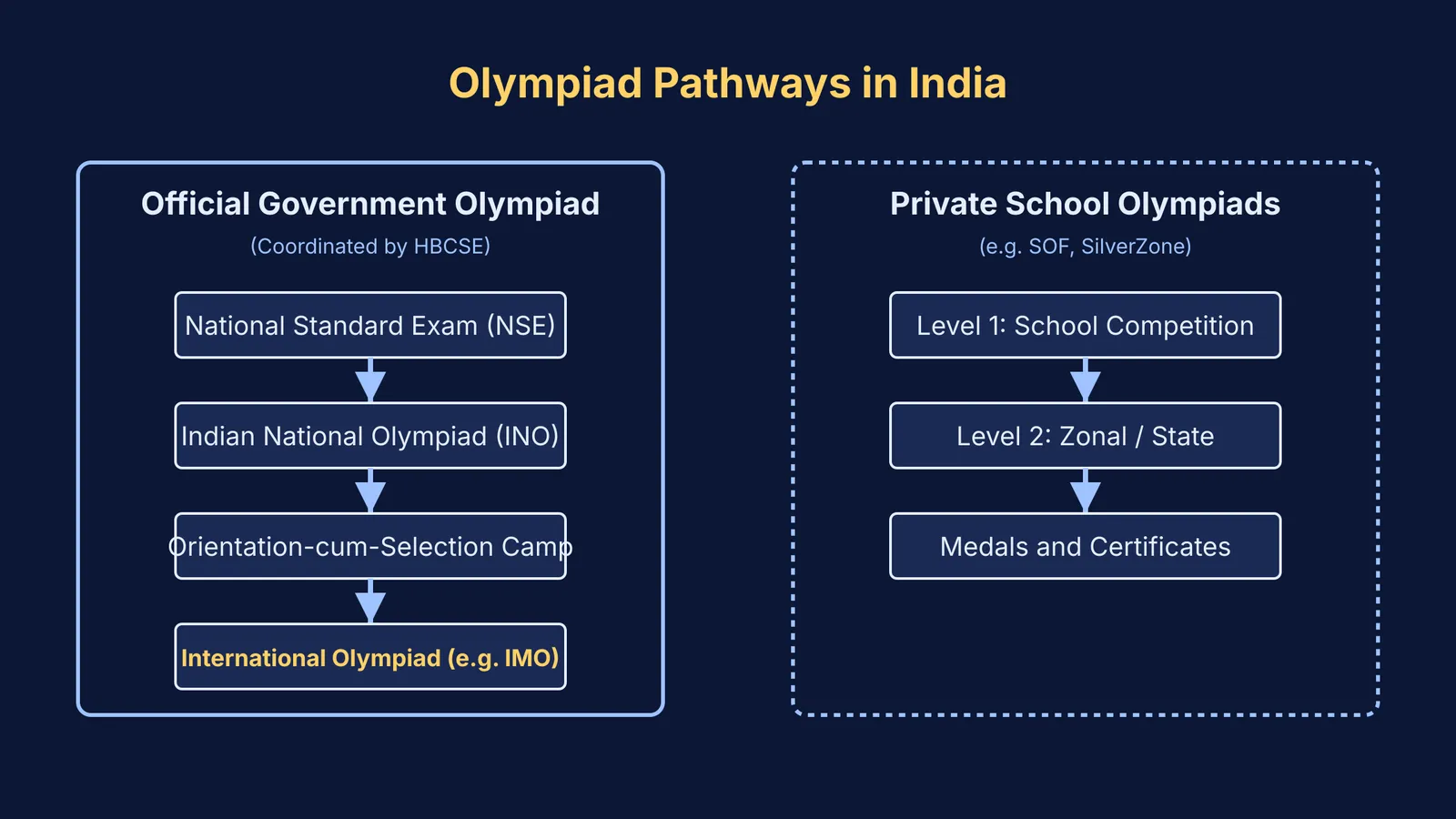
The Homi Bhabha Centre for Science Education (HBCSE) coordinates the official National Olympiad Programme in India (HBCSE). This is the only government-recognized pathway that selects students to represent India at the true International Mathematical Olympiad (IMO) or International Physics Olympiad (IPhO). The official route is highly rigorous and selective. It begins with the National Standard Examination (NSE), which is typically taken by older students in higher secondary classes. From there, only a fraction of students advance to the Indian National Olympiads (INO), and eventually culminate their journey in rigorous orientation-cum-selection camps (OCSC) where the final national team is chosen.
In contrast, private Olympiads are run by independent companies or foundations. The "International" in their title refers to their own internal global rankings, not the official, multi-nation academic events.
Are private Olympiads worth the fee?
In India, the registration fee for exams like those run by SOF is typically ₹125 per student per subject, with schools adding a small administrative top-up of ₹25 to cover their own expenses (SOF). The scale of these private exams is vast: SOF reports that over 99,000 schools in 70 countries register for their exams, with millions of students appearing annually (SOF).
For the cost of a few notebooks, a student gets the experience of sitting in an exam setting, a detailed Student Performance Report (SPR) that breaks down their performance by topic, and a participation certificate. However, it is crucial to understand what these certificates mean for the future. Unlike the official HBCSE Olympiads, which are highly regarded by top-tier universities like the IITs and MIT, private Olympiad certificates carry almost zero weight in college admissions. They are internal rewards meant to encourage students, not formal academic credentials that will secure a seat in a competitive university program.
When do school Olympiads actually help?
If they do not aid in college admissions, why do so many students take them? For younger children (Class 1 to 8), these exams offer several practical benefits that go beyond the final score:
Early exposure to competition: They provide a low-stakes environment for students to experience timed testing and multiple-choice questions (MCQs), which is how major entrance exams like JEE Main and NEET-UG are structured.
Familiarity with OMR sheets: Learning how to read instructions carefully and fill out an OMR sheet correctly is a mechanical skill that takes practice.
Syllabus alignment: The questions are usually based on the standard school curriculum (NCERT/CBSE/ICSE) but require higher-order logical thinking and application of concepts rather than rote memorization. This encourages students to think beyond the textbook.
If you decide to register your child, it is important to manage expectations. You can read more about Supporting your child's olympiad preparation: time and pressure to ensure the focus remains on learning rather than just collecting medals.
A checklist before paying the Olympiad fee
Before you fill out the registration form, discuss these points with your child:
Is the subject a strength or an interest? Sign up for one or two subjects they genuinely enjoy, rather than all five.
Will they do the practice papers? The real value comes from trying the previous years' papers at home, not just showing up on exam day.
Are they clear on the stakes? Remind them that a low score simply means they haven't learned those specific question types yet, and it will not affect their school grades or their future academic prospects.
How can parents support practice without pressure?
The best way to use private Olympiads is as a diagnostic tool. The performance report can highlight areas where your child struggles with logical reasoning or application-based questions.
If you notice your child understands a concept in their textbook but cannot solve the Olympiad problem, they might need a different approach to practice. In these cases, Fermi's AI tutor can step in. The tutor teaches rather than answers: it holds a line of reasoning across a session and decides whether to explain, ask or show to help the student find the solution themselves. For a deeper look at how to integrate this kind of help, you can explore Trying an AI tutor with your child: a 20-minute parent's guide.
Ultimately, treat school-level Olympiads as academic hobbies. Celebrate the effort, use the results to guide future learning, and maintain a balance. As we discuss in our guide on High expectations vs pressure: what research separates, learning should be driven by curiosity, not just the pursuit of a certificate.